What are the major quality levels of Austrian wine?
31 minutes read
If you’ve ever tried to understand Austrian wine classifications and felt slightly overwhelmed, let me reassure you straight away: you’re not bad at wine — the system is just precise. Very precise.
One of the most important elements used to distinguish the major quality levels of Austrian wine is the natural sugar content of the grapes at harvest. It’s not the only criterion, but it’s a fundamental one. In Austria, winemakers and regulators take grape ripeness very seriously. It forms the backbone of the country’s wine classification system.
Austrian wine law refers to this natural sugar content as must density, which describes the sugar level of the grape must before fermentation even begins.
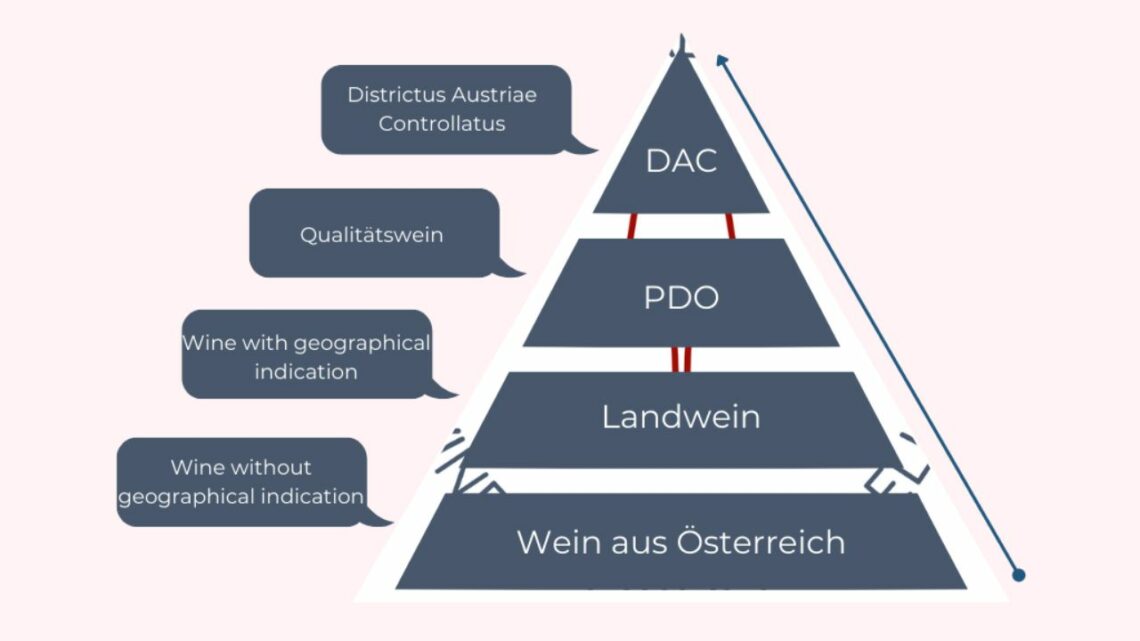
What are the major quality levels of Austrian wine? The major quality levels of Austrian wine are based on grape ripeness (must density) and origin. Austria officially distinguishes three wine categories: wine without geographical indication, Landwein, and Qualitätswein (PDO wine). Within Qualitätswein, the main quality levels are Kabinett, DAC, and Prädikatswein. Prädikatswein wines are further classified by natural sugar levels, from Spätlese to Trockenbeerenauslese. Austrian sparkling wines follow a parallel classification called Sekt g.U., with the levels Klassik, Reserve, and Große Reserve.
- What does “grape must” actually mean?
- How Austria measures grape ripeness
- Can sugar be added to Austrian wine?
- Who controls all of this?
- The three main categories of Austrian wine
- Kabinettwein : precision not power
- DAC
- Prädikatswein
- How to choose a Prädikatswein (without overthinking it)
- What to pair with each Prädikatswein level?
- Sekt g.U : when Austrian bubbles get serious
- How to choose Austrian Sekt (without getting lost)
- Sparkling wine food pairings: where to start
- Conclusion : What are the major quality levels of Austrian wine?
What does “grape must” actually mean?
European Union legislation, later specified by Austrian national law, defines grape must as the freshly pressed juice obtained exclusively from grapes before fermentation. Austria also recognizes partially fermented grape must, known locally as Sturm, which sits somewhere between juice and wine.
Producers may sell grape must as “Austrian grape must” only when they harvest and process the grapes in Austria, and only between August 1st and December 31st of the harvest year. Already, you can see how tightly regulated things are.
How Austria measures grape ripeness
In Austria, producers measure must density using Klosterneuburg must degrees, officially called degrees Klosterneuburger Mostwaage (°KMW).
If you’re more familiar with German wine, you’ll recognize Öchsle degrees, which Germany uses across the border. Internationally, people often translate this concept as potential alcohol, meaning how much alcohol the wine could theoretically produce if all the sugar fermented.
The Klosterneuburg system is wonderfully logical. One degree KMW corresponds to one percent of sugar by weight. In simplified terms, one degree KMW equals roughly five degrees Öchsle.
A little historical detour here, because wine is never just numbers. Baron de Babo, then director of the Klosterneuburg Viticulture School, developed the Klosterneuburg mustimeter in 1896. More than a century later, it’s still the reference tool. Austrian wine law continues to evolve, but it rests on deeply rooted foundations.
Can sugar be added to Austrian wine?
The answer is yes… sometimes.
For wines labeled Wein, Landwein, and basic Qualitätswein (but not Kabinett or Prädikatswein), Austrian regulations allow producers to increase the natural sugar content of the muProducers may do this by adding beet sugar (sucrose), concentrated grape must, or rectified concentrated grape must. Wine law refers to this process as enrichment, more commonly known as chaptalization.
However, Austria sets a strict limit: enrichment may not increase the alcohol content by more than 2% by volume. Once producers move into higher-quality categories, the law no longer allows enrichment at all.
Who controls all of this?
Several official bodies oversee Austrian wine, including the Federal Viticulture Inspection, the Federal Office of Viticulture in Eisenstadt, the Federal Higher College, and the Federal Office of Viticulture and Arboriculture in Klosterneuburg. In other words, Austria doesn’t leave wine quality to chance — official authorities actively monitor it.
The three main categories of Austrian wine
Before diving into the major quality levels of Austrian wine, it helps to understand that Austrian law legally divides wine production into three broad categories: wine without geographical indication, wine with geographical indication, and wine with a protected designation of origin.
Wine without geographical indication
At this level, labels stay fairly simple. For still wines, producers use “Wein” or “Wein aus Österreich”, while sparkling wines carry the name “Österreichischer Sekt.”
Even here, Austria sets clear minimum standards. Still wines must reach a must density of 10.7°KMW (around 51°Ö) and an alcohol level of at least 8.5% by volume.
Traditional terms are also allowed, which is where things get a little more charming. You might come across Bergwein, referring to wines grown on steep vineyard slopes exceeding 26%, or Heuriger, which simply indicates a bottled wine showing its vintage.
One detail often surprises people: even at this entry level, Austria doesn’t let producers do whatever they want. They may mention the grape variety and vintage only if they respect the maximum yield per hectare defined for Landwein and Qualitätswein. In other words, transparency still comes with discipline.
Sparkling wines without geographical indication follow their own strict rules. Producers may use the name “Österreichischer Sekt” only if they make the wine exclusively from one of the forty grape varieties approved for Qualitätswein, and only if the wine is flawless in appearance, aroma, and taste. Both Österreichischer Sekt and Sekt g.U. must also show a minimum pressure of 3.5 bar at 20°C.
Label wording matters here, too. If the grapes or the base wine come from Austria, producers may state “Österreichischer Sekt.” If only the production took place in Austria, the label must instead read “produziert in Österreich.”
Wine with geographical indication: Landwein
In Austrian wine law, Landwein is the traditional term that replaces the European category “Wine with Protected Geographical Indication.” It sounds simple, but Austria keeps this category deliberately strict. Producers may not mention any geographical unit smaller than the official wine region, and they cannot use any alternative marketing denomination.
Quality rules step up a notch here, too. Landwein must reach a minimum must density of 14°KMW and an alcohol level of at least 8.5% by volume. The grapes must also come from clearly defined areas: only the three large regions Weinland, Steirerland, or Bergland may supply grapes for Landwein.
Protected designation of origin: Qualitätswein, where things get serious (and interesting)
This is where Austrian wine truly begins to show its depth — and where the quality system really comes into focus.
Qualitätswein is the traditional Austrian term that replaces the European designation Wein g.U.. Think of it as the moment when origin, grape choice, and tasting quality all start to matter together. You’ll spot these wines easily thanks to the distinctive red-white-red banderole on the bottle neck, which also displays the producer’s identification number.
Before a wine can carry the Qualitätswein label, it must clear an important hurdle: state control. Only wines that pass this official check may be sold, and the state control number must appear on the label. This isn’t just paperwork — it’s Austria’s way of guaranteeing that the wine delivers what it promises.
From a production point of view, the rules tighten as well. Producers must make Qualitätswein exclusively from grapes harvested within the same wine-growing region, and they may use only approved grape varieties. Austria officially authorises around 40 grape varieties for Qualitätswein production — a mix of well-known international grapes and deeply local Austrian specialties. Don’t worry, though: you don’t need to memorise them all. In practice, a small handful of grapes account for most of what you’ll actually encounter in shops and on wine lists.
If you’re curious (or a bit nerdy like me), I’ve broken down the full list of authorised grapes in a separate guide.
The grape must must reach a minimum density of 15°KMW, ensuring sufficient ripeness. On top of that, the wine must display the typical sensory characteristics of its origin and successfully pass an official tasting evaluation.
Finally, alcohol levels come into play. Qualitätswein must reach at least 9% alcohol by volume, while Qualitätswein of the Prädikatswein type may start at 5%. This distinction already hints at the stylistic diversity that appears in the higher quality levels.
Now that Qualitätswein sets the framework, the real question becomes: how does Austria further differentiate quality within this category?
That’s where Kabinett, DAC, and Prädikatswein come in.
Within the Qualitätswein category, Austria defines several major quality levels, each with increasingly strict rules.
Kabinettwein : precision not power
This is where Austrian wine shows its talent for restraint.
A Qualitätswein may carry the designation Kabinett or Kabinettwein when the grape must reaches at least 17°KMW. From that point on, the rules deliberately limit intervention. The law strictly forbids enrichment and sweetening, keeping the wine’s balance firmly in the hands of the vineyard rather than the cellar.
Sugar and alcohol stay tightly controlled as well. The unfermented sugar content may not exceed 9 grams per liter, and the total alcohol level is capped at 12.9% by volume. The result isn’t power or concentration for its own sake, but something more subtle.
In practice, Kabinett wines focus on balance, freshness, and restraint — a style that rewards precision rather than excess.
DAC
This is where Austrian wine starts speaking clearly about place.
A Qualitätswein may also be marketed as DAC (Districtus Austriae Controllatus) when it meets additional criteria defined by the National Committee and approved by the Minister of Agriculture. With DAC, Austria moves beyond general quality rules and focuses on typical regional styles. The designation must always appear alongside the defined geographical area, because origin is the whole point.
Unlike other categories, DAC opens the door to more precision. Producers may use smaller geographical units, such as villages or single vineyards, to describe where the wine comes from. Increasingly, DAC wines follow a clear internal structure:
Gebietswein for regional expressions, Ortswein for village-level wines, and Riedenwein for single-vineyard bottlings. Each step narrows the focus and sharpens the sense of place.
What to expect in the glass: DAC wines aim to taste like where they come from. Expect styles that feel typical rather than experimental, with a strong link between grape variety, region, and structure. As you move from Gebietswein to Ortswein and Riedenwein, wines usually gain precision, depth, and definition, rather than sheer power.
If you’d like to go deeper into this system, I’ve written a full post dedicated entirely to DAC wines in Austria.
Prädikatswein
This is where Austrian wine leans fully into grape maturity.
In Austria, Prädikatswein forms part of the Qualitätswein category, but it follows its own logic. Producers make these wines from grapes harvested at special maturity levels, defined by naturally high sugar concentrations achieved through specific ripening and harvesting methods. Depending on the situation, producers may label Prädikatswein with a generic origin (such as Burgenland) or a specific origin (like Wagram), as long as that area does not yet hold DAC status for other wine styles.
Austrian and German wine law treat the Prädikatswein system as a distinctive feature, precisely because it classifies wines according to natural sugar concentration alone. At this level, the rules leave no room for shortcuts. The law strictly forbids enrichment: producers must not add sugar to the grape must, and any residual sugar in the finished wine must come only from an early interruption of fermentation, never from added grape must.
Before a producer may officially declare a wine as Prädikatswein, the wine must meet all legal criteria and receive a must weight confirmation from the Wine Control Office, certifying the quality and maturity of the harvested grapes. This step anchors the classification in measured ripeness, not stylistic intention.
Within the Prädikatswein category, several quality levels exist, each governed by clearly defined rules that correspond to increasing grape maturity and concentration.
What to expect in the glass: Prädikatswein is not automatically sweet — but it is always about ripeness and intensity. As you move up the hierarchy, expect wines with greater concentration, richness, and texture, often balanced by acidity rather than power. These are wines where harvest timing shapes the style more than cellar technique, and where patience — both in the vineyard and in the glass — pays off.
Spätlese : ripeness not excess
Spätlese marks the first step into the Prädikatswein hierarchy, where timing at harvest really starts to matter.
Producers make Spätlese wines from fully matured grapes, and the grape must must reach a minimum density of 19°KMW (94.2°Ö). To underline their status as wines of deliberate ripeness rather than immediacy, producers may not submit Spätlese wines for state control approval before January 1st of the year following the harvest.
What to expect in the glass: Spätlese wines often feel more expressive and rounded than Kabinett, with riper fruit and greater depth, yet they still rely on balance rather than weight. Depending on the style, they may appear dry or off-dry, but they always showcase a sense of maturity without heaviness.
Auslese : selection makes the difference
With Auslese, ripeness alone is no longer enough — selection becomes the key factor.
Producers make Auslese wines from carefully sorted grapes, selecting only fully ripe berries and eliminating any immature, defective, or diseased fruit. The grape must must reach a minimum density of 21°KMW (105°Ö), and, just like Spätlese, producers may not submit these wines for state control approval before January 1st of the year following the harvest.
What to expect in the glass: Auslese wines typically show greater concentration and richness than Spätlese, with more intense aromas and a fuller mouthfeel. Depending on the style, they can range from dry to clearly sweet, but they always reflect a deliberate choice in the vineyard rather than sheer sugar accumulation.
Beerenauslese : where noble rot steps in
Beerenauslese marks a clear shift in the Prädikatswein ladder, where nature starts to play a more visible role.
Producers make Beerenauslese from overripe grapes affected by noble rot. This concentration pushes the grape must to a minimum density of 25°KMW (127.3°Ö). Because these wines depend on exceptional ripeness and precise harvesting conditions, producers may not submit them for state control approval before April 1st of the year following the harvest.
What to expect in the glass: Beerenauslese wines are typically lusciously sweet, with rich textures and intense aromas shaped by noble rot. Expect notes of dried fruit, honey, and spice, balanced by vibrant acidity that keeps the wine from feeling heavy.
Eiswein: sweetness shaped by cold
With Eiswein, nature takes control in the most dramatic way possible.
Producers make Eiswein, or ice wine, from grapes that freeze at the time of harvest and pressing. This extreme condition concentrates sugar and acidity at once. Eiswein requires a minimum must density of 25°KMW (127.3°Ö) and follows the same timing rule as other high Prädikat levels: producers may not submit these wines for state control approval before April 1st of the year following the harvest.
What to expect in the glass: Eiswein wines are intensely sweet but remarkably pure and vibrant, often defined by piercing acidity. Expect crystalline fruit flavors, freshness, and a sense of precision rather than heaviness.
Strohwein / Schilfwein: sweetness through patience
Strohwein and Schilfwein rely less on weather drama and more on time.
Producers make Strohwein or Schilfwein from fully matured, sugar-rich grape clusters that they store for at least three months on straw, reeds, or hung on strings before vinification. This slow drying process concentrates the sugars naturally. Here again, the grape must must reach 25°KMW (127.3°Ö), and producers may not submit these wines for state control approval before April 1st of the year following the harvest.
What to expect in the glass: These wines often feel richer and rounder than Eiswein, with pronounced dried-fruit notes, a silky texture, and a deep sense of concentration built through slow dehydration.
Ausbruch: a uniquely Austrian twist
Ausbruch occupies a very particular place in Austrian wine culture.
With a minimum must density of 27°KMW, Ausbruch wines allow producers to add freshly made grape juice or wine of at least Spätlese quality during fermentation. This distinctive method sets Ausbruch apart from the other Prädikat levels and firmly anchors it in Austrian tradition.
What to expect in the glass: Ausbruch wines typically combine luxurious sweetness with complexity, offering layers of ripe fruit, spice, and often a noble-rot signature, balanced by structure rather than sheer sugar.
Trockenbeerenauslese: the summit of concentration
At the very top of the Prädikatswein hierarchy sits Trockenbeerenauslese.
Producers make these wines primarily from botrytized and withered berries, harvested berry by berry. The must density must reach a minimum of 30°KMW (156°Ö). As with the other high Prädikat levels, producers may not submit Trockenbeerenauslese wines for state control approval before April 1st of the year following the harvest.
What to expect in the glass: Trockenbeerenauslese wines are extremely concentrated, intensely sweet, and built for contemplation. Expect powerful aromas, extraordinary richness, and remarkable aging potential, often balanced by enough acidity to keep the wine alive for decades.
How to choose a Prädikatswein (without overthinking it)
With so many Prädikatswein levels, it’s easy to assume these wines are only for special occasions — or only for dessert. In reality, the name on the label mainly tells you how ripe the grapes were at harvest, not how or when you must drink the wine.
If you enjoy fresh, balanced wines with a hint of ripeness, start with Spätlese. If you’re curious about richer textures and deeper flavors, Auslese is a natural next step. From Beerenauslese onward, sweetness becomes a defining feature, and these wines shine in smaller pours, often paired with food or enjoyed slowly on their own.
Rather than asking “Is this wine sweet?”, a better question is: How concentrated do I want this wine to be?
The Prädikatswein ladder answers that question for you.
What to pair with each Prädikatswein level?
Spätlese
Great with lightly spiced dishes, roasted vegetables, Asian-inspired cuisine, or simply on its own as an aperitif-style wine.
Auslese
Pairs beautifully with richer dishes such as roast poultry, pork with fruit accents, or mildly spicy food. It also works surprisingly well with soft cheeses.
Beerenauslese
A natural match for desserts based on fruit, custard, or caramel — but also excellent with blue cheese, where sweetness and salt balance each other.
Eiswein
Shines alongside fresh fruit desserts, citrus-based pastries, or enjoyed solo as a meditation wine, where its acidity can take center stage.
Strohwein / Schilfwein
Perfect with nutty desserts, dried fruit, almond pastries, or aged hard cheeses that echo its concentrated, oxidative notes.
Ausbruch
A classic pairing with blue cheese, foie gras, or refined desserts, where complexity matters more than sheer sweetness.
Trockenbeerenauslese
Best enjoyed slowly and in small quantities. Pair with blue cheese, very simple desserts, or nothing at all — this is a wine that often is the dessert.
Sekt g.U : when Austrian bubbles get serious
Austrian sparkling wine with a protected designation of origin carries the official name “Österreichischer Sekt mit geschützter Ursprungsbezeichnung” — thankfully shortened in everyday life to Sekt g.U. This label signals that the wine follows a clearly defined quality framework. Under the regulations, producers may market these wines only under one of three designations: Klassik, Reserve, or Große Reserve, each with its own increasingly strict production rules.
Labels matter just as much here as they do for still wines. The commercial designation must state the category (quality sparkling wine or Sekt), the protected designation of origin — meaning the administrative region, and where applicable, the municipality or part of a municipality — as well as the mention “geschützte Ursprungsbezeichnung” or its abbreviation “g.U.” Producers may also choose to add the term “Hauersekt” to highlight estate-produced sparkling wine.
Sekt g.U. Klassik: freshness first
Sekt g.U. Klassik is the entry point into Austria’s PDO sparkling wines, and it sets the baseline for quality and origin.
Producers must harvest the base grapes within a single administrative region. The wine must age for a minimum of 9 months on lees, regardless of the production method, and producers may not sell it to consumers before October 22nd (Austrian Sparkling Wine Day) of the year following the harvest. The alcohol content indicated on the label may not exceed 12.5% by volume, and producers may indicate only the administrative region as the protected designation of origin.
What to expect in the glass: Klassik-style Sekt tends to be fresh, lively, and approachable, with clean fruit, fine bubbles, and an emphasis on drinkability rather than complexity. Think of it as Austria’s everyday expression of quality sparkling wine.
Sekt g.U. Reserve: structure and depth
With Sekt g.U. Reserve, the rules tighten — and the wines gain presence.
Producers must harvest and press the grapes within a single administrative region, with a maximum yield rate of 60%. They must harvest the grapes by hand and press whole grape clusters. These wines must age for at least 18 months on lees and must be produced exclusively using the traditional bottle fermentation method (Méthode traditionnelle). Producers may not release them for sale before October 22nd of the second year following the harvest, and residual sugar is limited to 12 g/l. As with Klassik, producers may use only the administrative region as the protected designation of origin.
What to expect in the glass: Reserve Sekt usually shows greater complexity and texture, with finer bubbles, more depth, and subtle autolytic notes from extended lees aging. These wines feel more gastronomic and often shine at the table.
Sekt g.U. Große Reserve: precision and origin
At the top of the sparkling hierarchy sits Sekt g.U. Große Reserve, where origin and craftsmanship take center stage.
Producers must harvest and press the grapes from a single commune, with a maximum yield rate of 50%, and they must again carry out harvesting and pressing manually using whole clusters. These wines must age for at least 30 months on lees and be produced exclusively using the traditional method. Producers may not sell them before October 22nd of the third year following the harvest. Residual sugar is capped at 12 g/l, and the label must include both the administrative region and a specific commune (or part of a commune), with at least 85% of the grapes originating from that commune.
One exception applies. If up to 15% of the grapes come from a neighboring commune — even if that commune lies in a different administrative region or winegrowing area — and the same winemaker grows those grapes and transports them for all post-harvest operations, the label may also mention that neighboring commune or administrative region.
What to expect in the glass: Große Reserve Sekt offers serious depth and precision, with layered aromas, fine structure, and strong aging potential. These are sparkling wines built for contemplation as much as celebration, where terroir matters as much as bubbles.
How to choose Austrian Sekt (without getting lost)
Choosing Austrian Sekt becomes much easier once you know what the three levels are trying to express.
If you’re looking for something fresh, easygoing, and versatile, Sekt g.U. Klassik is the natural choice. It works well as an aperitif and fits casual moments where you want quality without overthinking it.
If you prefer more structure and depth, especially for the table, Sekt g.U. Reserve is where things start to feel more serious. The longer lees aging and traditional method bring complexity and texture, making these wines ideal for food.
When you want a sparkling wine that truly speaks of place and craftsmanship, Sekt g.U. Große Reserve is the level to explore. These wines reward attention, age beautifully, and often feel closer to fine still wines with bubbles than to simple celebratory fizz.
Rather than asking “Which one is best?”, a better question is: Do I want freshness, structure, or precision?
The Sekt g.U. classification answers that for you.
Sparkling wine food pairings: where to start
You don’t need complicated pairings to enjoy Austrian Sekt — a few simple guidelines go a long way.
Sekt g.U. Klassik
Perfect as an aperitif, with salty snacks, seafood, light starters, or casual bites. Its freshness makes it easy to pair and even easier to enjoy.
Sekt g.U. Reserve
Great with food. Try it with roast poultry, creamy dishes, mushrooms, or richer seafood. The extra lees aging gives it the structure to handle more complex plates.
Sekt g.U. Große Reserve
Think of these as table wines with bubbles. They shine with refined dishes, shellfish, elegant fish preparations, or even white meats. In many cases, they’re best enjoyed the way you’d enjoy a great still wine — slowly, and with food.
Conclusion : What are the major quality levels of Austrian wine?
So, what are the major quality levels of Austrian wine?
At the heart of the system lie three legal categories: wine without geographical indication, Landwein, and PDO wine known as Qualitätswein. Within Qualitätswein, the key quality levels for consumers are Kabinett, DAC, and Prädikatswein, while Sekt g.U. provides a parallel hierarchy for Austrian sparkling wines.
By relying on must density, origin, and strict production rules, Austria has built a classification system designed to protect authenticity while guiding wine lovers with clarity. Once you understand how these elements fit together, Austrian wine stops feeling intimidating and starts to feel remarkably coherent.
That matters, because Austrian wine labels can feel overwhelming at first glance. Between unfamiliar terms, sugar levels, and multiple quality categories, it’s easy to feel lost — even if you already love wine.
This guide exists to change that.
By understanding how Austrian wine quality levels work, you gain something invaluable: confidence. Confidence to read a label, to choose a bottle without second-guessing yourself, and to explore wines beyond the usual French classics with curiosity rather than doubt. Think of it as a shortcut — not to become an expert overnight, but to finally feel legitimate in front of the wine shelf or the restaurant list.
Want a simple way to keep all of this straight?
Download the Austrian Wine Quality Levels – Quick Cheat Sheet and keep it handy next time you’re choosing a bottle.
Because in the end, wine is always more enjoyable when you understand what’s in your glass.


You May Also Like

Where To Sleep In Rust?
Traisental wine region : Fresh, Spicy, and Full of Austrian Character