How to taste a wine like a pro (Simple Checklist + Pro Tips)
18 minutes read
Throughout your travels, you’ll want to drink, buy, and let your friends back home taste the wines you discovered.
And yes—you’ll want to see that look of surprise (even astonishment!) when your bottle shines. So… how to taste a wine like a pro?
To taste wine like a pro, start by setting up a quiet, well-lit space with no distracting smells and take notes as you go. Check clarity, color, and intensity by tilting the glass over white paper. Smell first without swirling (the “first nose”), then swirl for deeper aromas (the “second nose”). Try to identify fruity, floral, spicy, or woody notes. Take a small sip, roll it across your tongue, and spit—notice sweetness, acidity, tannins, and finish. Rate balance, intensity, length, and complexity to gauge quality.
And above all, remember to enjoy the experience—wine tasting is about pleasure as much as precision.
Prepare yourself
Of course : the environment is the starting point! You want it to have enough light, without any smells. I also prefer quiet atmospheres, it helps to concentrate.
And it should be sufficiently spacious too with a hard support in order for you to take notes. Do take notes, because although you think you will remember, you will not! We are trained to remember through our eyes but not with our other senses. It does come with time but hey, even the best take notes! Be a pro, taste a wine like a pro!
Pro tip: the best time to taste is around 11:00 a.m.
Why? Because breakfast (and tooth brushing) is far, meaning it has usually been over two hours. Moreover, noon is approaching and your senses are at their peak because they know a meal should be coming soon. This could work also around six in the afternoon, but, let’s face it, you are on holidays, you might already be a little “warmed up” and your senses might not be as sharp you would want them to be.
If you are spitting (and I do think it is important to do while wine tasting, otherwise, your palate will very soon be saturated) and even if you are not, bring a bottle of water. Very important : stay hydrated!
Eye is the window the soul (at least the wine’s soul)
Three ideas : clarity, intensity, color!
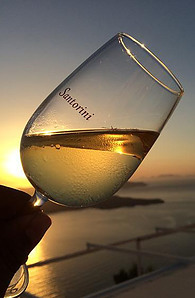
Turbidity means there a lot of suspended particles, which may indicate a defect in the wine.
However, old wines do tend to have particles.
In the olden days, they would not filter the wine as we do and it did not have any impact on the quality. Remember Veuve Clicquot who filtered champagne only for the beauty of it!
Intensity and color, on the other hand, are particularly relevant.
Concerning intensity, you should tilt your glass to 45 degrees and possibly have a blank white sheet of paper to fully appreciate it.
Put two fingers on the other side : if you can see them really well, it’s pale.
If you can not see them, it’s intense.
Anywhere in the middle is medium.
What do you learn? It can give you an indication on the grape variety and wherever you might be in for a supple or a more structured wine.
Concerning color, it is all about noticing the combination red, blue, yellow, green or brown (for whites, straw–gold; for reds, purple–ruby–garnet).It will help you determine the intensity of a wine or its age (a grenat wine will be older than a pure red one).
They are right under your nose (without you knowing it!)
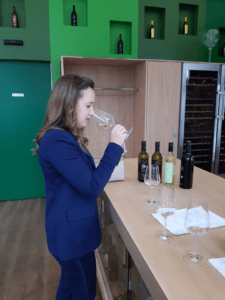
Let’s cover the most complicated, yet the most essential part of wine tasting : the nose.
Our nose have more receptors than we can count.
Our biggest issue? We never learned to use it! Like any other senses, it has to be trained.
So train it : markets, hikes, flower shop… sniffeverything!
However, if you are like me and live in town or do not know the names of half the fruits and flowers that Mother Earth gave us, Jean Lenoir provided us with the perfect shortcut : Le Nez du Vin!
When you bring your nose above the wine, a first flow of aromas emerges (in french : le premier nez : the first nose). They are the most volatile aromas.
If you twirl the wine a bit, the heavier aromas will come to your nose receptors (le second nez : the second nose).
Both are important. And if you want the restaurant sommelier to think that you are an expert, glance at him/her between these two “noses”.
Let’s plunge deeper : there are three main types of aromas : the primary aromas, the secondary aromas and the tertiary aromas.
Primary aromas come from either the grape variety or are born during fermentation.
The latters are called post-fermentation aromas.
They are divided into several subgroups :
- floral (acacia, carnation, honeysuckle, jasmine, hawthorn, lilac…)
- fruity (strawberry, raspberry, blackberry, blackcurrant citrus, lemon, lemongrass, apple, peach, pear, quince, pineapple, apricot…)
- vegetable (thyme, bay leaf, scrubland, pepper, cut hay, grass, herbal tea…)
- mineral (gun stone, chalk, iodine, flint…) and
- spices (pepper, liquorice…).
A simple wine will have a limited number of primary aromas whereas a more complex wine will offer a wider palette.
Secondary aromas are created during the vinification stages, following the fermentation.
They are also divided into several subgroups :
- aromas due to yeasts ([lees, autolysis] biscuit, bread, toast, pastry, brioche…),
- due to malolactic fermentation (butter, cream…),
- due to oak (vanilla, cloves, nutmeg, cedar, smoked).
Tertiary aromas appear during aging.
They are due to oxidation (when aging in oak), which then results in notes of coffee or caramel.
On the contrary, they can be due to limited oxygen (when aging in a bottle), which results in notes of gasoline, honey, mushrooms… In both cases, the fruity aromas evolve as well, developing into aromas of dried fruits.
Now how does it help us in qualifying the wine?
When primary and secondary aromas are dominant, the wine will be young. If we start to discern tertiary aromas, the wine is evolving. If the tertiary aromas are dominant, the wine has finished evolving. And lastly, when you start smelling unpleasant odors, the wine is tired, too old.
Watch (or feel) your mouth!
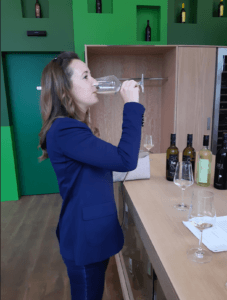
On the palate, there are many components to consider, thus several sips of wine will be necessary to fully assess all of its components.
Moreover, the latters may interfere with each other : alcohol and fruity aromas enhances the impression of sweetness whereas acidity decreases it.
The different components are as follows :
- sweetness (dry, off-dry, semi-dry to soft),
- acidity (tatric acid, malic acid -from grape juice- and malic acid – produced by conversion of malic acid in all the reds and many whites-),
- the tannins (extracted from the skins of the grapes during fermentation),
- the alcohol,
- the body (overall impression created by the association of all the elements),
- the finish (all the sensations that remain when the wine has been swallowed).
So take a sip and do not swallow, let the wine twirl in you mouth, let it explore all your palate, touch all your receptors and then spit it out.
For example : if your mouth waters after spitting, this is an indication of acidity. You can assess the level and types of tannins by the reaction on your gums.
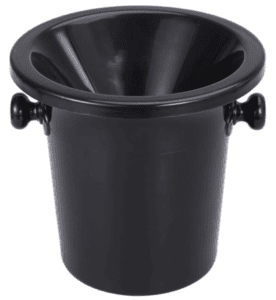
By the way, seeing as spitbuckets are not always available, yet essential to help you keep a nice and clean palate, enabling you then to taste MORE wines, I would recommend you come with yours.
This one (which you can get on Amazon here) is a really practical one with its curved handle. I bring it with me when I am off doing wine fairs and sometimes even at a wine bar or a restaurant, especially when I know I will be driving afterwards. This enables me to enjoy some wines of the evening and still get home safely!
How to assess like a pro?
So these are a few tools which will help you -objectively, more or less- choose a quality wine. But now that we have all the clues, how do we sum it up?
Let’s consider four criteria to assess the quality level of the wine : balance, intensity, length and complexity.
A wine that has
- 4/4 is an excellent wine,
- 3/4 a very good wine,
- 2/4, a good wine,
- 1/4, an acceptable wine.
Here you go!
You know all the secrets of a pro.
How to taste a wine like a pro? Just follow this checklist!
But don’t forget to enjoy yourself, have fun!
Quick story about myself : when I was studying for the WSET 2, and clearly wanted to ace the test, I would analyze every glass I drank. My friends did not help, because they would look at me every time I drank waiting for my speech to come.
I was so concentrated on trying to figure out the defects of the wine, to judge its quality that I stopped enjoying a glass of wine.
So, on my spare time, I would treat myself for a drink in a bar with a nice view and order the “vin au verre “(glass of wine) without being specific and just enjoy the drink and the view.
Of course, this wasn’t my best glass of wine but I learned (again) how to simply enjoy the drink, the view, the moment! Because, after all, wine is all about sharing and making memories, so allow yourself to drink a glass without giving it a second thought.
Where to next?
Book your private wine tasting with me!
Ready to put your new tasting skills into practice?
Join me for a private wine tasting — I’ll guide you through aromas, flavors, and stories behind the bottles.
Whether you’re a beginner or a curious enthusiast, you’ll never taste wine the same way again.
Train Your Nose Like a Pro with Le Nez du Vin Masterkit
You think tasting wine is all about the palate? Think again.
The real secret is your nose — and there’s a tool that can train it like a pro.
From fruity to floral, spicy to roasted notes, this kit helps you finally put words to what you smell.
Discover the wine world’s most famous aroma training tool
As an Amazon associate I earn from qualifying purchases



2 Comments
pasindu dimanka
Thank you very much for this valuable detailed post about How to taste a wine like a pro. Actually, I have also drunk wine. And I like it very much. But I haven’t thought much about this before. After looking at your post, I really wanted to do it this way. Keep posting valuable posts like this. I will definitely share this.
Mademoiselle
Thank you so much for stopping by and glad you liked it and learned about tasting wine. Don’t forget your spitbucket, it’s the trick to keeping your palate clean