
Weinviertel Wine
8 minutes read
Throughout your travels in Austria, there’s a moment that always happens: you taste something unexpectedly good… and you instantly imagine your friends back home.
You know the scene. You pull out that bottle, pour it, and wait for the look. The surprise. The “Wait, Austria makes this?!”
If that’s the vibe you want to create, let me introduce you to Weinviertel wine — one of Austria’s most underrated regions.
Weinviertel wine is Austria’s biggest wine region (in Lower Austria / Niederösterreich) — yet still wildly underrated. Whites dominate, with Grüner Veltliner as the star: peppery, fresh, and fruity, shaped by terroirs where loess rules and climates shift from cooler northern nights to warmer eastern influences. Weinviertel also made history as Austria’s first DAC in 2002, with strict style rules and a Reserve category since 2009. The wineries I’d recommend: Ebner-Ebenauer, Groiss, Gschweicher, Schloss Maissau, Schwareböck and Setze.
- Weinviertel: a quick overview
- Weinviertel wine region: one identity… or many?
- Terroir of Weinviertel wine: soils and climate
- Weinviertel grape varieties: Grüner Veltliner rules the kingdom
- Weinviertel DAC: Austria’s first DAC wine region
- Wineries in the Weinviertel
- Conclusion: why Weinviertel wine deserves your attention
Weinviertel: a quick overview (where are we exactly?)
The Weinviertel became part of Austria through the Treaty of Teschen in 1778, and vineyards were first established there in 1823.
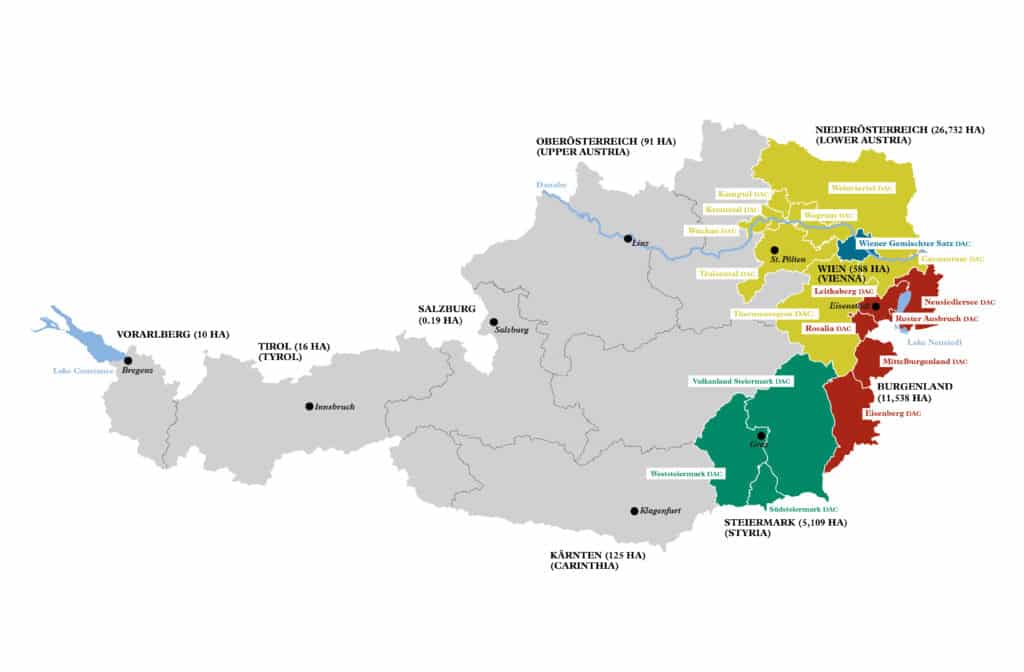
Today, Weinviertel belongs to the broader region of Niederösterreich (Lower Austria). It’s one of its 8 subregions — and yes, the Wachau is definitely the celebrity of the family… but Weinviertel is the one with the endless stories (and a lot less tourists).
Geographically, this is big. Like, really big:
- From the Danube in the south to the Czech border in the north
- From Mount Manhartsberg in the west to the Slovakian border in the east
It’s actually the largest specific wine-growing region in Austria.
© Austrian Wine / Austrian Wine
And if you enjoy wine tourism: the Weinviertel Wine Road stretches along a 400 km route and includes nearly 660 businesses, from wineries to restaurants, accommodations, and local food stops. Basically: if you like eating and drinking well (who doesn’t?), you’ll be happy here.
Weinviertel wine region: one identity… or many?
Here’s something important about Weinviertel wine: the region is more a collection of subregions than one perfectly unified “single style” area.
It covers 13,860 hectares, and the style is clearly dominated by whites: white wines account for three-quarters of total production.
Because of differences in climate and geology, Weinviertel can be divided into three sectors:
- Western Weinviertel
- Veltliner Country
- Southern Weinviertel
You’ll see why this matters in a minute — it explains a lot about why Weinviertel wines can taste so different from one village to the next.
Terroir of Weinviertel wine: soils and climate
(the simple version that actually sticks)
Let’s make this easy to remember.
The most common soil type is loess, covering over half of the vineyards. And loess is often combined with other soils like:
- gravel
- clay
- limestone

To the east, you’ll find two basins of loose rocks, separated by:
- the Leiser Berge mountains
- and the characteristic cliffs of the Waschberg area (east of Leiser Berg), made of light hard limestone
The northern border of Weinviertel towards Moravia is defined by the limestone cliffs of Staatz and Falkenstein, which offer ideal conditions for fruity and mineral wines.
Then you have the communities of Herrnbaumgarten and Schrattenberg, in a basin north of Poysdorf — a zone particularly suited for expressive red wines.
Weinviertel climate
Climatically, Weinviertel has two key personalities:
- In the north, the climate is generally dry, with warm days and cold nights, influenced by cool air moving south from the Bohemian massif
- In the east, it tends to be warmer
Translation? In one corner you get freshness and precision… and in another, richer ripeness and generosity.
Weinviertel grape varieties: Grüner Veltliner rules the kingdom
Even with all that diversity, there’s one star that absolutely dominates Weinviertel wine tastings:
Grüner Veltliner in Weinviertel
Weinviertel has around 6,700 hectares of Grüner Veltliner.
That’s:
- half of Austria’s total Grüner Veltliner vineyards
- and just under half of the world’s Grüner Veltliner vineyard area
Yes. The world.
So what does Weinviertel Grüner Veltliner taste like?
It’s famous for a spicy and peppery note, and this signature is remarkably consistent even with different soil types and long distances between wine-growing communities.
Think:
- green pepper
- white pepper
- and when more mature: black pepper
That peppery character pairs with a fruity bouquet and fresh acidity — basically the “I want another sip” style.
Other white grapes in Weinviertel
In the northeast of Weinviertel and around Poysdorf, you’ll also find:
- fresh Welschriesling
- and plenty of Pinot wines
Now move further southeast, close to the Marchfeld area near the community of Mannesdorf: here, the influence of the Pannonian climate becomes much more significant.
Thanks to the interaction with the microclimate of the March River, conditions are ideal for:
- Grüner Veltliner
- Riesling
- Pinot varieties
- aromatic grapes such as Traminer
…and this zone produces seriously high-quality wines.
And what about red Weinviertel wines?
If you’re wondering about reds (you should), head to:
- the Pulkautal valley near Jetzelsdorf and Haugsdorf (north-west)
- and the basin of Mailberg
Here you’ll find:
- fruity Zweigelt
- and Blauer Portugieser
ANECDOTE: despite its name, Blauer Portugieser comes from Austria. It ripens early and gives huge yields.
Weinviertel DAC: Austria’s first DAC wine region
Weinviertel isn’t the most glamorous Austrian wine region — it sits far from the usual tourist routes and was long considered a bit of a backwater.
And yet, it played a huge role in modern Austrian wine. In fact, Weinviertel was chosen as Austria’s very first DAC region, officially established with the 2002 vintage.
That choice was a clear statement: Grüner Veltliner belongs to Austria, even in a part of Europe where borders have shifted and grape varieties often exist on both sides.
The rules of the Weinviertel DAC
The rules here are refreshingly focused: Weinviertel DAC is exclusively dedicated to Grüner Veltliner, and that alone already tells you a lot about what to expect in the glass.
To carry the Weinviertel DAC name, wines must obtain a state control number from January 1st of the year following the harvest, and the appellation — including the mention “DAC” — must be clearly displayed on the label so there’s no confusion about origin or quality.
These wines must reach a minimum of 12.0% alcohol, and their residual sugar is capped at 6 g/l, which guarantees a dry, reliable style.
What does that mean in the glass?
In the glass, classic Weinviertel DAC wines are known for being fruity and spicy, with those unmistakable peppery notes Grüner Veltliner lovers adore. There should be no trace of botrytis or oak influence — the idea is freshness, clarity, and a straightforward expression of the grape.
In 2009, a more ambitious tier was added: Weinviertel DAC Reserve. These wines require a state control number from March 15th of the year following the harvest, a minimum alcohol level of 13.0%, and are classified as fully dry, with no perceptible residual sugar.
Compared to the classic DAC wines, the Reserve style is more full-bodied and intense, and it’s allowed a slight presence of botrytis and oak, adding depth and structure without losing balance.
If you like Grüner Veltliner with a clear, peppery personality and no surprises, Weinviertel is a safe bet — classic DAC for freshness and everyday drinking, Reserve when you want something richer but still firmly dry.
Wineries in the Weinviertel: my favourite part (obviously)
Okay, now we’re talking.
Here are a few Weinviertel wineries I genuinely love and recommend.
Ebner-Ebenauer
Run by the couple Manfred Ebenauer and Marion Ebner, this estate focuses on organic farming and produces wines designed for aging.
Highlights include single-vineyard Grüner Veltliners like:
- Bürsting
- Sauberg (from 30-year-old vines)
Their Alten Reben comes from vines over 45 years old.
And I also absolutely love their outstanding Blanc de Blancs with no dosage.
Their top-tier wine, “Black Edition,” is made from severely pruned vines, harvested slightly overripe, and aged in new barrels.
Groiss
A young winemaker, known for excellent Grüner Veltliner such as:
- the peppery “Dorflagen”
- the concentrated Reserve
- and their Sandberg Tradition, rich and spicy
I would also suggest the Rieslings from Groiss.
Gschweicher
With winemaker Bernard, who has worked in Kamptal and Marlborough.
The estate isn’t organic, but they do not use artificial fertilizers or herbicides.
Some vines are up to 85 years old, growing mostly on rock and loess soils.
Their Grüner Veltliner is excellent — my favourites come from the oldest vines in the primary rock soils.
Schloss Maissau
Specializes exclusively in Grüner Veltliner grown on granite soils.
This is a brilliant place to taste the impact of soil on wine.
Their wines are unoaked, but undergo prolonged lees contact.
Schwareböck
Another great estate with vines in:
- Sätzen
- Aichleiten
Sätzen (deep loess soils) delivers exceptional wines, while Aichleiten (sandstone and marl) adds a very distinctive character.
Again: a great way to taste terroir differences within Weinviertel wine.
Setze
If you want a change from Grüner Veltliner, Roter Veltliner is absolutely an option here.
Their vines come from the Kreimelberg vineyard, with 50-year-old vines on deep gravel soils.
These wines benefit from aging — and develop more spiciness over time.
Conclusion: why Weinviertel wine deserves your attention
The Weinviertel wine region is the largest specific wine-growing region in Austria, stretching from the Danube in the south to the Czech border in the north.
It is divided into three sectors, each with different characteristics and subregions.
Production is dominated by white wines, especially Grüner Veltliner, which offers a fruity bouquet and fresh acidity, often marked by its signature peppery spice.
Weinviertel terroirs are diverse, ranging from:
- loess
- gravel
- clay
- limestone
- granite
- and more
Climate also varies: the north is drier and cooler (influenced by air from the Bohemian massif), while the east is warmer.
Finally, Weinviertel made history as Austria’s first DAC region, with clear standards:
- max 6 g residual sugar
- 12–13% alcohol
- and a Reserve category created in 2009 for more full-bodied wines.
And yes: the wineries are absolutely worth the trip — from Ebner-Ebenauer and Groiss to Gschweicher, Schloss Maissau, Schwareböck and Setze.
Where to next?
Austria is a small country… with huge wine diversity. From peppery Grüner to bold Blaufränkisch and Vienna’s urban vineyards, here’s your guided tour of Austria’s must-know wine regions 🍷🇦🇹
Austrian wines are having a moment — and if you’re wondering where to buy Austrian wine online, I’ve got you. Here are my trusted retailers for great bottles, good value, and ethical sourcing 🍷🇦🇹
Want a private wine tasting at home, at the office, or even in an Airbnb in Provence? I’ll bring rare wines from Austria, Japan, and England — and make it fun, easy, and unforgettable 🍷✨


One Comment
Franck MULARD
Very interesting!