
What is Koshu similar to?
9 minutes read
Anthony Rose — a Master of Wine — once watched a Kōshū hold its own against Chablis 1er Cru Vaillons in a blind tasting in London. And honestly? That story never gets old to me.
Not because Kōshū is trying to be Chablis. It’s not. But because it proves something: this wine has a backbone. It shows up.
So what does it actually taste like? What do you compare it to when someone’s never heard of it?
Honestly, nothing is a perfect match. But if you’re tasting it for the first time — or trying to explain it to someone who keeps asking “but what does it taste like?” — starting with something familiar makes sense. So let’s do that.
Kōshū is Japan’s signature white wine, defined by high acidity, low alcohol (10-12%), and a distinctive saline precision. Often compared to Muscadet or Albariño, it offers a delicate profile of yuzu and mineral notes. Whether produced in a crisp “Sur Lie” style or as a structured orange wine, Kōshū is the ultimate companion for oysters and seasonal seafood.
First, What Is Kōshū?
Kōshū is Japan’s flagship white grape. It takes its name from Yamanashi Prefecture — Kōshū being the region’s ancient name — where it’s been cultivated since the 8th century. Most likely it arrived via the Silk Road, travelling from the Caucasus through China, picking up around 30% DNA from the wild Chinese vine Vitis davidii along the way.
In 2004, the OIV officially recognised it as a Vitis vinifera variety. That recognition mattered — it opened doors. Denis Dubourdieu came to Yamanashi. Bernard Magrez of Château Pape Clément came. The world started paying attention.
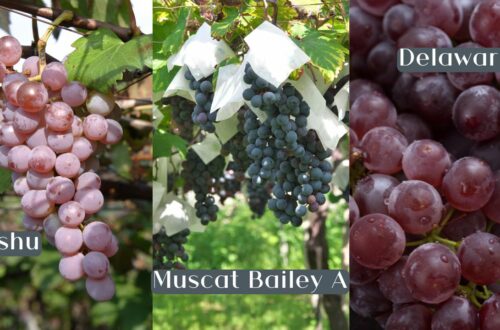
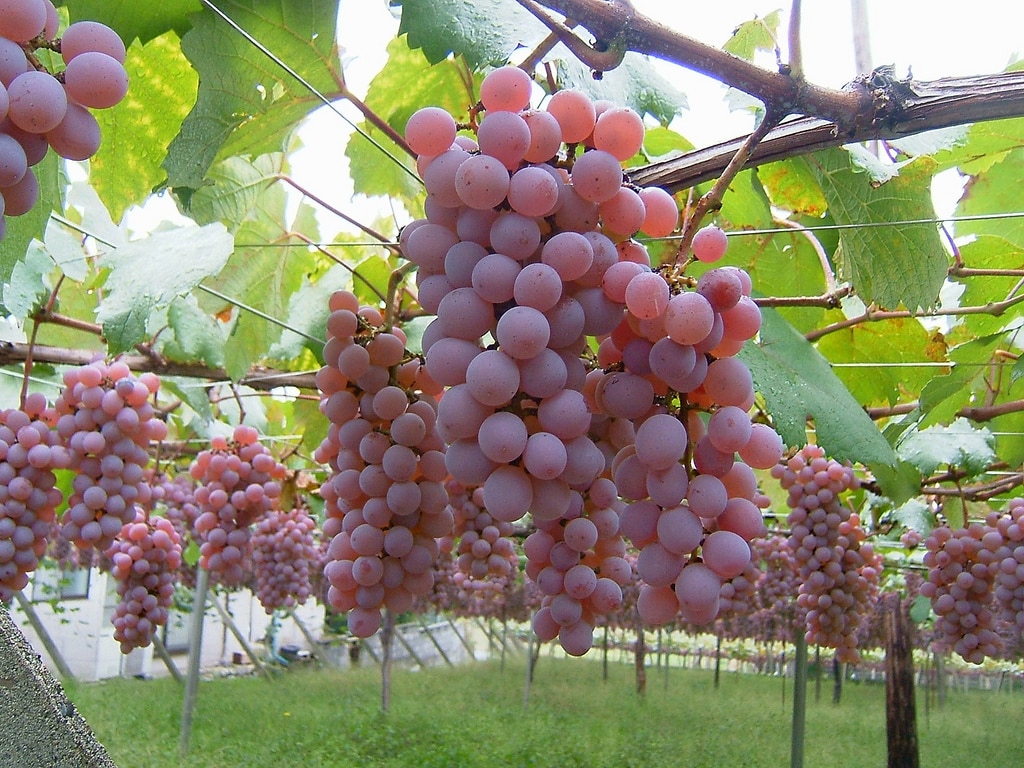
The grape itself is unlike anything you’ll find in Burgundy or Bordeaux. Pink-skinned, almost translucent, with a quality that reminds you of cherry blossoms — which feels very right for Japan. The skins are thick, which gives natural disease resistance. The bunches are loose, which allows airflow — essential in Yamanashi’s hot, humid summers.
And then there’s the way it’s grown.
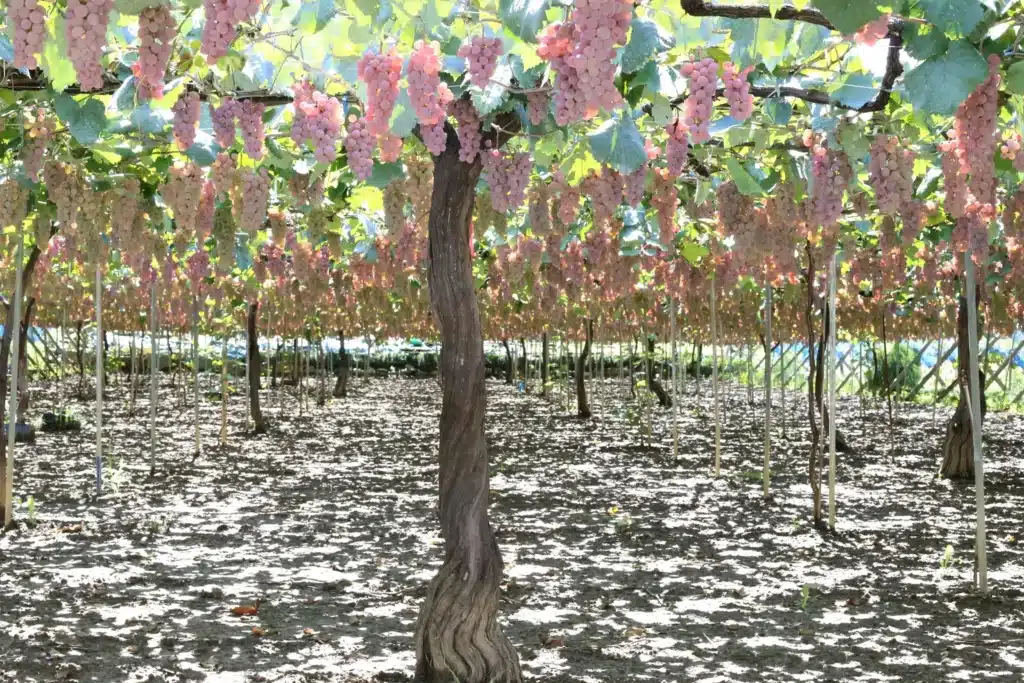
The tanana pergola system, introduced in the late 1500s, lets a single vine spread across up to 50 square metres. Walk through a Yamanashi vineyard at harvest and you’ll see the large pink bunches hanging overhead, each one sheltered under its own individual waxed paper umbrella. It’s one of the most striking images in wine.
What Does Kōshū Taste Like?
Before getting into comparisons, it helps to know what you’re working with.
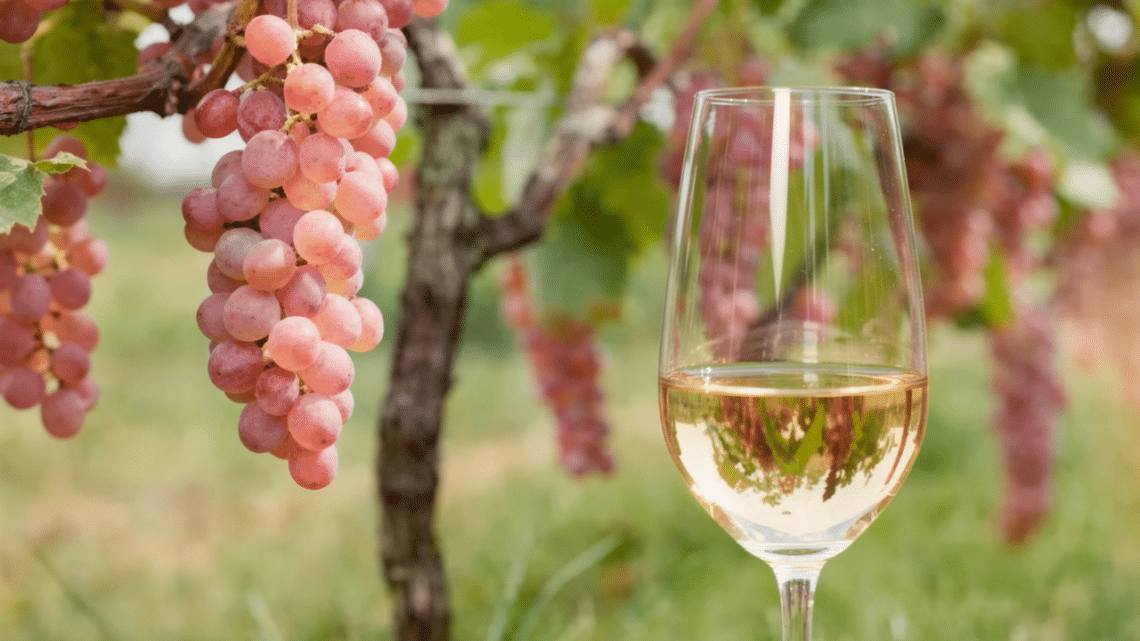
On the nose: yuzu, white peach, citrus blossom, a hint of grapefruit, and something quietly mineral underneath. On the palate: delicate, crisp, restrained — with low alcohol (typically 11-12% abv) and soft acidity. The texture is polished, almost silky. The finish is clean and understated.
That low acidity is worth dwelling on. For a long time it was seen as a problem — something to engineer around. But that framing misses the point. The softness is intrinsic to what Kōshū is. In the right context, paired with the right food, it’s not a weakness at all. It’s the whole point.
So What Is Kōshū Similar To?
A few reference points are genuinely useful — depending on the style you’re tasting.
Vinho Verde, Muscadet, Albariño all share Kōshū’s light body, low alcohol, and wet-climate freshness. Muscadet is perhaps the closest in feel — that clean, almost neutral quality that makes it endlessly useful at the table rather than the star of the show.
Alsace Pinot Blanc and restrained Sauvignon Blanc are the closest aromatic comparisons. There’s a reason for that: Kōshū shares specific aromatic compounds with both — particularly the citrus-driven thiol 3MH. It was Mercian who first identified this in the 1990s when developing their pioneering Koshu Sur Lie style, reducing copper in the vineyard to preserve it and harvesting 20-30 days earlier than tradition dictated to lock in freshness.
Chablis — as that blind tasting already suggested — isn’t an unreasonable comparison for the most mineral, restrained expressions. Particularly single-vineyard wines from Katsunuma’s recognised Grand Cru sites: Toriibira, Hishiyama, Jōnohira.
The Styles of Kōshū (And Who Is Making Them Well)
Kōshū is produced in virtually every style imaginable — fresh and unoaked, skin-contact, sparkling, sweet, even aged under flor. Here’s a breakdown.
Fresh & Unoaked (Sur Lie)
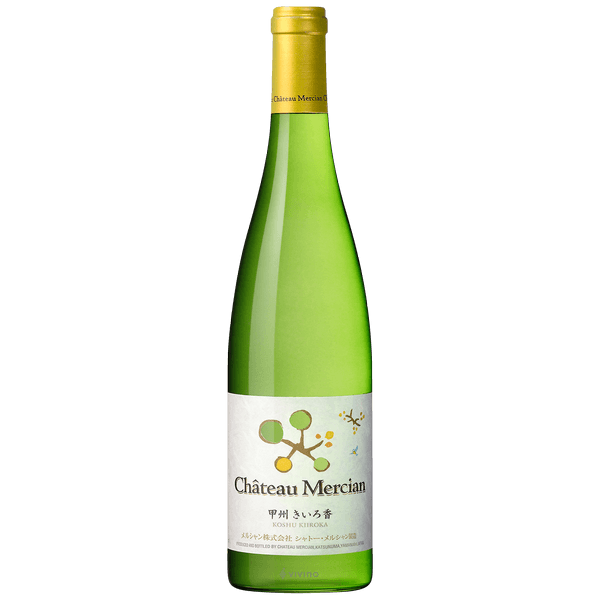
The most commercially significant and widely exported style. Château Mercian’s Koshu Kiiroka is the benchmark — the wine that essentially created the modern Kōshū category. Fermented at low temperatures with VL3 yeast, early harvested to capture maximum citrus character, minimal intervention. Clean, precise, endlessly food-friendly. Muscadet with more aromatic lift.
Single-Vineyard
Where Kōshū shows its most serious face.
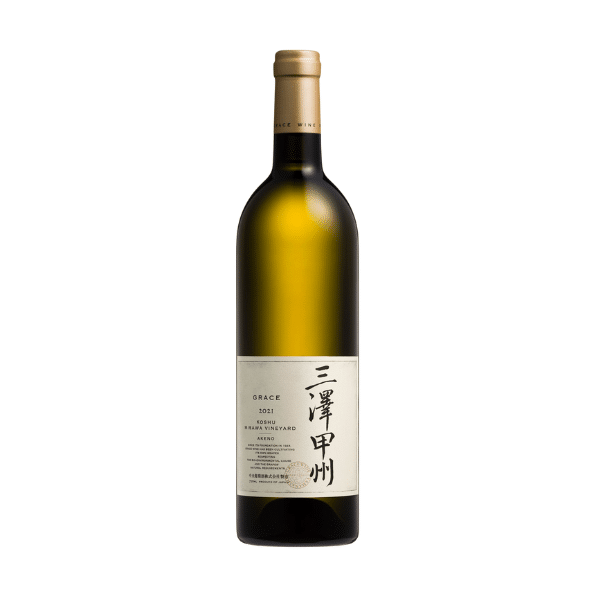
Grace Winery’s Misawa Koshu is the wine that put Japan on the global map — winning the first gold medal for a Japanese wine at the Decanter World Wine Awards in 2013. What makes it remarkable is how it achieved this: no cultured yeasts, no sur lie or barrel ageing, simply exceptional fruit from the high-altitude Misawa Vineyard (700m) expressing itself with complete clarity.
Katsunuma Jozo’s Aruga Branca Issehara is another essential reference — a single-parcel wine that since its 2001 debut has consistently shown what site-specific Kōshū can achieve. Its grapefruit character genuinely recalls Sauvignon Blanc.
Barrel & Concrete Aged
A small but growing category. Oak-aged Kōshū divides opinion — the grape’s delicacy can be overwhelmed if not handled carefully — but the best examples add texture and savouriness without masking the citrus core. These pair particularly well with Wagyu and wasabi, where the wine’s richness can meet the meat’s.
Concrete eggs and qvevri are also being used. The oxygen micro-exchange adds subtle roundness while preserving freshness more faithfully than new oak.
Sparkling
Every method is represented: pét-nat, Charmat, traditional method, carbonated. Traditional method expressions are the most compelling for wine professionals — there’s a natural affinity between Kōshū’s citrus notes and the biscuity complexity of extended lees ageing. Pét-nat releases lean into the grape’s wild, textural side in a way that suits the natural wine audience well.
Orange / Gris de Gris
Kōshū’s pink skin makes it a natural candidate for skin contact, and gris de gris expressions are gaining real momentum. These are notably more subtle than European orange wines — the astringency present but restrained, the texture plush rather than grippy. A gateway style for natural wine drinkers who might otherwise overlook Japanese wine entirely.
Sweet
Less commonly seen in export markets. Kōshū’s low natural sugar has historically been a challenge, but with careful canopy management, short pruning and high-altitude sites, concentrated styles are possible — particularly from the KW05 clone, which produces smaller, looser bunches and the highest sugar levels of the three main clones (18.1°Bx).
Aged Under Flor
Perhaps the most unexpected style. A small number of producers are exploring flor ageing — the same biological ageing used in Fino Sherry — with results that are genuinely singular. The saline, oxidative character of flor meets Kōshū’s citrus and mineral notes in a way that shouldn’t work on paper but somehow does.
Kōshū’s Secret Weapon: Food Pairing
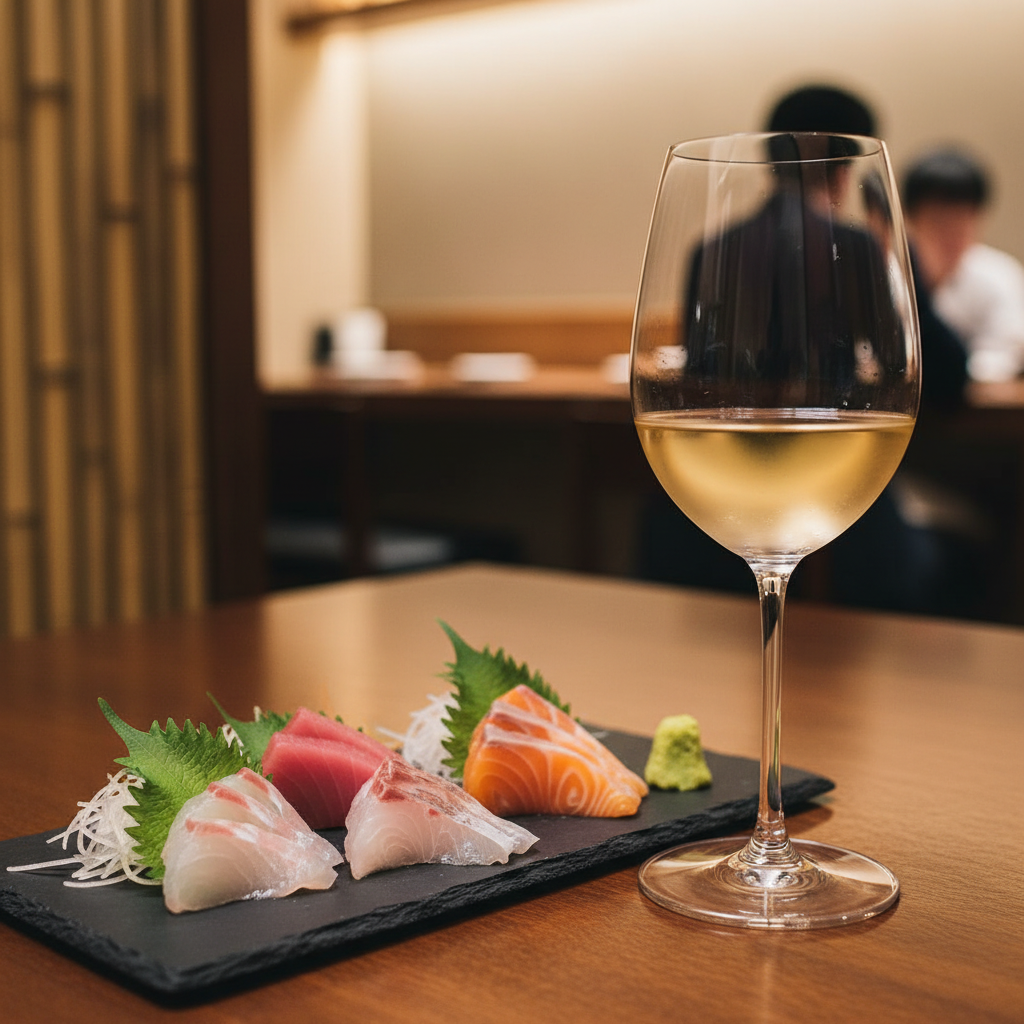
Two specific characteristics make Kōshū uniquely suited to food pairing. First, its low acidity — high acidity can make fish taste metallic, so Kōshū’s softness is an asset, not a flaw, at the sushi counter. Second, its very low iron content — high iron in wine is known to accentuate the “fishiness” of fish dishes. Kōshū has neither problem.
The result is a wine that handles raw fish — sashimi, sushi, oysters — better than almost anything else in the world. The citrus and saline elements complement rather than fight the iodine and umami of the sea.
Beyond fish: tempura-battered shiso leaf with asparagus and green beans, dashi-based broths, and — perhaps surprisingly — sharp blue cheese. Ayana Misawa of Grace Winery recommends the latter, and she’s right. The wine’s gentle acidity and low alcohol make it less confrontational with blue cheese than many higher-acid whites.
One pairing to avoid: butter and cream. The grape’s delicacy is simply overwhelmed.
The Clones Worth Knowing
Three main clones are in commercial use in Yamanashi:
| Clone | Character | Brix | Yield |
|---|---|---|---|
| KW01 | Fresh, aromatic, citrus-forward | 17.1°Bx | 80–100hl/ha |
| KW02 | Later ripening, larger bunches, more pronounced citrus | 16.7°Bx | 50–80hl/ha |
| KW05 | Concentrated, complex, small loose bunches, early harvest | 18.1°Bx | 40–70hl/ha |
Huggy Wines’ Koryu Koshu is made from the oldest KW05 vine in existence — a single-clone release that shows what this material can produce at its limit.
Beyond Yamanashi, a distinct clone grown in Osaka under the name Katashimo honbudō produces richer, more savoury wines. Katashimo Winery releases two versions: Gonoyama in a traditional style and Rikaen in a more modern style — both worth seeking out if you want to understand how far Kōshū’s expression can travel from the Yamanashi archetype.
My take on Kōshū
Honestly, when I have to describe it, I don’t reach for another wine.
I reach for oysters. That salinity. That backbone. Something clean that still has something to say. Kōshū has that. And that’s what gets people every time.
You pick up the glass — it’s practically transparent — and you think, okay, light, easy, maybe a little forgettable. Then you taste it.
There’s precision there. More acidity than a Sauvignon Blanc, but the alcohol is lower, so it never bites. It just holds its ground. You can draw comparisons. Muscadet, Vinho Verde, Albariño — they’ll get you in the neighborhood.
But Kōshū tastes like Kōshū. And once you’ve had it with oysters? The comparisons stop mattering anyway.
Where to next?
The Best Food To Pair With Japanese White Wine
If Kōshū made you think of oysters, you’re already on the right track.
But that’s just one expression of how these wines behave at the table.
From sushi to more unexpected pairings, this is where Japanese white wines really start to make sense.
Discover Unique Japanese Wine Grape Varieties
Kōshū feels familiar… and not at the same time.
That’s not an accident.
Once you see how Japanese grape varieties evolved — shaped by climate rather than tradition — the style in your glass starts to feel much more logical.
Yamanashi Wine Region: The Ultimate Guide to Japan’s Wine Capital
Kōshū doesn’t exist in isolation.
It comes from somewhere very specific — a valley that, on paper, shouldn’t even work for wine.
And yet, it does.
If you want to understand where that precision and restraint come from, this is where to look.


You May Also Like
The Best Food To Pair With Japanese White Wine
Matching Japanese Red Wines With Your Meal