Blaufränkisch Wines of Mittelburgenland: Austria’s Bold Red-Wine Secret
8 minutes read
You know that feeling when you taste a wine that stops you mid-sip?
Not because it’s loud or expensive or famous — but because it has that mix of depth and freshness, that “wait… what is this?!” energy.
If you’ve ever tried a great Blaufränkisch (or if you’re simply curious), this post is for you.
Because Mittelburgenland is one of those regions that doesn’t shout for attention — but once you understand it, you’ll start spotting it everywhere: on wine lists, in sommeliers’ favourites, and in bottles that seriously overdeliver for the price.
So yes, this is a long post — but by the end of it, you’ll be able to:
- understand why Mittelburgenland is THE red wine hotspot for Blaufränkisch
- picture the terroir and climate like you’ve been there
- decode what Mittelburgenland DAC really means
- and know which wineries to look for when you want the real thing
In other words: you’ll be able to buy (or order) Blaufränkisch wines of Mittelburgenland with confidence — and that’s exactly the kind of wine superpower I want you to have.
Now… let’s zoom out for a moment, because Mittelburgenland is part of a much bigger Burgenland story.
If you want to understand the Blaufränkisch wines of Mittelburgenland, here’s the shortcut: Mittelburgenland (south of Lake Neusiedl, near Hungary) is Austria’s red-wine stronghold for Blaufränkisch, with the region’s modern growth starting in the late 1970s and early 1980s. Warm air from the Pannonian plains and a sheltered landscape create perfect ripening conditions, while deep clay and loam soils (plus limestone, gneiss and schist in places) give the wines their signature structure and power. Blaufränkisch dominates the region (55% of vineyard plantings), and Mittelburgenland DAC wines must contain at least 85% Blaufränkisch in a three-tier DAC system introduced in 2005. Key wineries to know include Arachon, Gager, Gesellmann, Heinrich, K&K Kirnbauer and Weninger.
Mittelburgenland overall presentation
Before we zoom in, let’s place Mittelburgenland on the Austrian wine map.
Austria is small, but its wine regions have very distinct personalities — and Burgenland is one of the warmest, most red-wine-friendly parts of the country. It stretches along the eastern border, with Hungary right next door, and it’s famous for two things that might sound like opposites but actually make perfect sense here: luscious sweet wines around Lake Neusiedl… and seriously structured reds further south and on the slopes.

Mittelburgenland lies in that southern half of Burgenland, south of Lake Neusiedl towards the Hungarian border. If you’re new to Austrian geography, think of it as one of the country’s key red wine engines — especially if you love spice, depth and that “one more sip” freshness.
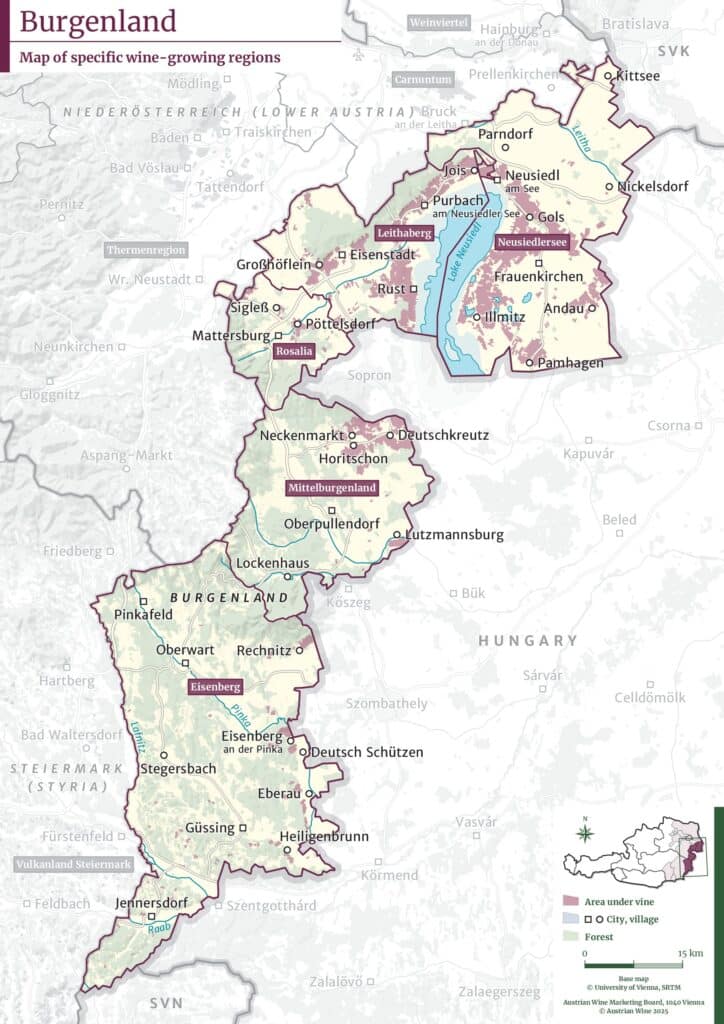
The first red wines in this region were produced in the late 1970s and early 1980s, and the grape that powered its rise has been (and still is) Blaufränkisch — the region’s calling card. Its origin is still a little mysterious… which, honestly, suits it perfectly.
If you’d like to get your bearings first, I’ve put together a simple overview here: Quick guide to Austrian wine regions (so you can see exactly where Burgenland — and Mittelburgenland — fit in).
Terroir of Mittelburgenland : climate and soil
Mittelburgenland is basically a natural comfort zone for vines.
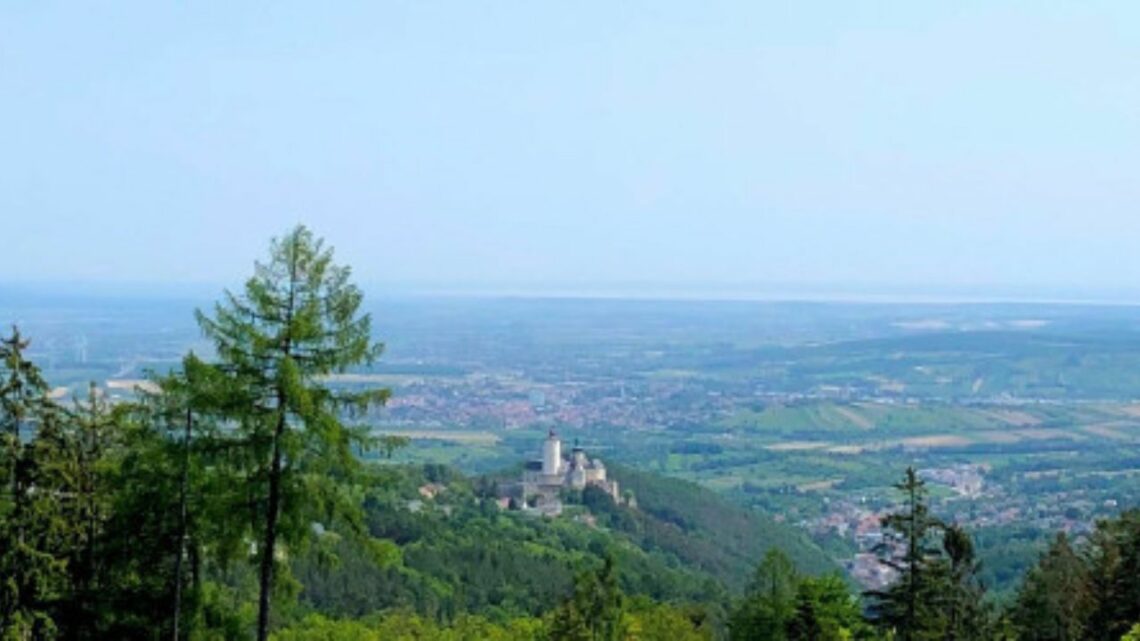
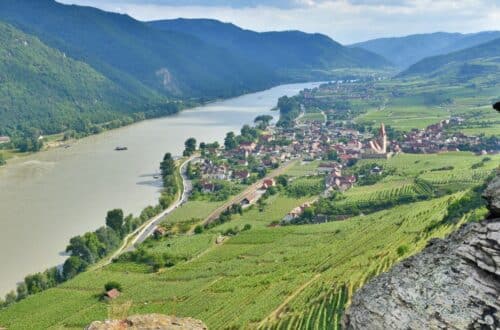
It’s a sheltered region — protected to the west by the Bucklige Welt hills, to the north by the Sopron massif, and to the south by the Köszeg massif — which means it avoids the harshest weather extremes. Add to that the warm air flowing in from the nearby Pannonian plains, and you get a climate that helps Blaufränkisch ripen beautifully.

In plain terms? Blaufränkisch gets the time and warmth it needs to develop colour, structure and flavour — without losing its freshness. That’s the magic.
Rainfall is moderate, and the vineyards are mainly concentrated in the northern part of the region — around Neckenmarkt, Horitschon, and Deutschkreuz.
Now, let’s talk about soils — not for the geology lesson, but for what it means in your glass.
Most vineyards sit on rich clay and loam soils, sometimes with limestone mixed in.
Clay is the star here: those heavy, deep clay soils hold onto water extremely well, which is a huge advantage in warm conditions. The vines don’t struggle, they stay steady — and that’s exactly how Mittelburgenland produces reds with that signature power and structure (the kind of Blaufränkisch that feels confident, not fragile).
Then things get more nuanced.
At higher altitudes, you’ll find gneiss, crystalline schists, and mica, while lower-lying sections can include limestone rocks.
The effect? More contrast and complexity — wines can gain a tighter, more focused feel, sometimes with extra energy and lift. And yes, there are also lighter soils such as sandy clays on a limestone substrate, which can bring a slightly more flowing, vibrant style.
Two vineyards are especially worth remembering:
- Hochäcker, with deep clay and silt over gravel
- Dürrau, with deep loam and clay soils enriched with iron
And if you’re wondering why producers love naming these sites — it’s because they help explain why one Blaufränkisch feels plush and structured, while another feels more vibrant, spicy, and precise, even within the same region.
Grapes of Mittelburgenland
The wine region spans across 2104 hectares, with Blaufränkisch accounting for 55% of the total planting — clearly the star of the show.
Mittelburgenland DAC
Mittelburgenland DAC has been in place since the 2005 vintage, and from the start, it made a very clear statement: this is Blaufränkisch country.
The three-tier system
The region follows a three-tier DAC system, all centred on this grape, which really thrives here. To qualify for the Mittelburgenland DAC designation, wines must be made predominantly from Blaufränkisch — at least 85%, to be precise — so there’s no ambiguity about style or identity.
At the classic Mittelburgenland DAC level, winemakers can apply for a state control number from May 1st of the year following the harvest, and the wines can be marketed from August 1st of the same year. These wines must reach a minimum alcohol level of 12.5%, with a maximum of 13.0%, and their residual sugar is capped at 2.5 g/l, ensuring a firmly dry profile.
If a wine carries the additional designation of a specific vineyard (cru), the rules tighten slightly: the state control number can only be applied for from July 1st of the year following the harvest, the wines can be marketed from October 1st, and the minimum alcohol level rises to 13.0%, with a maximum of 13.5%.
There is also Mittelburgenland DAC Reserve, the most ambitious tier, which requires a state control number from January 1st of the second year following the harvest and can be marketed from March 1st of that same year. Reserve wines must also reach at least 13.0% alcohol.
What does a Mittelburgenland DAC wine taste like?
In terms of style, Mittelburgenland DAC wines are full-bodied, fruity, and marked by spicy notes, a very typical expression of Blaufränkisch. They can be aged in traditional large oak barrels, previously used barrels, or stainless steel tanks, with minimal or even no perceptible oak influence — the focus is on fruit, structure, and freshness rather than wood.
Wines with a specific vineyard (cru) designation follow the same general profile, just with more precision and depth.
Mittelburgenland DAC Reserve, on the other hand, clearly steps things up: these wines show notable to dominant oak notes, coming from ageing in large oak barrels or smaller barrels, adding extra power, texture, and ageing potential.
If you like structured, spicy reds but don’t want heavy, jammy wines, Mittelburgenland is an easy win — classic DAC for pure Blaufränkisch character, cru wines for more precision, and Reserve when you want something bold and oak-driven.
Wineries in Mittelburgenland
Arachon
Arachon is more than just a winery; it is a collaborative project between FX Pichler from the Wachau, Manfred Tement of Styria, and the late Tibor Szemes, a negociant from Burgenland.
Under the guidance of winemaker Wolf Gregor, the aim is clear: produce high-quality wines in large quantities at affordable prices.
Gager Winery
Gager Winery focuses exclusively on red wines and employs manual harvesting techniques. Their goal is to create concentrated, powerful, flavorful reds.
Notable wines include their new-oaked “Gager” and “Mitterberg”.
Gager is mostly known for the popular blend “Quattro”, made from Blaufränkisch, Zweigelt, Merlot, and Cabernet Sauvignon.
Another standout: “Tycoon”, a blend of Cabernet Sauvignon, Blaufränkisch, and Tannat, aged for 30 months in new oak.
And “Q2” is a blend of Blaufränkisch, Cabernet Sauvignon, and Syrah, aged in older barriques, resulting in a more juicy and vigorous character.
Gesellmann Winery
Gesellmann has a strong focus on Blaufränkisch, representing half of their production.
Their “Hochäcker” wines are delicious, with aromas of cherry, blueberry, and sometimes even marzipan.
Their celebrated “Opus Eximium” (or “Op” outside Austria) is made from Blaufränkisch (60%), along with Zweigelt and St. Laurent, and aged for 18 months in one-third old barriques.
The resulting wines are supple and spicy, with that signature energy brought by the grape blend.
Heinrich Winery
Led by Silvia Heinrich, this winery specialises in rich, boldly flavored reds.
Around 80% of their production is Blaufränkisch, and their top wine — Goldberg Reserve — is superb, offering complex aromas of plums, bacon, and leather.
K&K Kirnbauer
Established in 1979, K&K Kirnbauer makes an exceptional Blaufränkisch called “GOLD” (or Goldberg Reserve).
Their “Girmer“ comes from old vine Zweigelt and is aged for 18 months in oak sourced from their own woodlands.
They also produce “Forever”, a Bordeaux-style blend.
Weninger Winery
Weninger is a passionate advocate of biodynamic farming, and a pioneer in both barrique ageing and Cabernet Sauvignon production (reserved for exceptional vintages).
They also have a vineyard and winery in Sopron, just across the Hungarian border, as part of a joint venture with Attila Gere of Villany.
Weninger’s principal Blaufränkisch wines include the excellent value “Hochäcker”, the old-vine Kirchholz, and the well-balanced Dürrau.
Conclusion : Mittelburgenland wines
The first red wines from Mittelburgenland — located south of Lake Neusiedl near the Hungarian border — were produced in the late 1970s and the early 1980s. Since then, the region has grown into one of Austria’s most exciting red wine strongholds.
Its sheltered location and the warm air flowing in from the nearby Pannonian plains create ideal conditions for Blaufränkisch, the grape that truly defines the identity of this area.
Mittelburgenland’s terroir is shaped by diverse soils including clay, loam, limestone, gneiss, and schist, all contributing to the power and structure of the indigenous red wines.
Blaufränkisch dominates plantings — accounting for 55% — alongside other varieties such as Zweigelt and Merlot.
The region follows a three-tier DAC system, with Blaufränkisch firmly at its core: at least 85% is required in DAC-labeled wines.
And the wineries? They deliver.
- Arachon aims to produce premium wines at accessible prices.
- Gager makes concentrated reds and the popular blend “Quattro.”
- Gesellmann makes elegant Blaufränkisch wines including the celebrated “Opus Eximium.”
- Heinrich produces rich and bold reds like Goldberg Reserve.
- K&K Kirnbauer offers standout Blaufränkisch and Bordeaux-style blends.
- And Weninger continues to lead the way in biodynamics and expressive terroir-driven Blaufränkisch.
In short: if you want to understand the soul of Burgenland reds, Blaufränkisch wines of Mittelburgenland are an amazing place to start.
Where to next?
Austria is a small country… with huge wine diversity. From peppery Grüner to bold Blaufränkisch and Vienna’s urban vineyards, here’s your guided tour of Austria’s must-know wine regions
Burgenland is Austria’s sunshine region: bold reds, legendary sweet wines, and terroirs that change everything from one hill to the next. So how about we try another style of Blaufränkisch?
Austrian wines are having a moment — and if you’re wondering where to buy Austrian wine online, I’ve got you. Here are my trusted retailers for great bottles, good value, and ethical sourcing


You May Also Like

Where To Buy Austrian Wine Online?
A Quick Guide to the best Austrian wine regions