Steiermark wine: Austria’s freshest region (and my personal favourite)
8 minutes read
You’ve heard it a thousand times: Austria = Grüner Veltliner and Riesling.
And yes — those wines are fantastic.
But if you stop there, you miss the most exciting side of the country.
Steiermark wine (Styria), in the south of Austria, is one of the country’s four main wine regions — and it plays a completely different game. Here, international grapes like Sauvignon Blanc and Chardonnay (Morillon) take centre stage, with wines that focus on freshness.
Steiermark also happens to be one of the most beautiful wine regions in Austria: steep vineyards, dramatic hills, and three zones that each bring their own specialty. Think Schilcher rosé in the west, Sauvignon Blanc in the south, and delicious Pinot Blanc everywhere.
And yes… it’s my favourite wine region. So I really want you to read the whole post
Steiermark wine (Styria) comes from southern Austria and is one of the country’s four main wine regions. Unlike Austria’s best-known styles (Grüner Veltliner and Riesling), Steiermark focuses on fresh, lively wines from international varieties such as Sauvignon Blanc and Chardonnay (Morillon), alongside Weissburgunder, Grauburgunder, Gelber Muskateller and Traminer. The region spans 4,630 hectares across three wine zones—Südsteiermark, Vulkanland and Weststeiermark—known for steep vineyards, wet conditions and a challenging climate that can drop to -20°C, increasing erosion and disease pressure like mildew. Soils range from sedimentary deposits in the Styrian Basin to Austroalpine rocks, with volcanic basalts and tuffs in the southeast. In 2018, all three zones obtained DAC status (Südsteiermark DAC, Vulkanland Steiermark DAC and Weststeiermark DAC), with wines classified as Gebietswein, Ortswein and Riedenwein. Weststeiermark is famous for Schilcher rosé, Südsteiermark for Sauvignon Blanc, and Vulkanland for aromatic styles including Traminer. Notable groups include natural-wine producers in “Schmecke das Leben” and the STK association, which ranks vineyards as Erste Lage and Grosse Lage.
Steiermark overall presentation
Sure — there are wine regions famous for powerful, structured wines.
But if you ask me where to find wines that feel consistently fresh, vibrant, and elegantly precise, I’ll take you straight to Southern Styria.
And what’s great is that this applies across all three Styrian wine zones:
- Vulkanland
- Weststeiermark
- Südsteiermark
Each produces its own specialties, mostly located in the southern part of the administrative region.

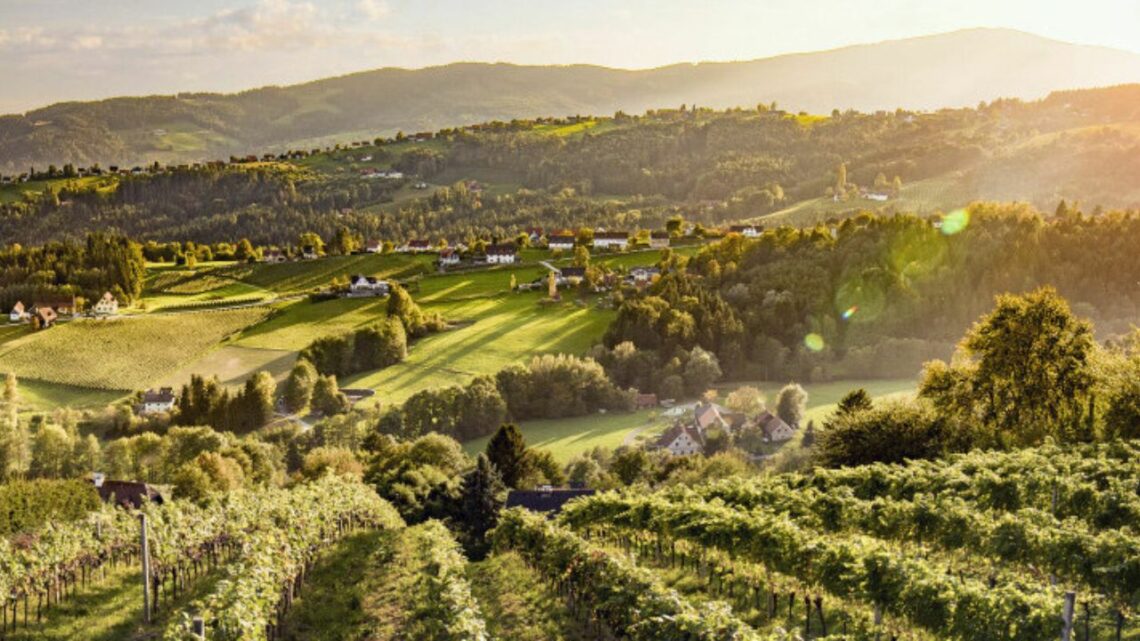
Steiermark covers 4,630 hectares of vineyards and looks like a postcard — no wonder people call it the “Tuscany of the North.”
(Fair warning: the slopes here are often steeper than Tuscany… and the wines are definitely fresher.)
Those steep vineyards matter, by the way. They’re part of why Steiermark wine tastes so intense and alive: vines have to work harder, yields are naturally limited, and everything is more hands-on.
Most vineyards cluster in the south — where the Celts grew grapes first, and the Romans later carried the tradition on.
Then history did what history does: wars and plagues in the 16th and 17th centuries caused a decline in viticulture.
It wasn’t until the 1840s that Archduke Johann revived winemaking. He had been banished to Styria for marrying a commoner and getting involved in politics his Habsburg relatives didn’t appreciate — but instead of sulking, he built. He established a research institute in the region, based in Maribor (now in Slovenia).
One more local tradition I love: the new vintage is celebrated with the light-bodied “Junker” wine, served from early November. Dry Gebietsweine are released starting from March of the following year, while wine lovers have to wait longer for Ortsweine and Riedenweine.
Terroir : climate and soil
Now, terroir — but I promise, we’ll keep it connected to the only thing you really care about: how the wine tastes.

In Steiermark, terroir is basically the reason the wines taste the way they do: fresh, lively, precise, sometimes even a little “nervy” (in the best way).
First, climate.
Steiermark is not an easy place for vines. Winters can be harsh, with temperatures dropping as low as -20°C. It’s also a wet region, and because many vineyards are extremely steep, erosion is a real issue. Add humidity and you get another headache for growers: diseases like mildew.
Depending on whether the vineyards are more exposed to the Alps or to the Adriatic Sea, conditions vary significantly.
This is exactly why Steiermark wines keep their energy. Cool temperatures + humidity + steep slopes = the vines have to work hard, and grapes don’t ripen in an “easy” way. Result: wines that stay bright, crisp, aromatic and super drinkable, even when they have texture.
Now, soils (aka what’s under your feet — and why it matters).
Around three-quarters of Styrian vineyards grow on sedimentary deposits in the Styrian Basin, while 20% of vines root in the hard rocks of the Austroalpine. A small percentage is found on coarse fluvial sediments that accumulated in the basin.
In the southeast, you even get volcanic influence: basalts, volcanic scoria, and tuffs (around three percent of the vineyards). Other sediments range from silts and marls to sands, blocks, gravels, tuffeaux, conglomerates… with occasional limestone.
Takeaway in your glass: This mix of soils is one reason Steiermark is so exciting: depending on where you are, wines can feel more flinty/mineral, more textural, more aromatic, or more tense and precise — even when it’s the same grape variety. (Yes, soil really does that.)
If you want to understand exactly how clay vs limestone vs volcanic rock changes the taste, I’ve written a full guide here: How does soil affect the taste of wine? (trust me, it will change the way you choose bottles forever).
And one last detail to keep in mind: among Steiermark’s sub-regions, Südsteiermark has the largest vineyard surface area — which helps explain why so many of the region’s most famous wines (especially Sauvignon Blanc) come from there.
Grape varieties & wine styles in Steiermark (by sub-region)
Let’s make Steiermark wine easy.
Instead of listing grapes in a vacuum, here’s the real way to understand Styria: three sub-regions, three distinct vibes. Same country, same freshness obsession… but very different bottles.
1) Südsteiermark: the Sauvignon Blanc kingdom
If you’ve heard people talk about Styrian Sauvignon Blanc like it’s a religion… they’re not completely wrong.
Südsteiermark is the largest Styrian sub-region, and it’s where Sauvignon Blanc really takes the crown. Alongside it, you’ll also find Welschriesling, Pinot Blanc (Weissburgunder), Morillon (Chardonnay), Pinot Gris (Grauburgunder), Riesling, Muscat Blanc à Petits Grains, and Traminer — but Sauvignon is the anchor.
What does it taste like? Think aromatic whites with energy: vibrant, expressive, fresh — the kind of wines that make food taste better and keep you coming back for another sip.
Want the full deep dive? Here’s my complete guide: Südsteiermark wines.
2) Weststeiermark: home of Schilcher (Austria’s pink rebel)
Weststeiermark is smaller, older, and wildly charming — but let’s be honest: you’re here for Schilcher.
Schilcher is that distinct Styrian rosé style with serious personality. It’s produced in the west, and it’s one of those wines that people either discover by accident… or actively hunt down once they’ve tasted it.
What does it taste like?
Fresh, edgy, super drinkable — the kind of rosé that feels more like a “real wine” than a poolside accessory.
Curious? I wrote a full post on it here: Weststeiermark wines
3) Vulkanland Steiermark: aromatic whites + volcanic energy
Now we head southeast — and the name already tells you what you need to know: Vulkanland has volcanic influence.
Here, your aromatic grapes feel completely at home. You’ll see Sauvignon Blanc again (it’s Styria), plus Muscat Blanc à Petits Grains, and in this part of Steiermark they’re beautifully complemented by a local favourite: Traminer.
What does it taste like?
Often more aromatic and expressive — sometimes with a slightly more “textured” feel. Still fresh (always fresh), but with a different energy than Südsteiermark.
Full guide here: Vulkanland Steiermark wines
The “across all Styria” grapes (your cheat sheet)
Now that you’ve got the map in your head, here are the grapes you’ll keep seeing across Steiermark:
- Sauvignon Blanc (the star, especially in Südsteiermark)
- Chardonnay / Morillon (can be full-bodied while staying fresh)
- Weissburgunder / Pinot Blanc (delicious everywhere)
- Grauburgunder / Pinot Gris
- Gelber Muskateller
- Traminer
- Welschriesling (the most widespread Styrian wine — very refreshing, with a bouquet reminiscent of green apples)
And if you like richer whites, Pinots can shine — especially Pinot Blanc from limestone soils. Give Morillon (Chardonnay) a bit more ageing and it turns beautifully full-bodied — think grey Burgundy vibes (Ruländer / Pinot Gris), but with that unmistakable Styrian lift.
Takeaway: If you want wines with maximum freshness + character, Steiermark is basically your playground. Just choose your lane: Sauvignon elegance (Südsteiermark), pink rebel energy (Weststeiermark), or aromatic volcanic charm (Vulkanland).
The DAC in Steiermark
The 2018 vintage marked a new era for Steiermark wine: all three wine zones obtained DAC status:
- Vulkanland Steiermark DAC
- Südsteiermark DAC
- Weststeiermark DAC
The typical white wines — including Schilcher in Weststeiermark — appear in three categories:
- Gebietswein
- Ortswein
- Riedenwein
All the grape varieties listed above can be used, but Ortsweine and Riedenweine tend to focus on local grapes.
Steiermark is also home to notable groups and associations.
The “Schmecke das Leben” group comprises natural-wine producers such as Strohmeier, Tauss, Wertlitsch, Andreas Tscheppe, and Sepp Muster.
And the STK (Steirische Terroir- und Klassikweingüter), similar to the Traditionsweingüter of Lower Austria, has established its own hierarchy:
- Erste Lage
- Grosse Lage
Member wineries include:
Gross, Lackner-Tinnacher, Neumeister, Polz, Sattlerhof, Tehment, Frauwallner, Wohlmuth, Hannes Sabathi, Erwin Sabathi, Maitz, and Winkler Hermaden.
The registered “STK” designation can be used for wines from different vineyards and regions, as long as they meet criteria that go beyond geography.
Before we get to those criteria, a short note on vineyards: in Steiermark, vineyards are much bigger than in the Wachau, for instance. With the many hills, vineyards have microclimates within them (exposition, altitude…). So wines from one vineyard can differ a lot depending on where vines are located in the vineyard.
However, what stays the same in each vineyard is the soil. So the best way to guess where a wine comes from is to know the soils of the vineyards.
And because vineyards are large here, you get something quite unusual: a Grand Cru and a Premier Cru can share the same name because they’re essentially the same vineyard. The differentiation comes from additional criteria.
Grosse Lage / Grand Cru
These wines come from the finest single vineyards. Grapes must reach full ripeness and are harvested later than other levels, resulting in concentration and ageing potential.
Vines must be at least 15 years old (rare in ranking systems). Yields are limited to 4,500 hl/h, and wines must age for at least 18 months before release.
Only a cuvée present on the market for at least a decade, proving long ageing potential, can carry the Grosse Lage label.
Erste Lage / Premier Cru
Also single-vineyard wines made from fully ripe grapes, with concentration and ageing potential.
Vines must be at least 12 years old, yields are limited (4,500 hl/h), wines must age for at least one year, and they must have shown in previous vintages that they can mature for at least five years.
Conclusion : Steiermark wines
So yes — Steiermark (Styria) is ridiculously pretty. But it’s not just a postcard wine region.
It’s one of Austria’s most exciting places to drink if you love wines with freshness, lift, and personality — the kind of bottles that make you go “one more sip” without even thinking.
With 4,630 hectares of vineyards (mostly in the south), Steiermark is built around three wine zones — Vulkanland, Weststeiermark, and Südsteiermark — and each one brings its own speciality. That’s what makes Styria so addictive: you can explore for ages and never get bored.
And this isn’t some “new discovery” either. Vines were already here in the time of the Celts and Romans, before wars and plagues in the 16th and 17th centuries slowed everything down. The region only truly came back to life in the 1840s, when Archduke Johann revived winemaking and even created a research institute to push local knowledge forward.
In the glass, Steiermark gives you a full playground of styles:
- Schilcher rosé in the west (yes, the rosé with attitude)
- Sauvignon Blanc and Muscat Blanc à Petits Grains along the South Styrian Wine Road
- aromatic wines like Traminer in Vulkanland
- the crisp, green-apple refreshment of Welschriesling
- and richer whites too, like Pinot Blanc (especially on limestone soils) and Morillon (Chardonnay) — which can be full-bodied but still stay fresh, a bit like grey Burgundies (Ruländer / Pinot Gris).
In short: if Austria is on your wine radar, Steiermark wines are the detour you don’t want to miss — because this region doesn’t just make fresh wine… it makes fresh wine with real soul.
Where to next?
Ready to explore Steiermark properly? Here are the three sub-regions you should know — each with its own personality:
Want aromatic whites with a little volcanic magic? Vulkanland is where freshness meets spice and perfume.
If you’ve never tried Schilcher (Austria’s most distinctive rosé), this is your sign. It’s the pink rebel of Steiermark — and it’s so fun.
Sauvignon Blanc lovers, you’re going to be very happy here. Think elegance, energy, and wines that make food taste better.


You May Also Like
What type of wine is Sekt?
Is Blaufränkisch sweet?