
What does Vulkanland Steiermark wine taste like?
6 minutes read
If you’ve been exploring Styrian wines and thought, “OK… but why does this one feel rounder, warmer, maybe a bit more generous?” there’s a good chance you’ve just met Vulkanland.
Because within Steiermark, Vulkanland plays a slightly different game.
Yes, freshness is still there (this is Styria, after all).
But Vulkanland wines often feel richer, softer, and more textured — and that’s not an accident.
In this post, I’ll show you:
- what Vulkanland Steiermark wine actually tastes like
- why volcanic soils and a warmer climate change the style
- which grapes really define the region
- and which producers best express Vulkanland’s personality
By the end, you’ll know when to choose Vulkanland — and when to look elsewhere in Styria.
Vulkanland wines from southeastern Styria tend to taste richer, rounder, and more textured than other Styrian wines. Shaped by volcanic and sedimentary soils and a slightly warmer climate, they often show subtle spice, softer aromatics, and generous mouthfeel while keeping freshness. Key grapes include Weissburgunder (Pinot Blanc), Welschriesling, Sauvignon Blanc, Grauburgunder (Pinot Gris), and Zweigelt. Klöch, with its heat-retaining basalt soils, produces some of the region’s most expressive wines. Compared to Südsteiermark’s razor-sharp style, Vulkanland offers depth, balance, and quiet complexity.
Vulkanland overall presentation
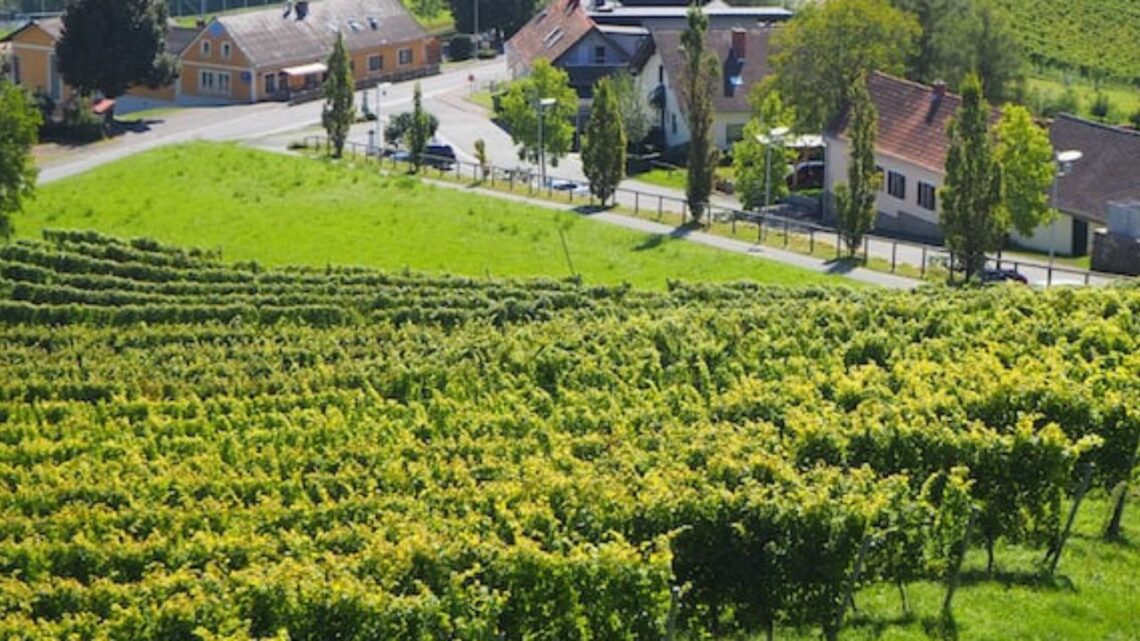
Vulkanland literally means “volcanic land” — and once you’re there, it makes perfect sense.
This part of southeastern Styria is one of Austria’s most authentic regions, both for wine and for travel.

Think rolling hills, charming villages, themed hiking trails (with excellent signage), and welcoming Buschenschank farm inns where wine comes with local food — and yes, with the famous Styrian pumpkin seed oil.
For centuries, this area was a highly disputed border zone. You can still see it today: castles and fortresses perched dramatically on basalt cliffs. Places like Riegersburg and Schloss Kapfenstein once served defensive purposes — today, they host cultural and culinary events instead.
Four wine routes now cross this hilly landscape, and the Styrian Wine Archive in St. Anna am Aigen offers a great overview of the region’s wine production. Add to that several thermal towns along the volcanic fault line, and Vulkanland becomes a place where wine, geology, and slow travel naturally meet.
Terroir of Vulkanland
Now, let’s get to the heart of the matter: taste.
Vulkanland’s soils are a mix of basalt and sedimentary soils (gravel and limestone). The region is dotted with extinct volcanoes — a rare feature in Austria — although less than 10% of the vineyards actually sit on pure volcanic soils.
Still, volcanic history is everywhere.
Ancient and more recent eruptions left behind:
- red trachyandesite
- hard black basalt
- porous basaltic scoria
- solidified ash tuffs
- and fine sediments from former crater lakes
Higher up, from the south to the east of the Joglland area near Hartberg, vineyards sit on hard crystalline rocks of the Austro-Alpine zone — mainly gneiss and mica schists. Further south, soils become looser, sandier, and more gravelly.
So what does that mean in the glass?
This geological mix gives Vulkanland wines a very specific profile:
- fine texture
- a subtle mineral–spicy edge (not aggressive, more savory than sharp)
- and often a slightly rounder mouthfeel than wines from cooler parts of Styria
Climate plays a big role too.
Vulkanland is slightly warmer, thanks to its location and the influence of the Pannonian plains. Grapes ripen earlier here.
Takeaway in your glass: earlier ripening + warmth = wines that feel richer and softer, with less piercing aromatics than Südsteiermark, but more body and generosity.
This is one of the key reasons Vulkanland Steiermark wine tastes different from the rest of Styria.
And then there’s Klöch.
Klöch is the most famous village in the region, and for good reason. Its basalt soils warm up quickly in summer and retain heat, creating ideal conditions for grape ripening. Wines from Klöch often show extra depth and balance — especially in aromatic varieties.
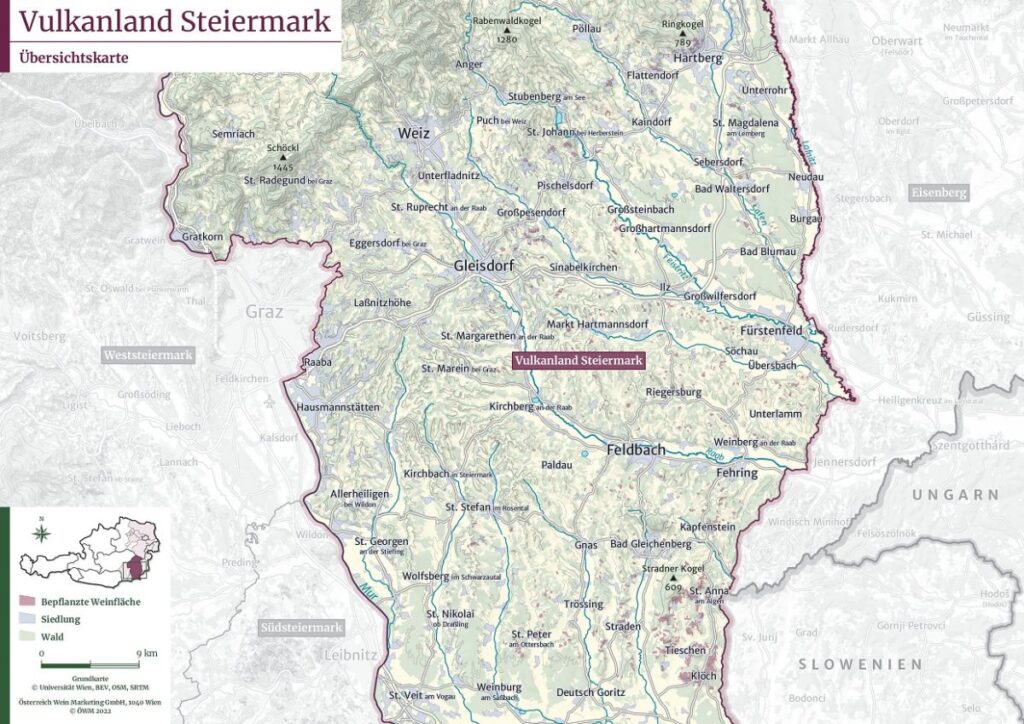
Other important wine-growing municipalities include: Bad Radkersburg, Feldbach, Gleisdorf, Hartberg, Kapfenstein, Riegersburg, St. Peter, Straden, Tieschen, and Weiz.
Up north, on Mount Ringkogel near Hartberg, vineyards climb up to 650 meters above sea level, making them some of the highest in Austria — which helps preserve freshness even in this warmer corner of Styria.
Grapes varieties in Vulkanland
Vulkanland counts 1,524 hectares of vineyards, with a clear identity.
The leading grapes are:
- Weissburgunder (Pinot Blanc)
- Welschriesling
These two grapes thrive here and produce some of the region’s most consistent, high-quality wines.
You’ll also find:
- Chardonnay
- Müller-Thurgau
- Sauvignon Blanc
Compared to Südsteiermark, Sauvignon Blanc in Vulkanland tends to feel less razor-sharp, more rounded and generous, with softer aromatics.
Another important grape is Zweigelt, which covers 190 hectares. Here, it often shows ripe fruit and approachable structure rather than power.
If you like whites that feel textured, balanced, and gently spicy, rather than ultra-cutting, Vulkanland is very much your zone..
All these grape varieties form the foundation of Vulkanland Steiermark DAC.
Vulkanland Steiermark DAC has existed since the 2018 vintage, and it’s one of Austria’s most diverse DACs when it comes to grape varieties.
The permitted palette is deliberately broad and includes Welschriesling, Pinot Blanc (Weissburgunder), Morillon (Chardonnay), Pinot Gris (Grauburgunder), Riesling, Muscat Blanc à Petits Grains, Sauvignon Blanc, Traminer (Gewürztraminer), as well as blends of these grapes. So yes — it’s a lot — but the idea is to reflect the richness and variety of this volcanic region rather than narrow it down to a single signature grape.
Like other DAC regions, Vulkanland Steiermark follows a three-tier system.
At the regional level, Gebietswein represents the broader expression of Vulkanland. These wines require a state control number from January 15th of the year following the harvest, except for Welschriesling, where the application can already be made from December 1st of the harvest year.
Ortswein, which highlights wines from specific villages or locations, requires a state control number from April 1st of the year following the harvest. There’s one important exception here: for Klöcher Traminer, the application starts earlier, from March 1st of the year following the harvest, but only for the first three years of the DAC.
At the top of the pyramid sits Riedenwein, the single-vineyard level, which also requires a state control number from April 1st of the year following the harvest.
Residual sugar rules are precise and depend on the category.
For Gebietswein, the maximum residual sugar is 4.0 g/l, and Riesling and Traminer must be labelled “trocken” (dry).
For Ortswein, the maximum residual sugar is again 4.0 g/l, with the same “trocken” requirement for Riesling and Traminer. Klöcher Traminer, however, is treated differently: it may be labelled “halbtrocken” (off-dry), or even without any residual sugar limit when produced as a Prädikatswein.
For Riedenwein, the maximum residual sugar remains 4.0 g/l, and Muscat Blanc à Petits Grains and Traminer must be labelled “trocken.”
To make this system easier to read on a label, Vulkanland also highlights signature grape varieties by municipality, especially at the Ortswein level.
In Oststeiermark, Riegersburg, Kapfenstein, Sankt Anna, Tieschen, Straden, and Sankt Peter, Sauvignon Blanc plays a central role, often alongside Pinot Blanc (Weissburgunder) or Pinot cuvées depending on the village.
Klöch focuses on Sauvignon Blanc and Traminer, while Sankt Peter again highlights Sauvignon Blanc and Weissburgunder. This village-by-village focus is there to help you decode labels more easily and understand what each place wants to express as its signature style, rather than leaving you alone with a long list of grape names.
With Vulkanland Steiermark, the label really is your guide — start with the village name to understand the style, expect Sauvignon Blanc to lead in most places, and remember that Klöch is the exception where Traminer can be richer or even off-dry.
Wineries in Vulkanland
I’ll be honest: I haven’t explored Vulkanland as deeply as I’d like yet — and this list will grow.
That said, two producers clearly show what Vulkanland can do.
Krispel
Krispel is known for its precision and its single-vineyard wines, especially Hochstrandl and Neusetzberg, both shaped by volcanic soils.
Their wines are consistently polished, expressive, and very “Vulkanland” in spirit: ripe, textured, and quietly complex.
Neumeister
Neumeister is impossible to miss — literally. The winery is built into a hillside, and visitors enter through a chimney. Dramatic? Absolutely.
Christoph Neumeister believes that in such a remote corner of Austria, you need to make an impression — and it works.
The estate is famous for its Sauvignon Blanc, which challenges stereotypes of Südsteiermark styles. But the real star here is Grauburgunder (Pinot Gris).
Their “Saziani”, from 45-year-old vines, ages 18 months in large casks and delivers a deep, layered, serious expression of the grape — one of the best arguments for Vulkanland’s potential.
Conclusion : Vulkanland Steiermark wines
So — what does Vulkanland Steiermark wine taste like?
In short: rounder, warmer, and more generous than other Styrian wines — without losing freshness.
Volcanic and sedimentary soils bring subtle spice and texture.
A warmer climate leads to earlier ripening and richer profiles.
Altitude and basalt help preserve balance.
If Südsteiermark is all about tension and razor-sharp aromatics, Vulkanland is about depth, comfort, and quiet complexity.
It’s the Styrian region you reach for when you want freshness with a bit more weight, and elegance without sharp edges.
And once you understand that, Vulkanland stops being “the volcanic one”… and starts being a very deliberate choice in your glass.
Where to next?
How does soil affect the taste of wine?
Want to go deeper on why these wines taste this way? This guide breaks down how different soils change texture, freshness, and aromatic profile — and once you read it, you’ll never look at a wine label the same way again.
Steiermark wines: a complete guide
Curious how Vulkanland compares to the rest of Styria? If this post made you realise Styria isn’t just “Austrian Sauvignon Blanc”, you’ll enjoy the full picture here: Fresh whites, volcanic soils, steep vineyards — and why this region plays by its own rules.
If Vulkanland feels rounder and softer, Südsteiermark is its sharper cousin — especially for Sauvignon Blanc lovers who crave tension and precision.
Want something completely different? Head west for Schilcher: Austria’s most distinctive rosé, with bite, energy, and zero blandness.


You May Also Like
A Quick Guide to the best Austrian wine regions
Blauburgunder vs Pinot Noir