What kind of wine is Südsteiermark famous for?
9 minutes read
If you’ve ever tasted an Austrian Sauvignon Blanc and thought, wait… this is sharper, more precise, more alive than I expected — there’s a good chance it came from Südsteiermark.
Because when people ask “What kind of wine is Südsteiermark famous for?”, the honest answer is simple: Sauvignon Blanc with energy, tension, and serious personality.
But that’s only the starting point.
Südsteiermark, in southern Styria, is one of Austria’s three Styrian wine zones (alongside Vulkanland and Weststeiermark). And while all of Styria obsesses over freshness, Südsteiermark pushes it the furthest — with whites that feel vibrant, aromatic, and incredibly food-friendly.
In this post, I’ll walk you through:
- what Südsteiermark wines are known for (beyond the buzzwords)
- why Sauvignon Blanc thrives here in particular
- how soil and climate shape the style in the glass
- how the Südsteiermark DAC helps you decode labels
- and which producers really capture the soul of the region
By the end, you’ll know exactly when to reach for a Südsteiermark bottle — and why.
Südsteiermark, in southern Austria, is best known for world-class Sauvignon Blanc. Shaped by steep vineyards, diverse soils (limestone, volcanic, gravel, schist), and a climate with hot days and cool nights, the wines combine aromatic intensity with freshness and precision. Alongside Sauvignon Blanc, Südsteiermark also excels with Pinot Blanc, Chardonnay (Morillon), Welschriesling, and Muscat. The Südsteiermark DAC, introduced in 2018, classifies wines into Gebietswein, Ortswein, and Riedenwein, highlighting both regional style and vineyard expression.
Südsteiermark overall presentation
Südsteiermark feels young — not because the region lacks history (far from it), but because many of its winemakers are curious, well-travelled, and very intentional about what they put in the bottle.
Yes, the local wine school in Silberberg plays a big role. But just as importantly, many producers here have tasted widely, worked abroad, and come back with ideas — then adapted them to their own terroir.
This is also a region that’s a joy to visit.
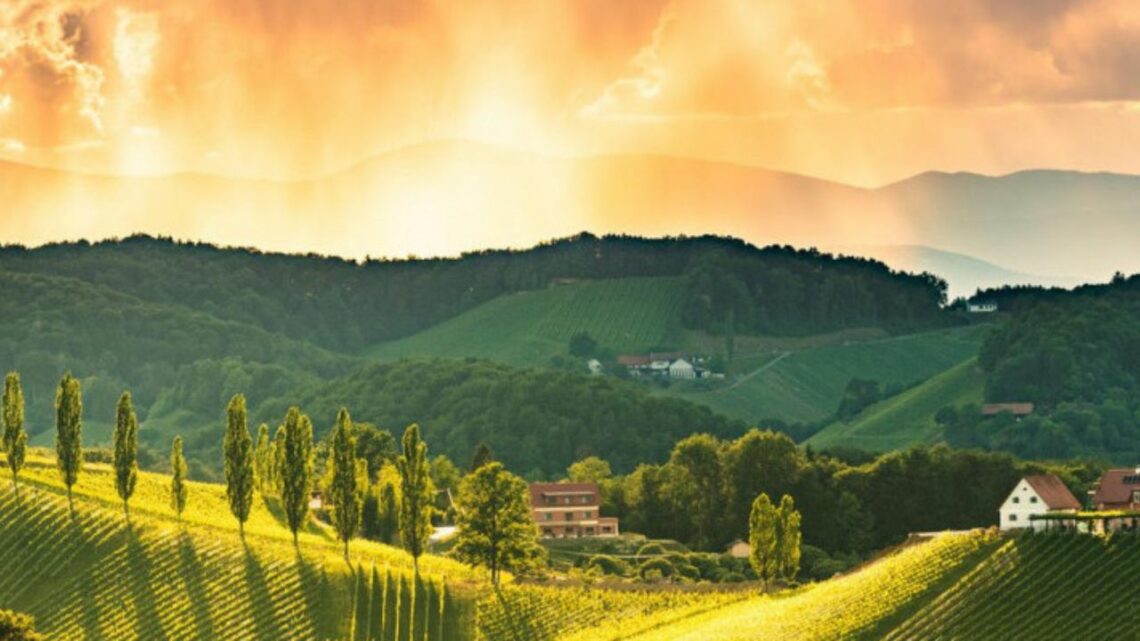
No matter the season, Südsteiermark shines — but autumn is magic. Driving the wine routes along the Slovenian border or through the Sausal hills west of Leibnitz, you quickly understand why this area has such a strong identity.
Villages like Ehrenhausen, Gamlitz, Leutschach, and Kitzeck are all worth a stop — for the views, yes, but especially for the wines.
One important difference compared to other Austrian regions: here, vineyards often sit around the winery itself. Each estate works its own surrounding slopes, which makes it harder to talk about famous standalone vineyard names — but easier to understand a producer’s style as a whole.
Terroir of Südsteiermark : soil and climate
For a relatively small region (around 2,560 hectares), Südsteiermark packs an impressive range of soils.

You’ll find:
- volcanic soils
- schist
- gravelly terraces
- sandy soils washed down from the Alps
- and pockets of limestone
So what’s the takeaway? This diversity gives wines layered aromatics and fine detail rather than sheer power.
Climate does the rest.
Südsteiermark experiences a wide diurnal range — hot days followed by cool nights. That temperature swing helps grapes build aroma during the day, then lock in freshness overnight. Add a mild, humid Mediterranean influence and a long growing season, and you get wines that feel expressive but never heavy.
In the glass, this usually translates to:
- vivid aromatics
- bright acidity
- clarity rather than richness
If you want to dig deeper into why soil plays such a big role in taste, I’ve broken it all down here: How does soil affect the taste of wine? (bookmark it — it’s a game changer).
Grape varieties in Südsteiermark (and what they taste like)
Südsteiermark is, first and foremost, a white wine region.
And at the top of the pyramid sits one grape:
Sauvignon Blanc (the undisputed star)
Südsteiermark Sauvignon Blanc is now internationally recognised — and for good reason.
Expect wines that feel:
- aromatic but not tropical
- precise rather than plush
- driven by freshness and tension
Think citrus, herbs, stone fruit, sometimes a smoky or flinty edge — always with energy.
The supporting cast (and why they matter)
Alongside Sauvignon Blanc, you’ll regularly encounter:
- Welschriesling – light, crisp, refreshing
- Pinot Blanc (Weissburgunder) – subtle, elegant, quietly complex
- Morillon (Chardonnay) – structured but never heavy
- Pinot Gris (Grauburgunder)
- Riesling
- Muscat Blanc à Petits Grains
- Traminer
Together, these grapes form the backbone of Südsteiermark DAC wines
Südsteiermark DAC (how to read the label)
Südsteiermark DAC has existed since the 2018 vintage, and in many ways it simply put official rules around what southern Styria was already famous for.
Today, Sauvignon Blancs from Südsteiermark are internationally renowned, so it’s no surprise that the DAC formalised the region’s strengths rather than reinventing them. The appellation allows a broad but coherent range of grape varieties: Welschriesling, Pinot Blanc (Weissburgunder), Morillon (Chardonnay), Pinot Gris (Grauburgunder), Riesling, Muscat Blanc à Petits Grains (Gelber Muskateller), Sauvignon Blanc, Traminer, and blends of these grapes.
Like the other Styrian DACs, Südsteiermark follows a three-tier system.
Gebietswein represents the broader regional expression, with a state control number required from January 15th of the year following the harvest — except for Welschriesling, where the application can already be made from December 1st of the harvest year.
Ortswein designates wines from specific villages or localities, and the state control number can be applied for from April 1st of the year following the harvest.
At the top, Riedenwein highlights single-vineyard wines, with the state control number available from May 1st of the year following the harvest.
Residual sugar rules are clear and consistent across the DAC.
For Gebietswein, Ortswein, and Riedenwein, the maximum residual sugar is 4.0 g/l. In addition, Riesling and Traminer must always be labelled “trocken” (dry) at Gebietswein and Ortswein level. At Riedenwein level, Muscat Blanc à Petits Grains and Traminer must also correspond to the “trocken” designation. The aim is precision and freshness rather than sweetness, even for aromatic varieties.
One of the most helpful parts of the Südsteiermark DAC is how clearly each village signals its preferred grapes, especially at Ortswein level.
Kitzeck-Sausal focuses on Sauvignon Blanc and Riesling. Eichberg and Leutschach highlight Sauvignon Blanc and Muscat Blanc à Petits Grains. Gamlitz is centred on Sauvignon Blanc and Gelber Muskateller, while Ehrenhausen emphasises Sauvignon Blanc and Morillon (Chardonnay).
This village-by-village focus helps you understand what each place wants to express as its signature style, rather than leaving you guessing.
And if you visit in autumn, you might also spot Junker on labels — youthful, early-released wines that celebrate the arrival of the new vintage.
If you love Sauvignon Blanc with tension and clarity, Südsteiermark is your safe zone — start with the village name to fine-tune the style, and trust that the DAC keeps everything fresh, precise, and dry.
Wineries in Südsteiermark
Now to the wineries!
These are producers that truly show what Südsteiermark is capable of — especially when it comes to Sauvignon Blanc and terroir-driven whites.
Georgiberg
Georgiberg is all about clean, precise, fruit-driven wines — the kind that make Südsteiermark so easy to love.
Their wines, particularly from the Wielitsch site, are straightforward in the best sense of the word: fresh, expressive, and very pure.
If you want a clear introduction to the region’s style without any make-up or tricks, Georgiberg is a very safe (and very good) place to start.
Gross
Run by brothers Johannes and Michael Gross, this estate is one of the region’s benchmarks.
Their flagship site, Nussberg, delivers wines with real depth and ageing potential. Fermentations happen in temperature-controlled stainless steel, mostly with natural yeasts, and the top wines age in large casks.
What does that mean in the glass? Sauvignon Blancs that combine aromatic clarity with structure — wines that don’t just impress young, but evolve beautifully over time.
Jaunegg
Jaunegg is one of the region’s rising stars.
After taking over the family estate in 2002, the team focused on making dense, complex whites with real substance. Their key vineyard, Knily, produces wines that feel serious and layered.
If you like Sauvignon Blanc with texture and grip (not just aromatics), Jaunegg should be on your radar.
Lackner-Tinnacher
Organic since 2012, Lackner-Tinnacher is a masterclass in terroir expression. (one of my favourite wineries by the way)
Most wines come from single vineyards, all aged in large casks. Each site brings a different personality:
- Steinbach: light, sandy and gravelly soils → lift and finesse
- Eckberg: marl and limestone → structure and tension
- Welles: ventilated gravel and sand → freshness and clarity
- Flamberg: pure limestone → precision and ageing potential
Vinification avoids botrytis, includes up to 24 hours of skin contact, and uses warm fermentation with natural yeasts (sometimes lasting up to four months). Wines age on fine lees without stirring.
The result? Exceptionally clear, long-lived wines that feel calm, focused, and quietly powerful.
Maitz
Maitz leans toward barrel ageing for its whites — but without ever letting oak dominate.
Their two standout sites tell two different stories:
- Schusterberg: more delicate, restrained, elegant
- Hochstermetzberg: creamier, broader, more generous
If you like comparing vineyard expressions side by side, Maitz is a great lesson in how site really matters in Südsteiermark.
Erwin Sabathi
Run by brothers Christoph, Gert, and Erwin, this is a large organic estate with serious ambition.
They own and lease a vast number of vineyards and are particularly known for their Sauvignon Blanc, especially Pössnitzberg Alte Reben — a wine with depth, energy, and impressive ageing potential.
Their Chardonnay (Morillon) is equally worth attention: structured, balanced, and far from generic.
Sattlerhof
Sattlerhof is another Sauvignon Blanc reference point.
Two key sites define the style:
- Sernauberg Pfarrweingarten: fossil limestone with loamy sands → tension and minerality
- Kranachberg: gravel and sand → aromatic lift and freshness
The wines feel precise and gastronomic — the kind you want at the table rather than just as an aperitif.
Skoff Original
A large organic estate working with 13 single vineyards, Skoff Original focuses on careful parcel selection and restrained winemaking.
White wines undergo up to 24 hours of maceration, which adds aromatic depth without heaviness. Expect perfumed, elegant styles, especially in:
- Morillon Grassnitzberg
- their range of Sauvignon Blancs
The Obegg vineyard, particularly the Hochsulz wines, really stands out for its balance and finesse.
Tement
One of the pioneers of modern Südsteiermark, another of my favourites!
Around 60% of production is Sauvignon Blanc, and the legendary Zieregg vineyard — right on the Slovenian border — is the estate’s crown jewel. Its mixed soils (loam, limestone, blue clay) give wines with remarkable depth and tension.
The Grassnitzberg sites add warmer sandy loams over eroded limestone, while Morillon comes from Zieregg, Sulz, and Muschelkalk.
If you want to understand why Südsteiermark Sauvignon Blanc is world-class, Tement is essential.
Conclusion : Südsteiermark wines
So — what kind of wine is Südsteiermark famous for?
Fresh, aromatic, high-precision white wines, led by Sauvignon Blanc.
This is a region where soil diversity, climate contrast, and thoughtful winemaking come together to produce wines that feel alive in the glass — vibrant, focused, and deeply tied to place.
If you love whites with energy rather than weight, detail rather than gloss, Südsteiermark is absolutely a region to know.
And if you’re ready to drink beyond Bordeaux… this is one of Austria’s strongest arguments.
Where to next?
Austrian wines are having a moment — and if you’re wondering where to buy Austrian wine online, I’ve got you. Here are my trusted retailers for great bottles, good value, and ethical sourcing
Want something completely different? Head west for Schilcher: Austria’s most distinctive rosé, with bite, energy, and zero blandness.
Austria is a small country… with huge wine diversity. From peppery Grüner to bold Blaufränkisch and Vienna’s urban vineyards, here’s your guided tour of Austria’s must-know wine regions


You May Also Like
Burgenland wine: Austria’s red + sweet wine powerhouse (Neusiedlersee, Blaufränkisch & DAC guide)
What is Rotgipfler?