Weststeiermark wines
7 minutes read
If you think rosé is always light, fruity, and harmless… Weststeiermark is about to surprise you.
Because this is not your poolside pink.
Weststeiermark is one of the three wine zones of Steiermark (Styria), in southern Austria — and it’s the most distinctive, the most rebellious, and arguably the most misunderstood of the three.
This is the home of Schilcher, a rosé with bite, tension, and attitude. A wine that divides opinions — and that’s exactly why it’s interesting.
In this post, I’ll walk you through:
- what makes Weststeiermark DAC unique
- why Schilcher tastes the way it does
- how soil, climate, and altitude shape the wines
- and which producers really capture the soul of the region
By the end, you’ll know whether Weststeiermark wines are your thing — and how to spot the good ones.
Weststeiermark DAC is the most distinctive wine appellation in Styria, Austria, and the only region allowed to grant protected designation of origin to Schilcher. Located on the foothills of the Koralpe and Reinischkogel mountains, Weststeiermark is shaped by crystalline gneiss and schist soils, high altitude, and a wet Illyrian climate with Mediterranean influences. These conditions produce wines with high acidity, freshness, and precision. Blauer Wildbacher dominates plantings and is the base for Schilcher, a dry, structured rosé with strong personality, as well as rare sparkling, red, and sweet wines. The Weststeiermark DAC, introduced in 2018, also includes typical Styrian white varieties, with Sauvignon Blanc playing an important role at the Ortswein level. Key producers include Langmann, Domäne Müller, and Strohmeier.
Weststeiermark overall presentation
Weststeiermark is the smallest of Styria’s wine regions — but don’t let the size fool you.
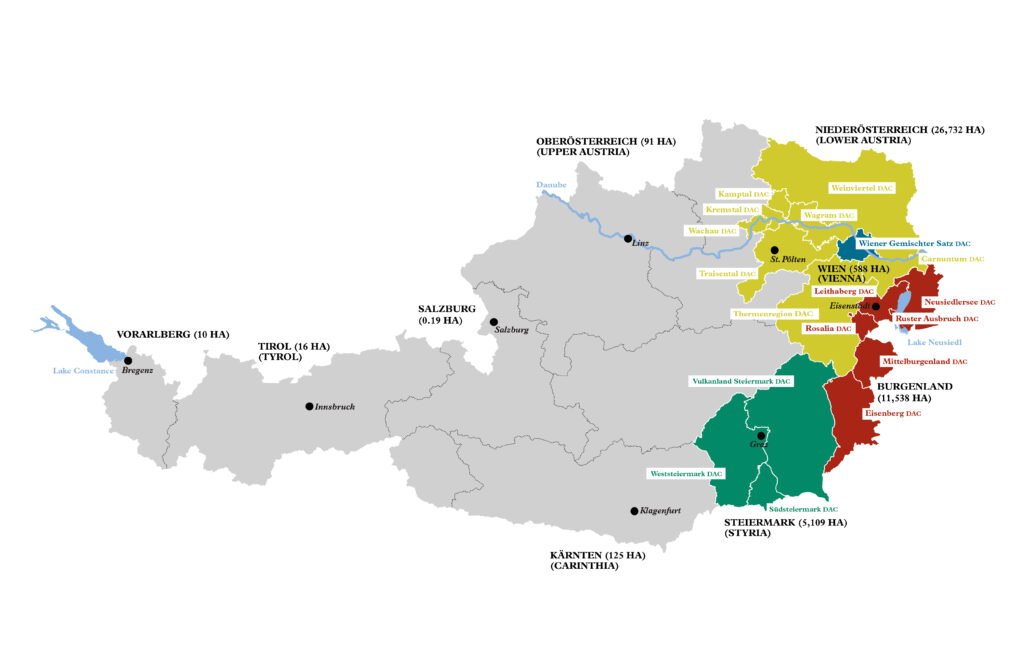
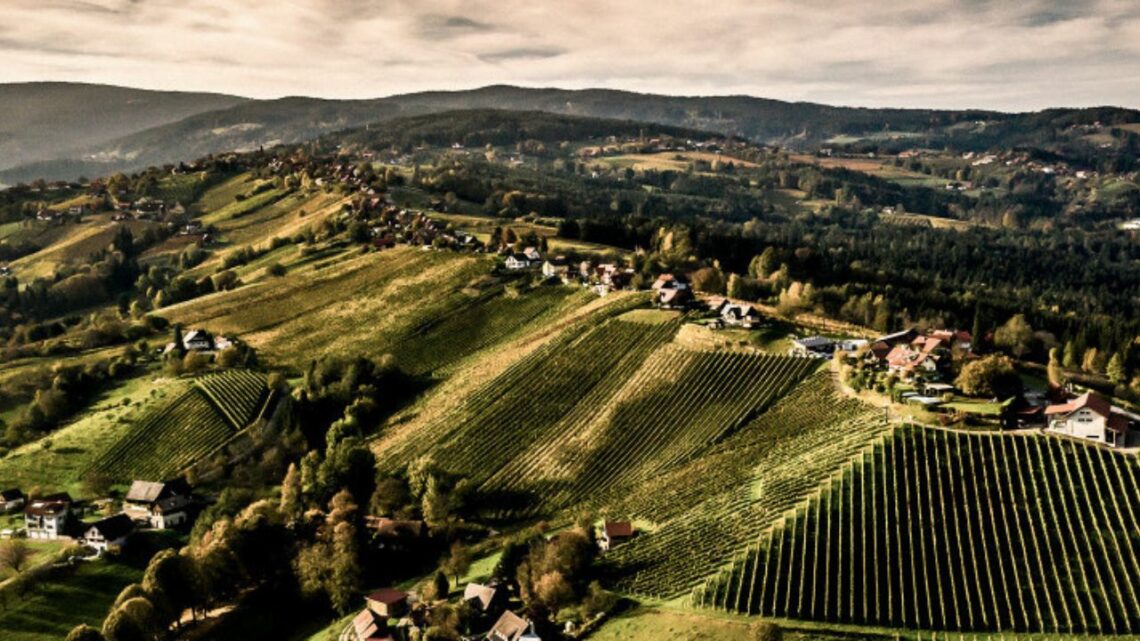
Wine has been grown here for a very long time. Illyrians, Celts, and later the Romans all cultivated vines in this rugged landscape. Today, vineyards stretch in a long, narrow band at the foothills of the Koralpe and Reinischkogel mountains, climbing up to 600 meters in altitude and running all the way to the Slovenian border.
This geography matters.
Steep slopes mean strong daytime warming, while the surrounding mountains protect vineyards from cold winds. The result? Grapes that ripen slowly but steadily, keeping freshness while developing real character.
If you like combining wine with the outdoors (which, honestly, Austria does brilliantly), this is a dream area. Villages like Greisdorf, Gundersdorf, Wildbach, and Wies offer great hiking routes — and some very rewarding wine stops along the way.
And then there’s the grape that defines the region.
Blauer Wildbacher is the undisputed star of Weststeiermark.
So much so that the region used to be called Schilcherland until 2019.
This grape is incredibly versatile: it can produce elegant sparkling wines, tannic reds, and refined sweet wines. (The sparkling and sweet versions are rare and are labeled simply as “Steiermark”.)
But its most famous expression is something very specific — and very local.
Terroir of Weststeiermark: soil and climate (and why it matters)
Weststeiermark sits on hard crystalline rocks from the Austro-Alpine zone.
In practical terms, that means soils dominated by gneiss and schist, often acidic, with very good drainage.
You don’t need to remember the geology lesson — just the takeaway: these soils naturally limit vigor and push the vines to struggle a little. That struggle translates into wines with high acidity, precision, and tension rather than richness.

Climate adds another layer.
The region is protected by the Koralpe mountains to the west and benefits from what’s called an Illyrian climate — Mediterranean influences combined with significant rainfall.
So what does that mean in the glass?
- plenty of freshness
- vibrant acidity
- wines that feel sharp, lively, and refreshing, not soft or rounded
This combination of cool altitude, crystalline soils, and wet conditions is exactly why Weststeiermark wines taste the way they do — especially Schilcher.
Grape varieties in Weststeiermark
Weststeiermark is a patchwork of small vineyards, and one grape clearly dominates.
Blauer Wildbacher covers 333 hectares out of the region’s 550 hectares.
This late-ripening grape is the backbone of Schilcher and one of the reasons the wines keep such intense freshness. It’s usually vinified in stainless steel, with little to no malolactic fermentation — which helps preserve acidity and that signature “zing”.
So what should you expect from Schilcher?
- a striking pale pink, almost shimmering colour
- high acidity
- a dry, structured mouthfeel
- a style that feels more like a serious wine than a casual rosé
Schilcher has been around for centuries — written references go back to the 16th century — and it has always been a wine with personality.
Alongside Blauer Wildbacher, you’ll also find:
- Weissburgunder (Pinot Blanc)
- Chardonnay
- Welschriesling
- Sauvignon Blanc
- Zweigelt
But make no mistake: this is Blauer Wildbacher territory.
Weststeiermark DAC
Weststeiermark DAC has existed since the 2018 vintage, and its creation officially recognised what makes this corner of Styria truly different from the rest.
Quite simply, Weststeiermark is the only region in Styria allowed to grant a protected designation of origin to Schilcher, the local rosé made from Blauer Wildbacher. That’s a big deal — it firmly anchors Schilcher to its place of origin and makes it impossible to confuse with a generic rosé style.
Alongside Schilcher, the DAC also covers a broad range of typical Styrian white grape varieties, with Sauvignon Blanc playing an especially important role, particularly at village level.
The permitted grape varieties for Weststeiermark DAC include Blauer Wildbacher (Schilcher), Welschriesling, Pinot Blanc (Weissburgunder), Morillon (Chardonnay), Pinot Gris (Grauburgunder), Riesling, Muscat Blanc à Petits Grains, Sauvignon Blanc, Traminer, and blends of these grapes.
Aside from Schilcher, Weststeiermark follows a three-tier system.
At the regional level, Gebietswein represents the broader expression of the area and requires a state control number from January 15th of the year following the harvest. There are two exceptions: for Welschriesling and Schilcher, the application can already be made from December 1st of the harvest year.
Ortswein designates wines from specific villages or localities. Here, the state control number can be applied for from April 1st of the year following the harvest, except again for Schilcher, where the application starts earlier, from February 1st of the year following the harvest.
At the top of the pyramid, Riedenwein highlights single-vineyard wines, with the state control number available from April 1st of the year following the harvest, and once more February 1st for Schilcher.
Residual sugar rules are simple and strict: across all categories, the maximum allowed residual sugar is 4.0 g/l, reinforcing the region’s crisp, dry style. Riesling and Traminer must always be labelled “trocken” (dry), and at Riedenwein level, Muscat Blanc à Petits Grains and Traminer must also correspond to the “trocken” designation. This keeps even the more aromatic grapes firmly in a fresh, precise register.
At Ortswein level, villages clearly signal what they do best. Ligist, Stainz, and Deutschlandsberg all focus on Blauer Wildbacher (Schilcher) and Sauvignon Blanc, as does Eibiswald. This village-by-village emphasis helps you understand the local character straight from the label and reinforces the idea that these wines genuinely belong here.
If you see Weststeiermark DAC on a label, it’s a guarantee of origin — Schilcher that truly comes from its home, and crisp Styrian whites (especially Sauvignon Blanc).
Wineries in Weststeiermark
Here are a few producers that really capture the spirit of the region:
Langmann
Langmann is a benchmark for Schilcher, working with two distinct single vineyards. Precision, consistency, and deep respect for the grape — these are wines that show how serious Schilcher can be.
Domäne Müller
Best known for its excellent Sauvignon Blanc, Domäne Müller also made history by producing the first Schilcher Trockenbeerenauslese (TBA) in 2000 — proof that Blauer Wildbacher can go far beyond rosé.
Strohmeier
One of my personal favourites. Strohmeier makes classic Schilcher, but also a brilliant sparkling version called Lestein, grown on loam soils. Add to that an intense Weissburgunder, and you get a producer who plays with style while staying deeply rooted in place..
Conclusion : Weststeiermark wines
Weststeiermark may be small, but it has one of the strongest identities in Austrian wine.
This is a region shaped by altitude, crystalline soils, and a wet Illyrian climate — all of which push wines toward freshness, acidity, and precision rather than power.
Blauer Wildbacher defines the region, especially through Schilcher: a rosé that is anything but neutral. High-acid, structured, and unapologetically different, it’s a wine you either learn to love — or never forget.
With the introduction of Weststeiermark DAC, the region finally got formal recognition for what it has always been: a place that does its own thing, on its own terms.
If you like wines with energy, edge, and real personality — and if you’re ready to drink beyond Bordeaux — Weststeiermark deserves your attention.
Where to next?
How does soil affect the taste of wine?
Want to go deeper on why these wines taste this way? This guide breaks down how different soils change texture, freshness, and aromatic profile — and once you read it, you’ll never look at a wine label the same way again.
Steiermark wines: a complete guide
Curious how Weststeiermark compares to the rest of Styria? If this post made you realise Styria isn’t just “Austrian Sauvignon Blanc”, you’ll enjoy the full picture here: Fresh whites, volcanic soils, steep vineyards — and why this region plays by its own rules.
Austrian wines are having a moment — and if you’re wondering where to buy Austrian wine online, I’ve got you. Here are my trusted retailers for great bottles, good value, and ethical sourcing


You May Also Like
Why are Austrian wines not as well known as of other countries?
Wine Tourism In Wachau For Grüner Veltliner Enthusiasts