Rosalia Wines in Austria: Blaufränkisch, Rosé & DAC Explained (Terroir + Best Producers)
7 minutes read
Have you ever clicked on an Austrian wine region and thought… wait, should I know this one?
That’s exactly what happens with Rosalia.
It’s officially “new” (it only became a wine-growing area in 2018) — but the wines don’t feel new at all. They feel confident. They feel sunny. They feel like the kind of reds and rosés you open with friends and suddenly go: why aren’t we drinking this more often?
Here’s what you’ll get from this post:
- what Rosalia tastes like (and why)
- what the terroir actually changes in the glass
- what Rosalia DAC means
- and which wineries to look for when you want the real thing
In short: you’ll know how to spot rosalia wines in austria with confidence — and yes, that’s a wine superpower.
Rosalia wines in Austria come from Burgenland and officially became a wine-growing area in 2018, but the region’s winemaking history dates back over 2,500 years. Rosalia is known for full-bodied red wines and fruity, refined rosés, shaped by a warm Pannonian climate and young mineral-rich sediments from a prehistoric sea. Soil types range from gravelly to highly calcareous, creating distinct wine styles across the region. Blaufränkisch dominates vineyards (60%), producing robust reds with fruity and spicy notes, while rosé—often made from Blaufränkisch—offers a fresh, fruit-forward profile. Rosalia DAC ensures quality standards and includes a signature Rosalia DAC Rosé described as fruity, fresh and spicy. Recommended wineries include Weingut Migsich, Domaine Pöttelsdorf, Weingut Piribauer, Weingut Alfred Fischer, Weingut Lassl, Weingut JbN, Weingut Waldherr, Weingut Döller, Weingut Franz Steiger and Vinum Rosali..
Rosalia overall presentation
Rosalia is one of Burgenland’s DAC regions — and Burgenland, if you don’t know it yet, is basically Austria’s sunshine corner for wine.
Geographically, it sits as the southwest extension of Leithaberg, and in the northern part of Rosalia, Blaufränkisch really shines — giving wines with depth and length (aka the kind of reds that stay with you long after the sip).
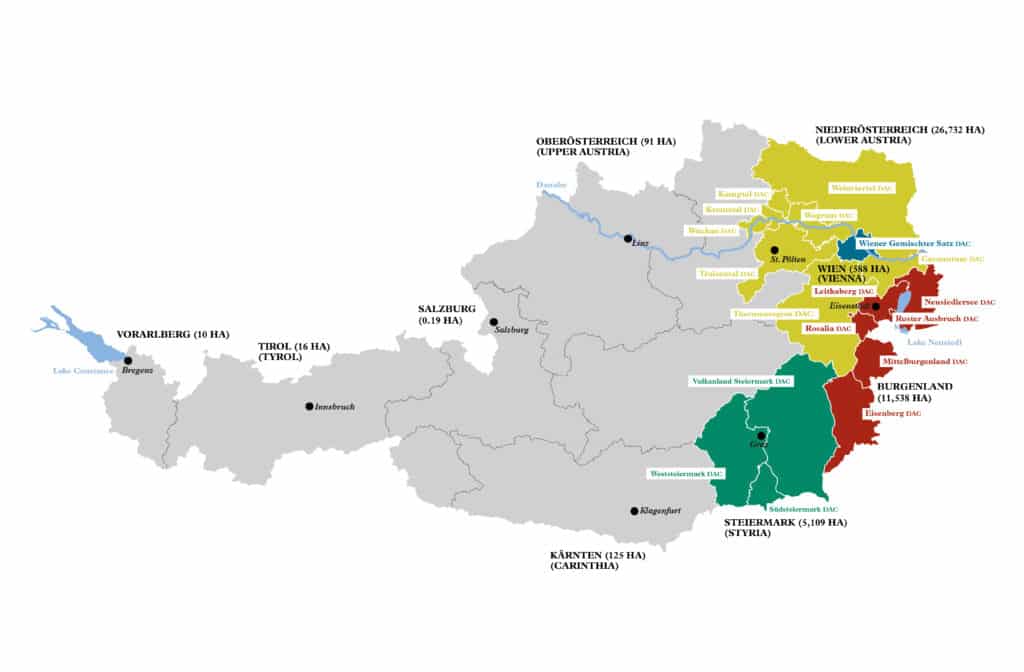
Rosalia might have “migrated” in 2018 from a major climate zone to an official wine-growing area — but make no mistake: wine is not new here.
Over 2,500 years ago, the Celts already recognised the potential of this region for vine cultivation.
Today, 297 hectares are dedicated to vineyards, producing mostly full-bodied, spicy red wines and fruity, refined rosés.
Rosalia is a very “drinkable” region — you go there for reds with substance, and rosés with real flavour (not bland summer water).
Terroir of Rosalia: climate and soil
Rosalia wines in Austria get their style from two things working together:
- the Pannonian climate
- and geologically young sediments from a prehistoric sea
That mix creates very favourable conditions for growing grapes — and it also explains why Rosalia wines often feel both ripe and fresh.

The southwest part of the region consists of crystalline rocks, followed by progressively younger Neogene sediments from the Vienna Basin towards the northeast. The sequence begins with coarse blocks in a sandy and clayey binder, covered by gravelly sandy and clayey sands.
These formations support vineyards in the south and west of Mattersburg and near Draßburg. Lower-lying areas such as Walbersdorf, Marzer Kogel, and Schattendorf also sit on these sediments — remnants of an ancient sea where waves crashed against the foothills of the Rosalia range 16 to 12 million years ago.
Towards the north and northeast, you find a band of relatively newer predominantly sandy sediments, followed by even younger sandy sediments linked to the deposits of the ancient Pannonian Lake. In these areas, vineyards in Pöttelsdorf, Sigleß, Bad Sauerbrunn, and the northern vineyards of Antau thrive.
Gravel-dominated vineyard soils are rare, except in the vicinity of Neudörfl and Baumgarten.
In southern crus, soils alternate between slightly calcareous and calcareous. Central and northern crus, on the other hand, are predominantly highly calcareous.
So what’s the point of all this?
It means Rosalia doesn’t give one single style. Depending on whether the soils are sandy, gravelly or calcareous, wines can feel:
- more lifted and fruity (often with sandier soils)
- more structured and intense (often with heavier soils)
- more “precise” and mineral (often with more calcareous influence)
If you want the deeper “why”, I cover it here: how soil affects the taste of wine.
Grape varieties in Rosalia
Blaufränkisch clearly dominates Rosalia, covering 60% of the vineyard area, followed by Zweigelt.
Heavy soils yield robust wines with typical fruity, spicy and fine notes of the region.
And rosé matters here too — a lot.
In a nutshell, Rosalia is a dream region if you like reds with spice AND rosés with flavour.
Rosalia DAC
Rosalia is one of Austria’s younger DAC regions, and it officially came into focus between 2017 and 2018, making it a relatively new addition to the DAC landscape.
Geographically, it helps to think of Rosalia as the south-western extension of Leithaberg, sharing some of the same climatic and geological influences, but with its own, slightly lighter-footed personality.
Rosalia has two related appellations
Since its creation, Rosalia has worked with two related appellations: Rosalia DAC for red wines, and Rosalia DAC Rosé, both designed to highlight the region’s red grape heritage in different ways.
For Rosalia DAC (red wines), the permitted grape varieties are Blaufränkisch and Zweigelt, the local red stars of the area. Wines can also include other red grape varieties classified as Qualitätswein, as long as the rules are respected.
These wines must apply for a state control number from January 1st of the year following the harvest, and they must reach a minimum alcohol level of 12.0%, ensuring ripeness and body.
In terms of style, Rosalia DAC reds are dry, with residual sugar capped at 4 g/l, and they’re known for being fine, fruity, spicy, and aromatically complex, rather than heavy or overworked.
The DAC Rosé appellation
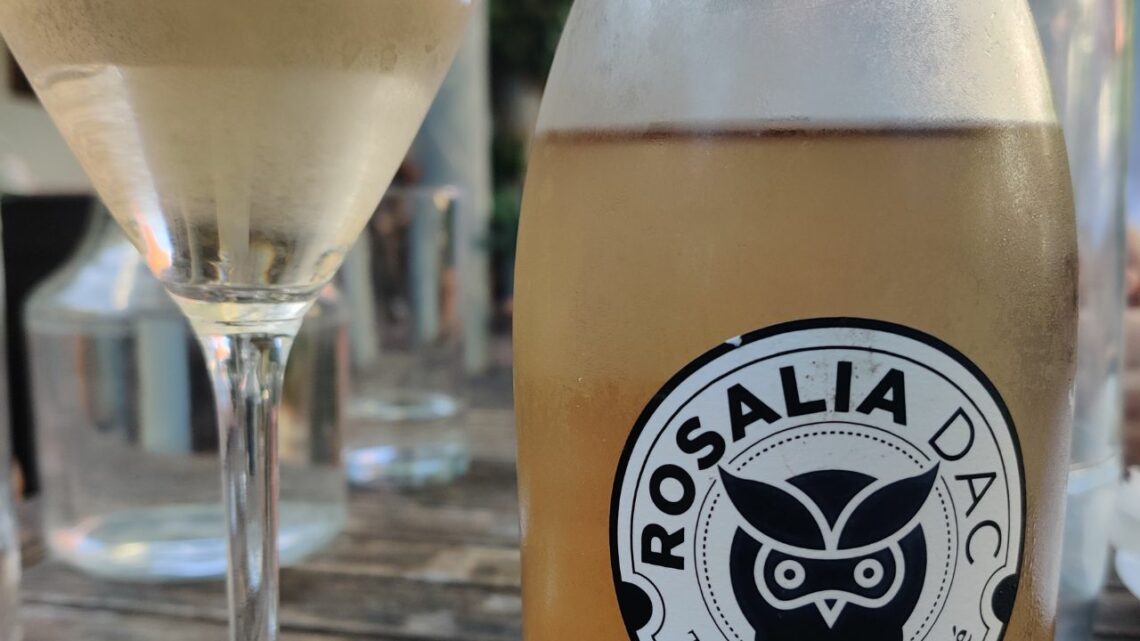
Alongside this, Rosalia also has a dedicated Rosalia DAC Rosé appellation. These rosés can be made from one or more red grape varieties authorised as Qualitätswein, giving producers flexibility while keeping quality high. Like the reds, Rosalia DAC Rosé wines require a state control number from January 1st of the year following the harvest and are explicitly labelled as dry. In the glass, the style is very clear and very local: fresh, fruity, and gently spicy, which is exactly the typical character of the area.
For wines of higher ambition, the designation Rosalia DAC Reserve can be used. These wines require a state control number from November 1st of the year following the harvest and must reach a minimum alcohol level of 13.0%, signalling a more powerful and concentrated expression. Unlike the classic DAC wines, Rosalia DAC Reserve does not have specific residual sugar requirements, allowing more freedom in winemaking choices while still staying true to the region.
If you like reds that are spicy and expressive without being heavy — or dry, refreshing rosé with real character — Rosalia is an easy pick: Zweigelt and Blaufränkisch for reds, and rosés that stay crisp, dry, and full of personality..
Wineries in Rosalia
Here are the wineries recommended by Falstaff:
- Weingut Migsich
- Domaine Pöttelsdorf
- Weingut Piribauer
- Weingut Alfred Fischer
- Weingut Lassl
- Weingut JbN
- Weingut Waldherr
- Weingut Döller
- Weingut Franz Steiger
- Vinum Rosali
Conclusion : Rosalia wines
So… Rosalia might have become an official wine-growing area only in 2018, but let’s be very clear: this is not a “newbie” region. Rosalia has over 2,500 years of winemaking history, and today its 297 hectares of vineyards focus on exactly the kind of wines you want on your table: full-bodied reds and fruity rosés.
The region’s style comes straight from its terroir: a warm Pannonian climate combined with young sedimentary soils from a prehistoric sea — basically the perfect setup for grape growing. And the geology here is anything but boring: you get a region that can produce wines with real personality.
No surprise then that Blaufränkisch dominates here, covering 60% of the vineyard area, followed by Zweigelt. Those heavier soils help produce wines that feel robust, with the region’s typical signature: fruit, spice, and finesse. And rosé is not an afterthought either — it plays a genuinely important role in Rosalia.
Rosalia’s identity is also protected through the Rosalia DAC classification. Wines can include not only the main grape varieties but also other common red grapes permitted for Qualitätswein — and the result, especially the Rosalia DAC Rosé, is exactly what you’d hope for: fruity, fresh, and spicy.
If you want to start exploring Rosalia wines in Austria, you’re spoiled for choice. Falstaff recommends several wineries worth putting on your radar: Weingut Migsich, Domaine Pöttelsdorf, Weingut Piribauer, Weingut Alfred Fischer, Weingut Lassl, Weingut JbN, Weingut Waldherr, Weingut Döller, Weingut Franz Steiger, and Vinum Rosali.
In short: Rosalia looks “new” on paper… but in the glass? It’s confident, expressive, and incredibly easy to love. If you want reds with spice and depth, and rosés that actually taste of something, Rosalia wines in Austria are a brilliant place to start.
Where to next?
Burgenland is Austria’s sunshine region: bold reds, legendary sweet wines, and terroirs that change everything from one hill to the next.
If Rosalia feels juicy and fruit-forward (especially in rosé), Leithaberg is its sharper, more mineral cousin — and yes, Blaufränkisch lovers will be very happy there.
How does soil affect the taste of wine?
Ever wondered why two wines from the same grape can taste wildly different? Spoiler: it’s what’s under your feet.


You May Also Like
Sustainable And Organic Blaufränkisch Producers In Burgenland
The Impact Of Terroir On Grüner Veltliner Production