Best Leithaberg wines
11 minutes read
Let me guess why you’re here.
You’ve heard Burgenland is Austria’s warm, generous wine playground — reds, sweet wines, sunshine, Lake Neusiedl fog magic… the whole package.
But now you keep seeing one name pop up when people talk about the most mineral, structured and elegant side of Burgenland: Leithaberg.
And you’re wondering:
- What makes Leithaberg wines different from the rest of Burgenland?
- Why is Blaufränkisch so exciting here?
- And most importantly… what are the best Leithaberg wines to try?
Perfect. This is exactly what we’re doing today.
Because Leithaberg is where Burgenland gets a little more serious (in the best way): cooler climate, limestone and schist soils, and wines that keep their freshness even when the sun is doing the most.
In this guide, I’ll walk you through the region, its terroir (with the “so what” in the glass), its grape varieties, the Leithaberg DAC rules — and then we’ll get to the fun part: the best wineries to know.
Glass in hand. Let’s head west of the lake!
If you’re looking for the best Leithaberg wines, here’s the shortcut: Leithaberg is one of Burgenland’s most exciting wine areas, located west of Lake Neusiedl, and known for mineral, structured wines — especially Blaufränkisch with extra freshness thanks to the region’s cooler climate. The magic comes from the soils: Leithaberg mixes fossil limestone (its signature), with pockets of schist and acidic gneiss, plus well-drained loams, sands, clays and gravels in the lower areas. Result? Reds with lift, tension and elegance. Leithaberg covers 3,097 hectares and grows mainly Blaufränkisch (sometimes blended with Zweigelt, St. Laurent or Pinot Noir), plus whites like Pinot Blanc, Chardonnay, Grüner Veltliner and Welschriesling. The Leithaberg DAC (since 2010) requires at least 85% Blaufränkisch and oak ageing. Key producers include Kollwentz, Prieler, Altenburger, Braunstein, Triebaumer (ET) and Heidi Schröck.
Quick context: where Leithaberg fits in Burgenland
If you’ve already read my full guide to Burgenland wines, you know one thing: this region can feel like several wine regions in one trench coat.
That diversity mostly comes down to terroir:
- around Neusiedlersee, shallow water + autumn mists + noble rot (botrytis) create ideal conditions for outstanding sweet wines
- while the slopes of Leithaberg, Eisenberg and Mittelburgenland, with their limestone, clay and schist soils (good water retention + drainage), are a playground for red wines

Each area has its signature:
- Mount Eisenberg = elegant Blaufränkisch
- Mittelburgenland + north Rosalia = Blaufränkisch with depth and length
- eastern slopes of the Leitha mountain = complex white wines + Blaufränkisch
- Seewinkel = sweet wines, especially Welschriesling
If you want the full deep dive, I break down all Burgenland zones here: https://dianewinevoyage.com/burgenland-wines/
Now… let’s zoom into the one that delivers the most mineral energy and fresh structure: Leithaberg.
Terroir of Leithaberg: soil and climate
So what makes Leithaberg feel so different in the glass?
It all comes down to what’s under the vines — and yes, Leithaberg is one of those regions where geology actually matters (in a delicious way).
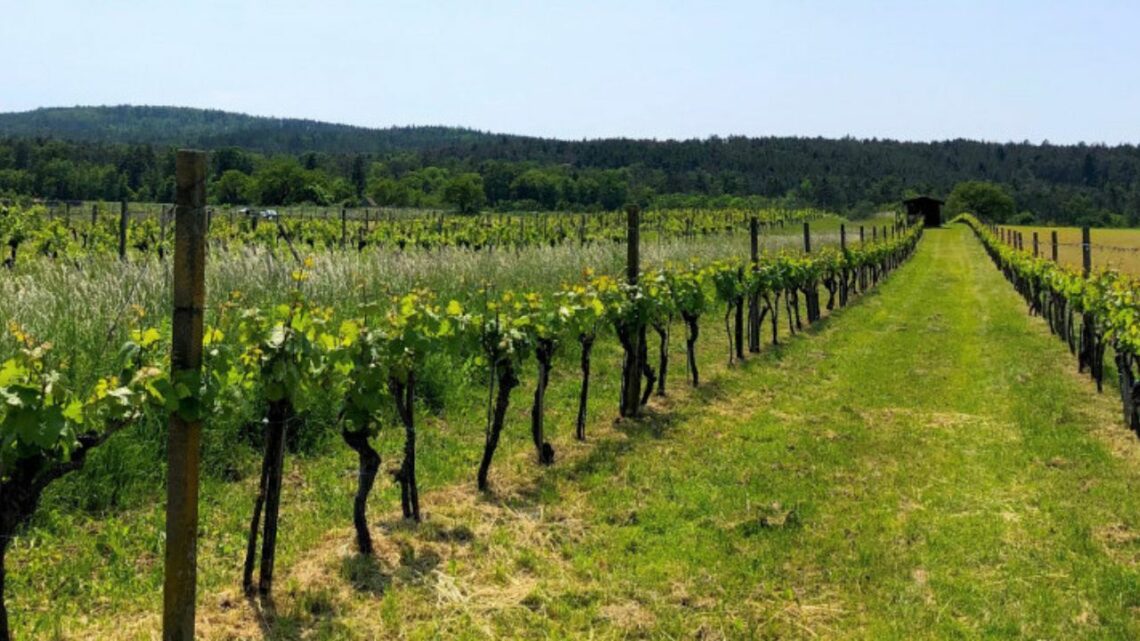
I’ve spoiled things a bit for you already: the Leitha Mountain is primarily made of fossil limestone, but as you climb higher, you start running into completely different formations — schist and gneiss. That contrast (limestone vs acidic rock) is one of the secrets behind the region’s mineral, structured style.
Anecdote: the “cooler Leithaberg” effect
And it’s not just soil. According to Hans Nittnaus, a renowned winemaker, Leithaberg has a cooler climate than the Neusiedlersee region across the lake, which results in Blaufränkisch wines with slightly higher acidity.
That extra acidity is exactly what gives Leithaberg Blaufränkisch its energy — that lift and precision that makes you want another sip.

The bedrock story (in a Leithaberg nutshell)
The oldest rocks in the area are the acidic schists and gneisses of the Austro-Alpine region. They form the central part of the Leitha Mountain and host the highest vineyards, located between Breitenbrunn and Donnerskirchen, as well as some isolated vineyards around Eisenstadt and Oslip.
However, the most characteristic rock in the area is the Leitha limestone.
Its origin dates back to the calm, shallow waters of a warm sea that surrounded the Leitha Mountain 16 to 11 million years ago, creating optimal conditions for small reefs.
Leitha limestone is a hard and light-colored limestone composed of algae and rich in remains of marine organisms such as shells, snails… and even sharks.
It contrasts sharply with the slightly older, quartz-rich and sandy gravel of the Rust chain.
Separated from the Leitha limestone by tectonic shifts, these two very different bedrocks coexist closely, creating vineyard soils that alternate between acidic and limestone profiles — and that’s exactly why Leithaberg wines can feel both structured and so mineral.
Lower areas: the “easy-draining” gift
In the lower-lying areas, vineyards are established on:
- loose loams
- sands
- often limestone gravels of the Pannonian Basin
- as well as clays, lacustrine clays
- and gravelly river sediments
These are mostly well-drained soils — which is great for red wines.
So… what does this mean in the glass?
Okay — quick pause before your eyes glaze over from words like “gneiss” and “tectonic shifts”
Here’s the real takeaway: Leithaberg’s terroir isn’t geology for the sake of it. It’s the reason these wines taste the way they do.
Because the region combines limestone-rich slopes with pockets of schist and acidic gneiss, plus those well-drained loams, sands and gravels in the lower areas, Leithaberg wines often deliver that rare combination of:
- freshness and lift (thanks to the cooler climate and higher acidity)
- mineral tension (hello limestone + schist)
- structure without heaviness (especially in Blaufränkisch)
- and a kind of quiet, salty elegance that makes the wine feel “serious”… but still incredibly drinkable
In short: Leithaberg reds aren’t big, jammy, loud wines. They’re more the “polished, precise, one-more-glass” kind.
And if you’re wondering why two Blaufränkisch bottles can taste completely different even within the same area… the answer is often simply: what’s under the vines. Want to experience it yourself? Try opening two bottles of Heinrich side by side : same winemaker, same grape…different soils
If you want the fun deep dive (without turning it into a geology exam), I wrote a full guide here: How does soil affect the taste of wine?
Grapes for Leithaberg wines
Leithaberg covers an area of 3,097 hectares and is known for producing wines from grape varieties such as Blaufränkisch, above all.
Blaufränkisch wines can also be blended with:
- Zweigelt
- St. Laurent
- Pinot Noir
And because Burgenland is the hottest wine region in Austria, this is also where you find international grape varieties (the warm-climate crew), including:
- Merlot
- Cabernet Sauvignon
- Syrah
For white wines, you may encounter:
- Chardonnay
- Grüner Veltliner
- Welschriesling
- Weissburgunder (Pinot Blanc)
Leithaberg DAC
Leithaberg DAC was officially launched in 2010, and it covers a very specific and slightly complex area on the western side of Lake Neusiedl.
The defined production zone includes the administrative district of Eisenstadt and its surroundings, the free city of Freistadt Eisenberg, the municipalities of Jois and Winden, and even certain Ried (single-vineyard) sites within the municipality of Neusiedl am See. It’s a DAC built around geology as much as geography — limestone, schist, and a strong sense of place.
What are the rules of the Leithaberg DAC?
Both white and red wines are allowed under Leithaberg DAC, with clearly defined rules.
For white wines, the permitted grape varieties are Pinot Blanc (Weissburgunder), Chardonnay, Neuburger, and Grüner Veltliner, either as single-varietal wines or blends. These whites can be aged in stainless steel tanks or barrels, depending on the producer’s choice.
For red wines, the focus is firmly on Blaufränkisch: at least 85% Blaufränkisch is required, with up to 15% St. Laurent, Zweigelt, or Pinot Noir allowed. Red wines must be aged in oak barrels.
Both white and red wines must be dry, with residual sugar below 2.5 g/L. Across the board, minimum alcohol is 12.5%, and in practice most wines fall between 12.5% and 13.5%, as indicated on the label.
Timing and style rules add another layer of precision.
For white Leithaberg DAC wines, a state control number can be applied for from May 1st of the year following the harvest.
Red wines, because of their mandatory oak ageing, are released later and require their state control number from May 1st of the second year following the harvest. In the glass, Leithaberg DAC wines are known for being spicy, elegant, and strongly mineral-driven, with little to no perceptible wood influence, even when oak is used — structure and freshness always come first.
Ruster Ausbruch has its own DAC
One important nuance: the village of Rust lies within the Leithaberg DAC boundaries, but its famous Ausbruch wines are not part of Leithaberg DAC. Instead, they fall under the broader Burgenland appellation.
Rust Ausbruch is a historic and highly respected sweet wine style, with vines first planted around 130 years ago, often compared to Trockenbeerenauslese (TBA). Leading producers — including Heidi Schröck — emphasise the minerality and salty edge of Ausbruch, linked to loamy sand soils with limestone and schist. They also point out that sweet wines from the eastern side of Lake Neusiedl tend to show more explosive tropical fruit flavours, as grapes ripen earlier there.
In 1991, a group of dedicated producers founded the Cercle Ruster Ausbruch, with the aim of protecting, promoting, and defending this exceptional style.
Wineries in Leithaberg
Now, to the wineries! Here are some of the most famous wineries in Leithaberg where quality is usually constant.
Markus Altenburger
Markus took over the winery in 2012 and immediately made major changes, including cutting yields by half.
The flagship wine: “Vom Kalk” (“From the Limestone”) — a direct tribute to the terroir.
Top vineyard: Gritschenberg, exceptional but subject to vintage variation (meaning the quality really depends on the year). It was planted in the 1970s by Markus’ grandfather on limestone soil.
Birgit Braunstein
Practicing biodynamic viticulture since 2001, and deeply passionate about natural wines.
Her Blaufränkisch is aged:
- 8 months in amphorae
- then 24 months in barrels
Her St. Laurent from Goldberg vineyard is known for its elegance.
Feiler Artinger
Famous for magnificent sweet wines — but don’t overlook their Blaufränkisch “Solitaire”.
Their Ausbruch wines are made from:
- Pinot
- Welschriesling
- Muskat Ottonel
Toni Hartl
Produces the single-vineyard Eisner, made from 40-year-old vines on iron-rich Leithaberg soils — one of the top Blaufränkisch wines.
They also produce great Chardonnay from Thenau in the best years.
Kollwentz (THE great producer)
Kollwentz is the reference, or at least my personal crush.
They were the first estate to plant Cabernet Sauvignon in the region.
Many vineyards sit on the southern slopes of Leithaberg, with soils ranging from fossil limestone to deeper loam.
Their most famous white: Tatschler, made from Chardonnay vines planted in 1988 on slate and limestone.
It’s barrel-fermented, undergoes malolactic fermentation, then ages in oak for 15 months.
Another standout: “Gloria”, grown high on Leithaberg on fossil limestone and aged in new barriques.
And yes — I love all their Blaufränkisch wines, including Steinzeiler, a blend of young Blaufränkisch and Zweigelt.
Prieler
Another crush of mine by the way…
Best-known estate in Schützen, with the family taking over the vineyard in 1972.
They practice organic farming and are famous for exceptional Weissburgunder (Pinot Blanc) under Leithaberg DAC.
Their Blaufränkisch wines are excellent too. The Goldberg vineyard, rich in slate, clay, and loam, produces wines with real structure and power.
Heidi Schröck
Heidi took over in 1983 and has produced excellent Ausbruch wines since the 1993 vintage.
These Ausbruch wines are blends of:
- Welschriesling
- Weissburgunder
- Gelber Muskateller
Ernst Triebaumer (ET)
ET makes iconic Blaufränkisch from the Mariental vineyard.
They launched a project to increase bee populations and use sheep for green cover trimming.
Their cellars are powered by solar energy.
Mariental lies north of Rust on limestone soils with vines up to 60 years old.
Another top site: Oberer Wald.
Their Sauvignon Blanc “Vogelsang” is consistently good.
Their superb Ausbruch wine is a blend of:
- Chardonnay
- Welschriesling
- Sauvignon Blanc
Robert Wenzel
A highly traditional Ausbruch producer.
He makes Ausbruch by adding 20% of fresh must of Trockenbeerenauslese (TBA) quality to the botrytised grapes — using must from the same variety as the Ausbruch fruit.
Wenzel has always wanted Ausbruch to be distinct from TBA, especially by fermenting must to relatively high alcohol levels.
In 1984, he was one of the first in Burgenland to replant Furmint, and collaborated with Tokaj’s master winemaker Istvan Szepsy to identify an ancient Tokaj strain. That strain was planted in Rust in 2006.
The estate produces three Furmint wines — the standout is “Saz”, a blend of Furmint and Gelber Muskateller.
These wines are immensely complex, with aromas of quince, peach, mandarin depending on the vintage, plus fine acidity, silky texture and excellent length.
Conclusion : Leithaberg wines
Leithaberg is a wine region in Burgenland, Austria, located mostly west of the Neusiedlersee.
Its terroir is shaped by diverse soils: limestone (the most characteristic rock), along with schist and gravel. Vineyards also extend into lower areas with loams, sands, and clay soils.
The climate is slightly cooler than the Neusiedlersee region, producing Blaufränkisch wines with higher acidity.
Leithaberg cultivates many grape varieties:
- Blaufränkisch (mainly)
- Grüner Veltliner, Welschriesling, Weissburgunder (Pinot Blanc), Chardonnay
- Zweigelt, St. Laurent
- Merlot, Cabernet Sauvignon, Syrah
Leithaberg DAC wines must be aged in oak.
Notable wineries include Markus Altenburger, Birgit Braunstein, Feiler Artinger, Toni Hartl, Kollwentz, Leberl, Prieler, Heidi Schröck, Turner, Rosi Schuster, Erwin Tinhof, Ernst Triebaumer (ET), and Robert Wenzel.
Where to next?
Austria is a small country… with huge wine diversity. From peppery Grüner to bold Blaufränkisch and Vienna’s urban vineyards, here’s your guided tour of Austria’s must-know wine regions
Austrian wines are having a moment — and if you’re wondering where to buy Austrian wine online, I’ve got you. Here are my trusted retailers for great bottles, good value, and ethical sourcing
How does soil affect the taste of wine?
Quick warning: once you understand soil, you’ll never look at a wine shelf the same way again Here’s my easy guide to why the same grape tastes wildly different depending on what’s beneath the vines.
Same grape, same winemaker… two terroirs (Heinrich Blaufränkisch tasting)
What happens when you taste the same grape, made by the same winemaker, but grown on two completely different soils? I did the experiment with two Blaufränkisch from Heinrich — and the contrast is honestly delicious.


You May Also Like
Cover Cropping In Austria
What are the red wines of Burgenland?