
What Shintoism Taught Me About Japanese Wine
8 minutes read
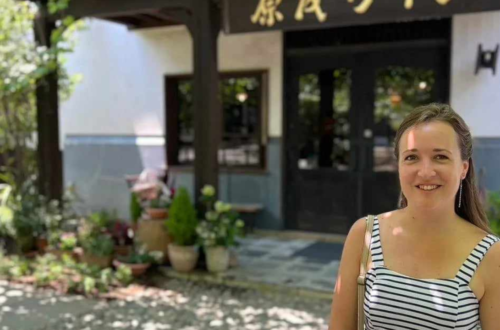
I walk into Galerie K Paris. Before I’ve said a word, someone’s already kneeling down to swap my shoes for a pair of slippers. Kei Miyagawa, who runs the place, is dressed up too, for a Monday afternoon appointment with one visitor and her notebook.
It’s only once we started talking about wine that the ritual made sense to me. That care in how I was welcomed wasn’t separate from what Kei explained afterward.
At Galerie K, Master Sake Sommelier and Kura Master founder Kei Miyagawa traces Japanese wine back to Shinto. It explains why Kōshū is meant to be drunk the moment it arrives, not aged. Moreover French cuisine’s shift over the last 36 years, less salt and sugar, more acidity and umami, has landed it on exactly the terrain Japanese wine was always built for, which is why Kei calls this the moment for it in France. Galerie K itself sells online only.
A country that sees gods in big things
Here’s where that instinct comes from: Shinto, Japan’s traditional religion. It’s built on reverence for the big stuff in nature, mountains, waterfalls, a tree that’s clearly seen a few centuries.
Stand in front of something genuinely imposing and feel that little jolt of awe? In this tradition, that jolt means a kamisama, a deity, broadly speaking, is right there with you. And if anything, in theory, can house a kamisama, then everything is worth handling with care. Including, it turns out, the welcome you give a visitor on a random Monday afternoon.
The Story of Sakura
Have you ever wondered why cherry blossoms are so important in Japan? Beyond the fact that they’re beautiful, there’s a real story and fascinating story in Japanese folklore.
The word sakura, which means “cherry blossom,” is sometimes interpreted as “the place where the deity Sa descends and resides.” In this interpretation, Sa is the deity of rice and rice fields, while kura means the sacred place where a deity lives. Put the two together—Sa and kura—and you get sakura: the place where the deity Sa dwells.
Long ago, when Japanese communities depended almost entirely on rice farming, people believed that every spring the mountain deity would descend into the villages and become the guardian of the rice fields. This deity was thought to protect the crops and ensure a successful harvest.
That’s why the blooming of the cherry blossoms was so meaningful. It wasn’t just a beautiful sign that spring had arrived. It was believed to mark the arrival of the deity and to tell farmers it was time to begin planting their rice.
Kōshū, or the art of drinking right now
That same idea, receive what’s in front of you, don’t try to hold on to it, comes back a few minutes later.
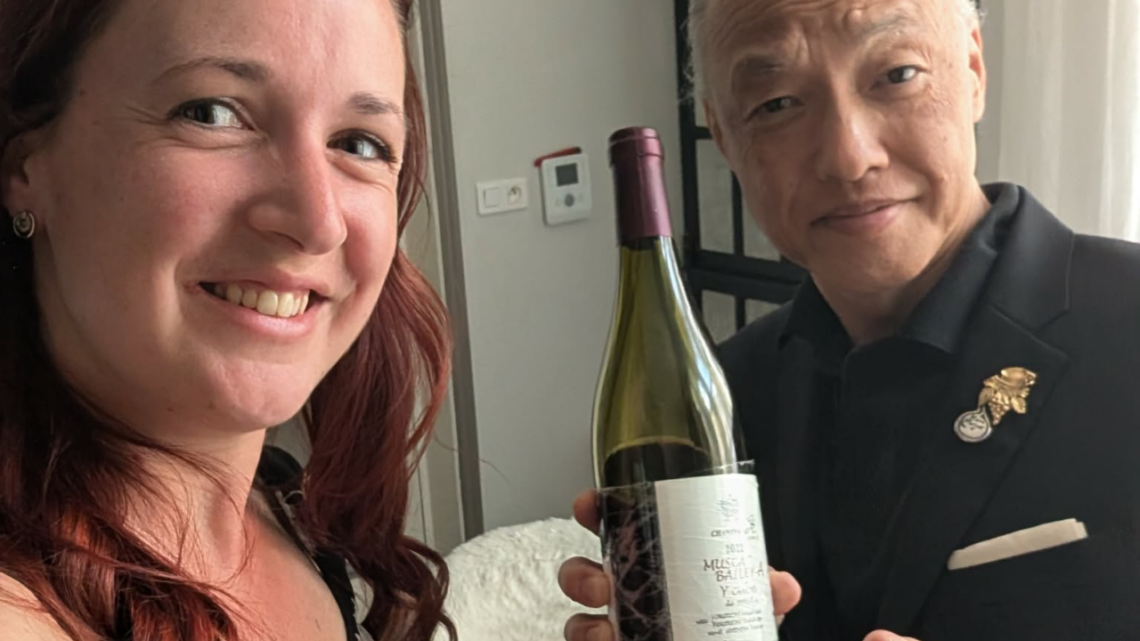
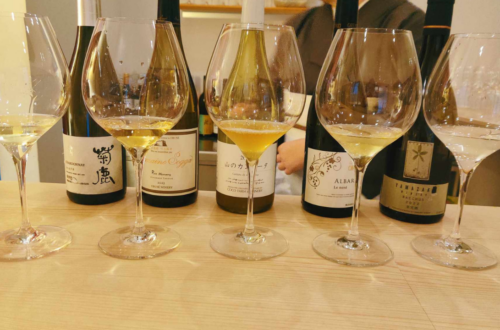
Kei pours me two wines from Chanter estate: a 2024 Kōshū and a 2022 Muscat Bailey A. Kōshū sits close to a pinot gris in structure, subtle, almost shy, a lot like Japanese cuisine itself.
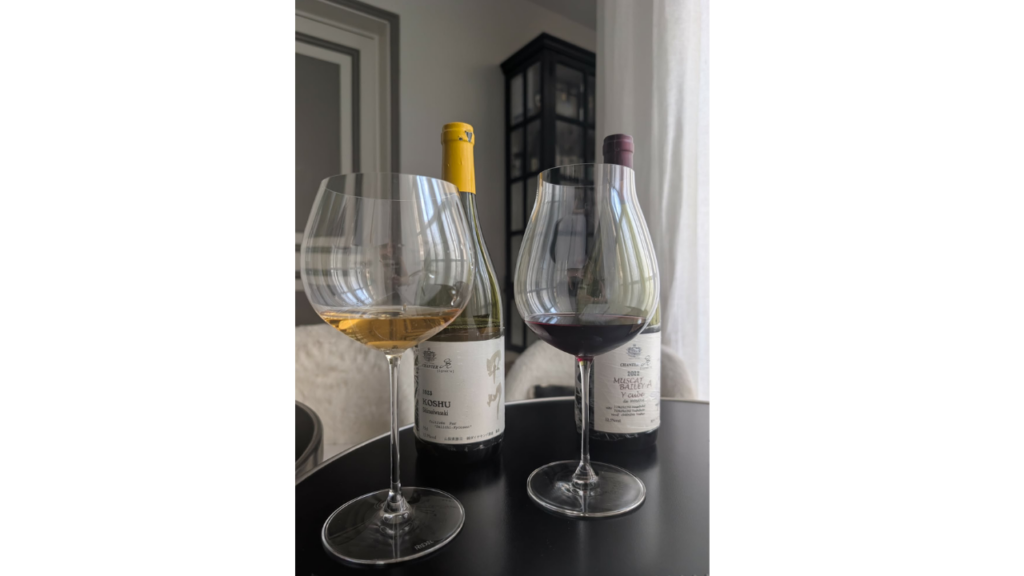
Kei walks me through the word: the character shu means what’s just arrived, what’s right here, right now. In Japanese culture, that’s basically an instruction: drink it now, don’t wait.
It’s the same reflex Kei described with the cherry trees, just applied to a glass instead of a mountain.
That idea of now runs through the whole way Japan eats: the season, right away, no delay. France does almost the opposite. Things age, sauces build slowly, time does the heavy lifting, think of a beef bourguignon, hours of simmering before it’s anywhere near ready.
Two completely different philosophies of time, both sitting on the same table. It’s a big part of why Kōshū surprises people first with how light it is. It was never built to wait. It was built to be drunk today.
Why French cuisine is catching up with Japan
Which brings us to what might be the best part of the whole conversation.
Kei describes how, in one generation, French gastronomy quietly changed direction: less salt, less sugar in desserts, less fat in sauces. And in the same breath, more acidity and more umami, that deep savory note you’d normally chase in a good broth or a well-aged parmesan.
Thirty-six years ago, when Kei arrived in France, the gastronomic restaurants we know of today didn’t serve any salad. At best, you’d get a leaf of lettuce next to the cheese course, not a dish of its own. Crunchy raw vegetables? Also a fairly recent habit. Before that, everything got slow-simmered into submission.
That shift matters more than it sounds, especially after everything Kei just told me about Kōshū. A cuisine leaning more acidic, more umami than salty, less sweet, less fatty, is exactly the terrain Japanese wine has always been built for. Kei put it simply: this is the moment for Japanese wine. The French table has drifted, without really planning to, into speaking the same language.
Who’s telling me all this
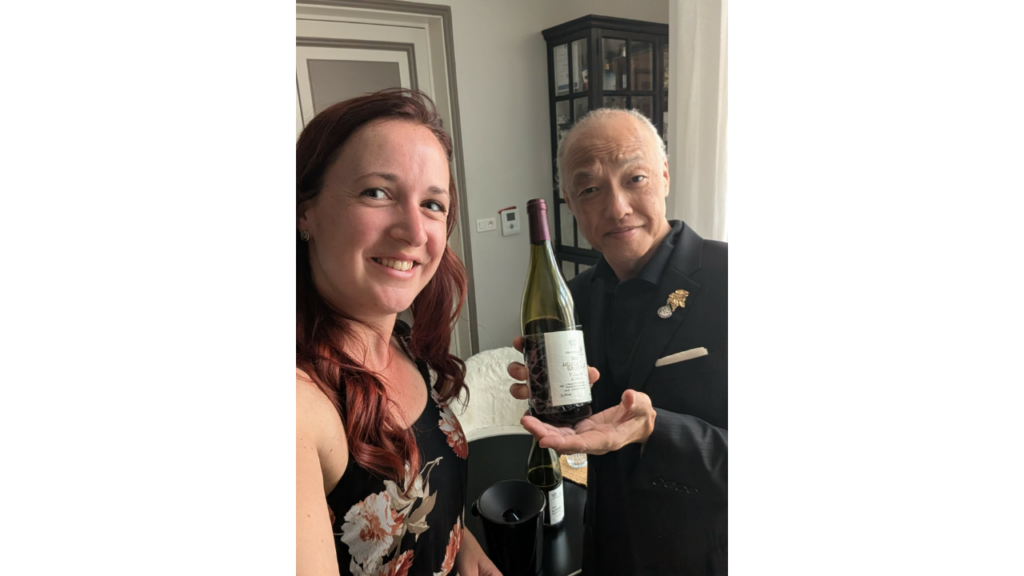
At this point I wanted to know how one person ends up knowing this much, so here’s a bit of Kei’s own story.
The beginning
Keiichiro Miyagawa, born in 1962. He arrived in France in 1990 and joined Restaurant Suntory Paris on the Champs-Élysées, becoming its director by 1993. In 2006, he helped launch French restaurants in Japan’s Wakayama prefecture as general manager of the Hôtel de Yoshino.
Back in France, he took over alcohol sales, sake especially, at Workshop Issé, a Japanese gourmet shop, in 2007. There he helped bring premium Ginjo sake to the whole country.
Galerie K Paris was born
Then, in 2010 (well, on 24/12/2009 to be exact), he founded Galerie K Paris: wholesale Japanese alcohol, wine trading, consulting for restaurants.
He’s been a member of the Paris Île-de-France Sommelier Association since 1990. He also holds the title of Master Sake Sommelier, Kikisake-shi, awarded by the Sake Service Institute (SSI), whose international branch he now runs (well at least up until 2025 because the title disappeared after)
In 2016, he founded the Kura Master association, whose first competition ran the following year alongside Xavier Thuizat.
In 2019, he opened the École des Maîtres du Saké in Paris. And the titles kept stacking up after that: Sake Samurai in 2020, an honorary distinction on the recommendation of the JSS (Japan Sake and Shochu Makers Association), then Master Sommelier of the UDSF (Union de la Sommellerie Française) in 2023.
Xavier Thuizat, name-checked above for founding Kura Master, isn’t just a random co-signer. He’s since become France’s Best Sommelier in 2022, then Meilleur Ouvrier de France in 2023 — two of the toughest titles in French sommellerie. Having one of the country’s most decorated sommeliers chair the competition’s jury says more than any statistic about how sake, and Japanese wine along with it, has earned a serious seat at the table of French sommellerie.
Today, Galerie K Paris sells exclusively online, B2B and B2C, and sees visitors by appointment in its Paris office rather than a shop you can just wander into.
Presence of sake in Michelin-starred restaurants in 2025
A little “aparté” but just so you get my point on the place of Japanese beverages (here sake and in the future wine: we can see that this Japanese beverage is gradually finding its place in French fine dining.
Today, the Michelin Guide lists 654 starred restaurants in France.
Among the 31 three-star restaurants, 7 already offer sake, which represents 22.6%.
For two-star restaurants, 16 out of 81 establishments serve sake, corresponding to 19.8%.
In Paris, where we looked specifically at one-star restaurants, 37 out of 112 include sake on their beverage list.
These numbers show that, although sake is still relatively new in the French gastronomic scene, it is steadily gaining recognition among some of the country’s most prestigious restaurants. And Japanese wine is definitely going to follow.
Back to what was in the glass
None of that career history matters much if the wine itself doesn’t hold up, so here’s what I actually tasted.
The Muscat Bailey A had seen oak: smokier than the grape’s usual fruit-forward style, with notes that land somewhere near peach melba, and real length on the finish.
Structurally, it’s somewhere between pinot noir and gamay, happiest served alongside a Burgundy rather than in competition with one.
Kei also pointed me toward Diamant estate, and Yoshio Amemiya, the winemaker whose range Galerie K Paris distributes online.
Amemiya-san’s background makes Kei’s Burgundy comparison almost literal: this third-generation winemaker trained at the CFPPA in Beaune, then under Simon Bize, a benchmark name in the Côte de Beaune. A double lineage, Japanese by family estate, Burgundian by training, that probably explains the silky style running through his wines.
His pairing advice: umami-forward soup, raw or lightly cooked fish, a crunchy vegetable salad, exactly the register French cuisine has been drifting toward.
One address, two worlds
A welcome ritual, a word’s etymology, a Shinto belief, a shift in French cooking habits.
Walking out of Galerie K Paris, I couldn’t shake the feeling that they were all telling me the same thing: a country that puts extreme care into every detail, and a France starting to speak that same language at the table.
Maybe Japanese wine doesn’t need as much cultural translation as we think. It’s just showing up right on time.
Galerie K Paris is part of our selection of verified addresses in Where to Find Japanese Wine in France.


You May Also Like
The Salon des Vins Japonais in Beaune

What Is the Right Wine Serving Temperature (and Why It Matters More Than You Think)?