What is the Sekt method?
7 minutes read
If you’ve ever tried to understand how Sekt is made, you may have stumbled across a confusing idea: the Sekt method.
So let’s clear this up straight away.
There is no single “Sekt method.”
In Austria, Sekt can be produced using three different methods, depending on the style, quality level, and intention of the producer.
Once you understand that, everything suddenly becomes much easier to follow.
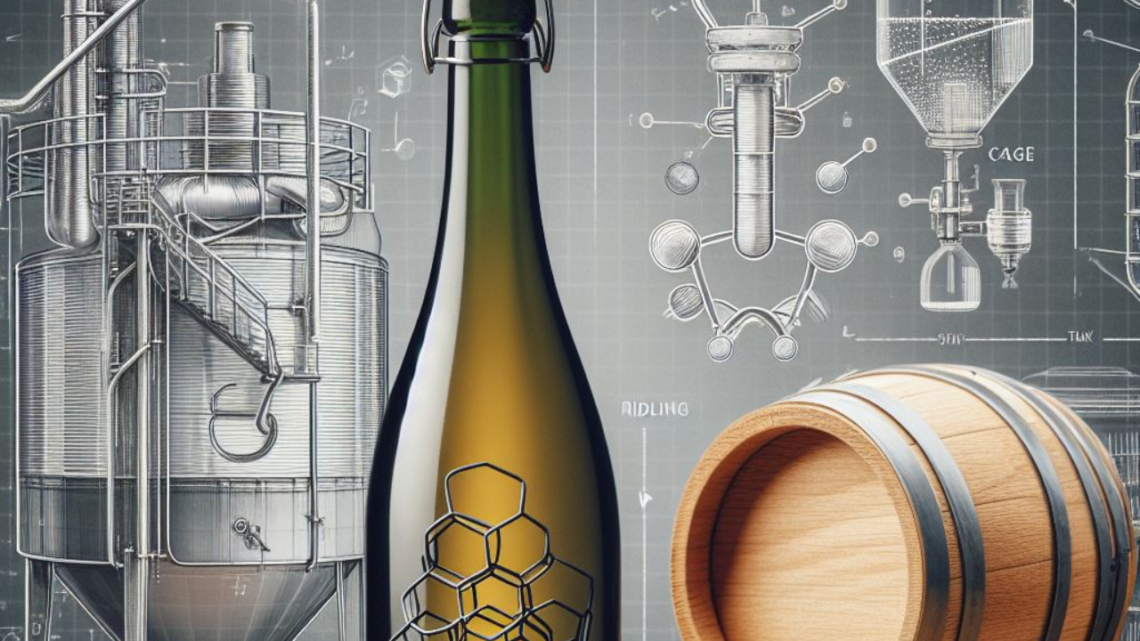
There is no single “Sekt method.” In Austria, Sekt can be produced using three different methods. The traditional method, where the second fermentation happens in the bottle, creating complex, age-worthy sparkling wines. The transfer method, which also uses bottle fermentation but removes yeast by filtration in tanks, mainly for special formats. The Charmat method, where the second fermentation takes place in pressure tanks, producing fresh, fruit-forward sparkling wines meant to be enjoyed young. The method used depends on the intended style and quality level of the Sekt.
First things first: the two types of Sekt
Before we talk about production methods, it’s important to understand that Austrian Sekt exists in two distinct categories.
Österreichischer Sekt is the broad category. It does not have a protected geographical indication and offers producers a lot of flexibility in sourcing grapes and choosing production methods.
Sekt g.U., on the other hand, has a controlled designation of origin (geschützte Ursprungsbezeichnung). It sits higher in the quality hierarchy and must follow specific rules regarding origin, production, and ageing.
Both categories can use different production methods — but the stricter the quality level, the more restrictive the method becomes.
If you want to know more about these categories, you should check my guide on the quality levels in Austrian wine.
The traditional method (méthode traditionnelle)
The traditional method, also known as méthode champenoise, is the most complex — and most prestigious — way to produce sparkling wine. It is used for Champagne, high-quality Sekt, and other serious sparkling wines around the world.
After the base wine is made, a mixture of yeast and sugar (called the liqueur de tirage) is added. The wine is then bottled and sealed with a temporary cap.
Inside the bottle, a second fermentation takes place. The yeast consumes the sugar and produces alcohol and carbon dioxide. Because the bottle is sealed, the carbon dioxide has nowhere to go — it dissolves into the wine, creating pressure of around 5 to 6 bar.
Once fermentation is complete, the wine is left to rest on its lees (the dead yeast cells). This ageing phase is crucial: the longer the wine stays on the lees, the finer and more persistent the bubbles become, and the more complex the aromas.
How the yeast is removed: riddling and disgorging
After ageing, the yeast needs to be removed — without losing the bubbles.
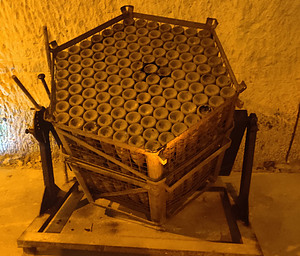
Traditionally, bottles are placed upside down in riddling racks. Over several weeks, they are gently turned and tilted a little more each day. This slow process causes the yeast to gradually collect in the neck of the bottle. The full riddling process can involve around 32 individual movements and take six weeks or more.
Today, many producers use gyropalettes instead. These are mechanical cages that hold hundreds of bottles at once and replicate the riddling movements in just a few days. The result is the same — the yeast gathers neatly in the bottle neck — just much faster.
The final step is disgorging. The neck of the bottle is frozen in a cold brine bath, trapping the yeast in a small ice plug. When the bottle is opened, the internal pressure ejects the frozen yeast cleanly.
Before the final cork is inserted, a dosage liqueur is added. This determines the final sweetness level of the wine.
The transfer process (partial bottle fermentation)
The transfer method sits somewhere between the traditional method and tank fermentation.
Just like in the traditional method, the second fermentation happens in the bottle, followed by a period of ageing on the lees. The difference comes afterwards.
Instead of riddling and disgorging each individual bottle, the contents of many bottles are emptied into a pressure tank. The wine is then filtered to remove yeast and sediments, the dosage liqueur is added, and the wine is rebottled under pressure.
This method avoids riddling and disgorging entirely and is mainly used for special bottle formats, where traditional disgorging would be impractical.
The Charmat method
The Charmat method (also called the tank method) is a very different approach.
Here, the base wine is transferred to large pressure tanks, where yeast and sugar are added. The second fermentation happens in the tank, not in the bottle. As with the traditional method, the yeast converts sugar into alcohol and carbon dioxide — but everything takes place at scale.
After fermentation, the sparkling wine is filtered, chilled for two to three weeks, adjusted with dosage liqueur, and bottled using a special pressure bottling machine.
This method is typically used for entry-level sparkling wines or styles where freshness and fruit are the main focus. These wines are meant to be enjoyed young, rather than aged.
Sweetness levels in Sekt: what “brut” really means
You’ll often see terms like brut or extra brut on Sekt labels. These refer to the amount of residual sugar in the wine, not to quality.
- Brut nature / brut zero: 0–3 g/L
- Extra brut / extra herb: 0–6 g/L
- Brut / herb: 0–12 g/L
- Extra dry / extra trocken / très sec: 12–17 g/L
- Dry / trocken / sec / secco: 17–32 g/L
- Medium dry / demi-sec / halbtrocken: 32–50 g/L
- Sweet / doux / dolce: over 50 g/L
These terms help you anticipate how the wine will taste — from bone-dry to noticeably sweet.
Quality levels in Sekt g.U.
In 2016, the Austrian Sparkling Wine Committee (Österreichisches Sektkomitee), together with industry experts and the Federal Ministry of Agriculture, introduced a structured system for Sekt g.U.
From that point on, Sekt g.U. could only be marketed under three quality levels: Klassik, Reserve, and Grosse Reserve.
Each designation must clearly indicate:
- the category (Sekt or quality sparkling wine)
- the protected origin (region, and sometimes municipality)
- the mention g.U. (geschützte Ursprungsbezeichnung)
An additional mention of Hauersekt is also possible.
Sekt g.U. Klassik
The grapes must come from a single administrative region. The wine must be aged on the lees for at least 9 months, regardless of production method, and the alcohol level must not exceed 12.5%.
Sekt g.U. Reserve
Grapes must be harvested and pressed within a single region, with hand-harvesting and whole-cluster pressing required. The wine must be aged on lees for at least 18 months and produced exclusively using the traditional method. Residual sugar is limited to 12 g/L.
Sekt g.U. Grosse Reserve
The strictest level. Grapes must come from a single commune, be hand-harvested and whole-cluster pressed, and the wine must be aged on lees for a minimum of 30 months, using only the traditional method. Residual sugar is again capped at 12 g/L, and the commune must be stated on the label. Mentions such as Grosslage or Ried may also appear.
So… what is the Sekt method?
There is no single Sekt method. Instead, Austrian Sekt can be produced using three different methods, each serving a different style and purpose:
- the traditional method, for complex, age-worthy sparkling wines
- the transfer method, mainly for special formats
- the Charmat method, for fresh, fruit-driven wines meant to be enjoyed young
Understanding this doesn’t require memorising technical steps — just knowing that the method tells you a lot about what to expect in the glass.
And once you know that, Sekt suddenly feels much less mysterious
Where to next?
What is the difference between Sekt and Champagne?
Same bubbles, very different rules, origins, and philosophies. Here’s what really sets them apart.
Grüner Veltliner, Riesling, Chardonnay… Sekt is far more diverse than most people expect.
They’re often confused, but their production methods and styles tell very different stories.


You May Also Like
What is Bergland in Austria?
What kind of wine is Südsteiermark famous for?