
Where to Find Japanese Wine in France?
23 minutes read
Okey, so imagine: you’re at a Parisian Japanese restaurant, the kind that likes to call itself “gastronomic,”. And you ask for the wine list hoping to spot a Koshu or a Muscat Bailey A (the two grapes Japan’s actually known for).
Instead, you get handed a list of Burgundies and Côtes-du-Rhônes. Perfectly nice wines, no complaints there, but not one word about the country your dinner came from.
I’ve seen this exact scene play out at almost every address I’ve visited. At some point it stops looking like bad luck and starts looking like the rule.
So a few months back, I started digging.
Calling wine shops, combing through restaurant menus, checking online retailers, chasing down a lot of dead ends along the way. Turns out plenty of places that proudly advertise “sake and Japanese spirits” don’t have a single bottle of wine on hand. Others call themselves specialists in “wines of the world,” mention Japan right there on their website, and then… nothing, not one bottle actually in stock.
Every single address that made it onto this list is here because I checked it myself, through an independent source. Real wine, actually sitting on a shelf somewhere. Not sake wearing a wine costume. And definitely, not a listing that only exists on a website.
The list ended up shorter than I’d hoped. But everything on it got checked twice. .
Where can you actually find Japanese wine in France? After reaching out to wine shops, combing through restaurant menus, and checking online retailers, and ruling out plenty of dead ends (sake mistaken for wine, listings that only exist on paper), here is a short but twice-verified list. We have three restaurants (Enyaa, Le 228L, La Cachette), three physical wine shops (Umami / Épicerie Umai, Nishikidôri, Toulouse Sake Club), and a handful of French and European retailers that genuinely ship. One question remains : why do so few Japanese restaurants dare to feature their own country’s wine?
Japanese wine, in a few lines, for newcomers
If this is new territory for you: Japan’s been making wine for over a century now, mostly in Yamanashi prefecture, at the foot of Mount Fuji. It’s a bit as if all of France’s wine production came out of a single département.
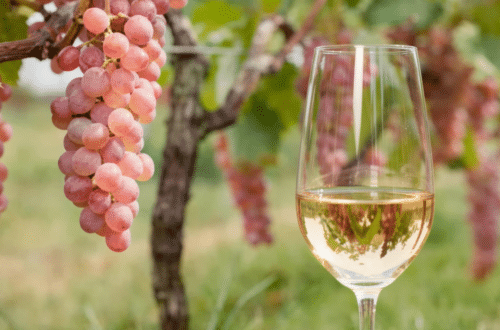
The star grape is Koshu, a white grape with thick, slightly pink skin, tough enough to survive Japan’s brutal summer humidity. On the palate it often reminds people of a Muscadet, that same freshness and lightness, or an Albariño for the citrusy edge. Then there’s this saline note that catches you off guard, almost like a drop of soy sauce slipped into the glass. It’s crisp, easy to drink, rarely above 12 degrees, and works beautifully with raw fish or a light poultry dish.
On the red side, Muscat Bailey A is a hybrid grape bred in Japan back in the 1920s, crossing one American and one European variety. Much more understated: soft tannins, sometimes a ripe gamay vibe.
Here’s the thing about why it’s all so rare: Japan’s total wine production is tiny by world standards, and most of what gets made never leaves the country, because domestic demand already outpaces supply. Even a historic name like Katsunuma Jozo, one of the first to export to Europe back in the 2000s, still only sends about 1% of its production outside Japan today. So no, French wine lists aren’t ignoring Japan on purpose. The export pipeline is just barely getting off the ground.
I’ll stop myself here before this turns into a history lesson. If you want the full story, region by region, I’ve already written that up on the blog. This post has one job: telling you where to actually find the stuff, in France, right now.
On the plate: the restaurants that actually dare to serve Japanese wine
Bad news first: across every Japanese restaurant I checked in France, Michelin-starred or not, Paris or elsewhere, the vast majority pour sake.
Sometimes a genuinely beautiful selection of it.
But almost never a bottle of wine that actually comes from Japan. More on that later. Here are the three places where I could confirm, with total certainty, that it’s actually on the list.
Enyaa (Paris, 1st arrondissement)
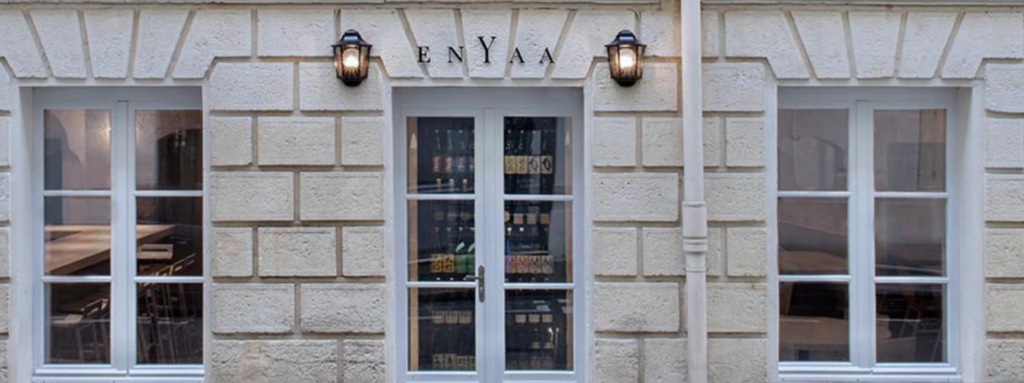
It is probably the clearest proof I found anywhere in the capital.
It’s a kaiseki restaurant, kaiseki being that Japanese art of building a meal from a succession of small courses, almost like movements in a piece of music, and it runs its own little wine shop right next door.
You’ll find the Aruga range from the Katsunuma estate there: a Koshu and a Muscat Bailey A, named on the list, price included. That level of clarity is rare. Most restaurants that actually carry Japanese wine don’t say so on their online menu, you usually have to call and ask just to be sure it’s really there.
Le 228L
In Pigalle, this is a natural wine bar first and a Japanese restaurant second, and that combination is exactly what makes it worth mentioning.
Natural wine, quick refresher, means as little intervention as possible: no additives, little to no filtration, wild yeasts instead of the lab-selected kind. The cellar holds over 500 references and goes, as the team puts it, “from the Canary Islands to Japan.”
Japan, here, means a cuvée from Takeda estate in Yamanashi, a “Sans Soufre Blanc” made with zero intervention, sitting comfortably among a list that already leans natural.
The chef, Naohisa, used to be sous-chef at the Michelin-starred Abri, and he brings a real Japanese sensibility to the kitchen without ever turning it into a gimmick.
Japanese wine just slots into an already adventurous list here instead of getting waved around as a talking point, which is probably why it took me a while to find it in the first place. Nobody’s trying to make a big deal out of it.

La Cachette
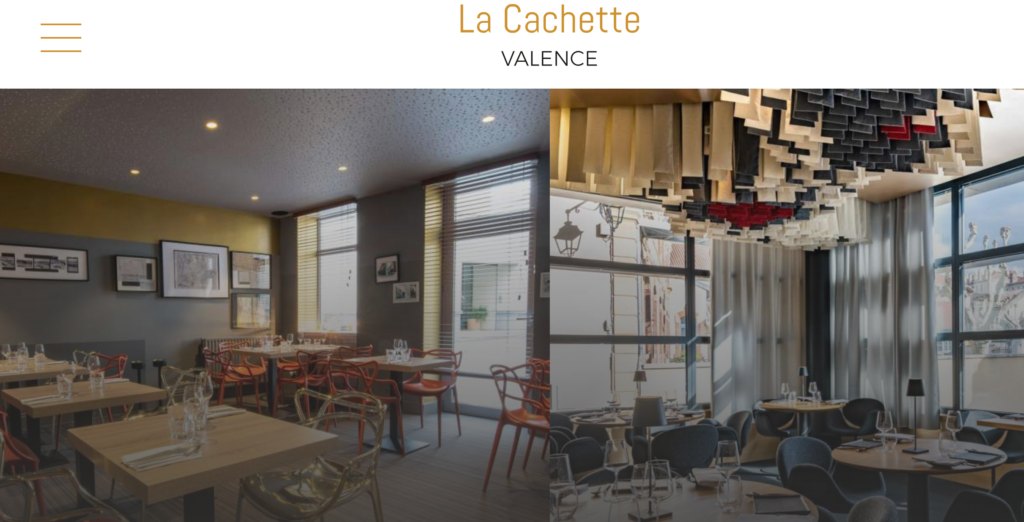
In Valence, la Cachette was the best surprise of this whole search.
A Michelin star, three hours from Paris, run by Japanese chef Masashi Ijichi and his wife, pastry chef Sachi Ijichi, since 2005. Their 600-bottle list explicitly includes wines from Japan alongside Italy and Spain, an openness that runs through the whole restaurant, a real dialogue between the Drôme and Japan rather than a French spin on Japanese food. Good proof this story isn’t just a Paris thing.
And what about wine bars?
Natural wine and Japanese wine actually share a lot of the same DNA: small production, real respect for terroir. So that’s exactly where I went looking.
And here’s maybe the most surprising find of the whole search: outside of Le 228L (which is as much Japanese as it is a wine bar), I couldn’t find a single “generalist” natural wine bar, you know the type that’s treated natural wine like a religion for twenty years, carrying so much as one Japanese bottle.
That connection just hasn’t been made yet. I’d call it a missed opportunity more than a lack of interest.
At the wine shops: four physical addresses that actually carry it
If you’d rather walk out with a bottle than drink it on the spot, here are the physical shops where I confirmed Japanese wine actually on the shelf, not just sake. (You’d be amazed how much it is mixed up with sake, sometimes by wine professionals!)
Épicerie Umai

Épicerie Umai actually has two addresses in Paris: Jourdain (19th), open since 2022, and a newer one in Batignolles (17th), which opened in September 2025.
Jourdain is where you’ll find the bigger of the two wine selections, probably the deepest lineup of Japanese natural wine in France: about fifteen references, including the French exclusive on Grape Republic, plus ASAP, an urban winery out of Tokyo.
The team imports directly and only sells what they’ve actually tasted and liked, and they’ve deliberately capped prices under 35 euros, a choice that keeps things accessible if you’ve never tried Japanese wine before.
If you want just one bottle to try: Grape Republic’s Muscat Bailey A, whole-cluster fermentation, poured alongside a rich tonkotsu ramen. The acidity cuts right through the fat.
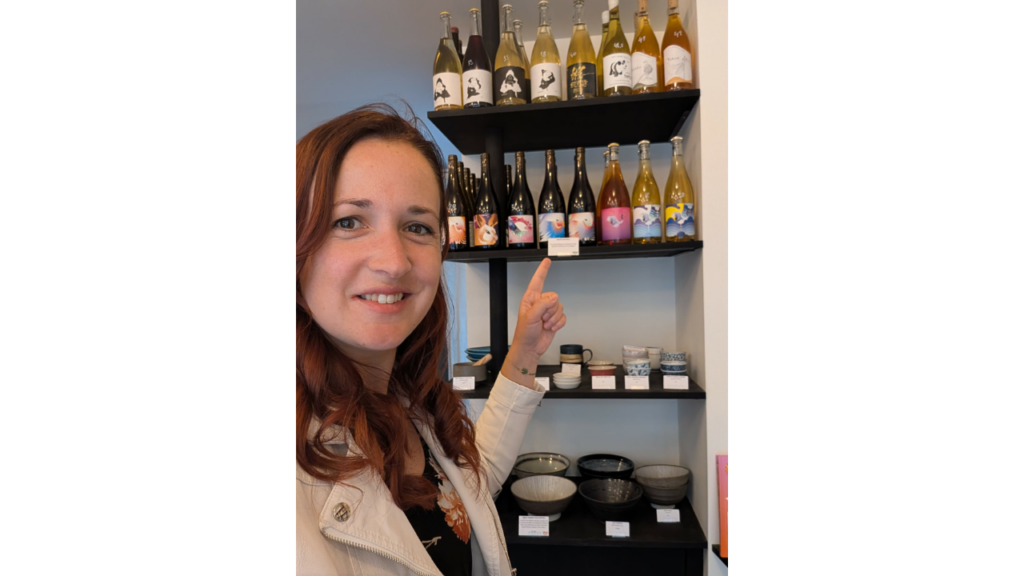
Nishikidôri
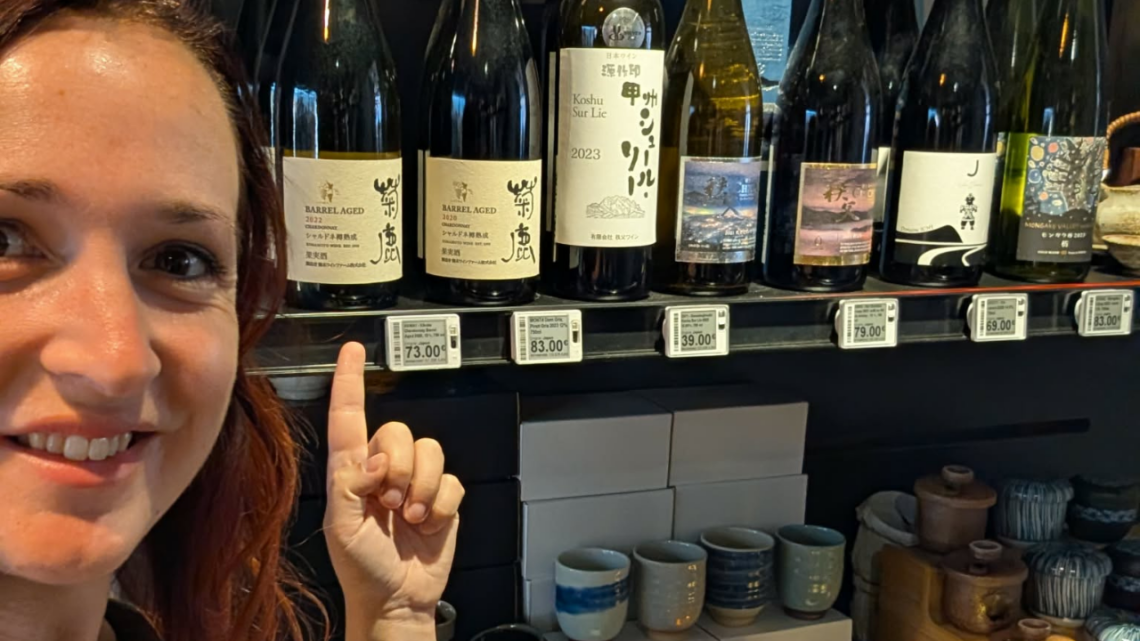
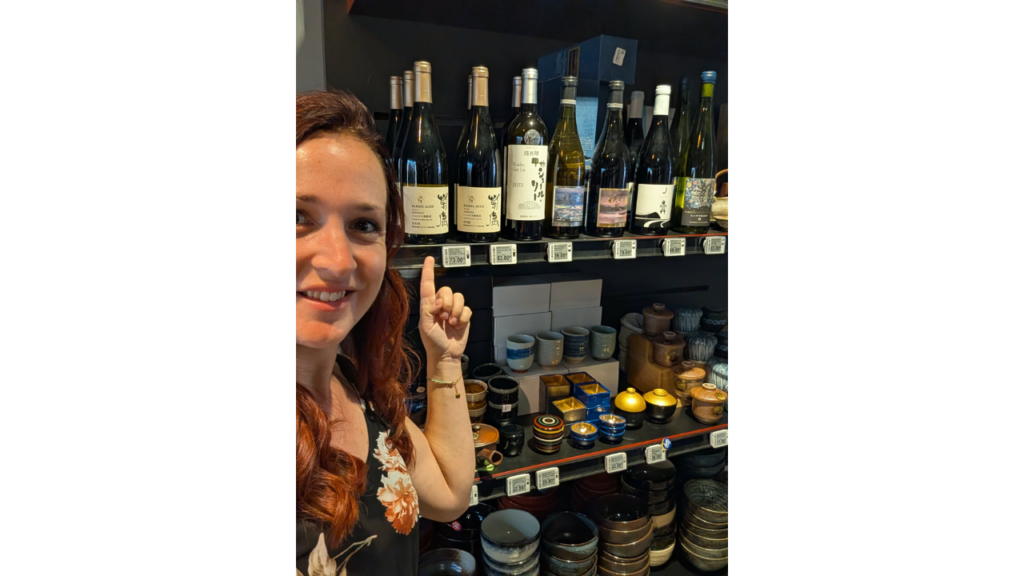
Nishikidôri is a fine food shop near Palais-Royal, was founded by Olivier Derenne, who also runs PALMIFRANCE, his import company since 2003. The man has spent thirty years traveling across Japan, about 170 days a year there, and he’s one of the most serious importers on the French market, with a catalog of 27 Japanese estates (another twenty are about to open up to the public, currently reserved for restaurateurs).
His rarest find on the shelf right now is a Chichibu Wine, white and red, 2021, from the oldest wine estate in Saitama, founded in 1889, aged in barrels that previously held one of Japan’s most celebrated whiskies, Ichiro’s Malt. There’s also a lees-aged Koshu from the same estate, and two Chardonnays from Nagano.
Prices run from 20 to 150 euros depending on the cuvée.
Toulouse Sake Club

And because not everything happens in Paris: Toulouse Sake Club, a fine food shop and cellar that also runs tasting workshops, stocks Koshu from Grace estate, a century-old house now run by the founder’s daughter, who’s been racking up medals since taking over, plus cuvées from Hirakawa Winery in Hokkaido, in store and online.
As far as I know, it’s the only physical shop outside Paris where you can buy Japanese wine with any certainty. A real anchor point if you’re not based in the capital.
Online: today’s most reliable option
If your city doesn’t have a specialized wine shop yet, still the most common scenario by far, the internet’s your safest bet.
Galerie K
One address to start with: Galerie K Paris sells exclusively online, wines from Yoshio Amemiya, a Japanese winemaker working with Koshu and Muscat Bailey A, alongside a big sake selection.
Its address near Place Vendôme isn’t a shop you can walk into, it’s an office where the team meets clients and professionals by appointment
Other French retailers
Beyond that, here are the other French retailers where I confirmed Japanese wine actually for sale: Explorateur de Vins, La Bouteille Dorée, 1jour1vin, and Les Grappes all carry a selection built mostly around Koshu from Grace Winery in Yamanashi, the name you’ll run into constantly doing this kind of search. Think of it as the “gateway” producer for the region, the way a Sancerre is often someone’s first step into Loire wines.





La Pangée stands out with something rarer and more natural: Hitomi Winery.
European retailers
Four European retailers ship to France too, if you want to widen the net beyond national borders.
UENO GOURMET (Germany, offices in Switzerland and the UK) is mostly a sake specialist, probably the biggest supplier of its kind in Europe, and it’s added Koshu to the catalog and ships to France without any fuss.

VINVM (UK) has a dedicated France shipping page, though expect customs fees post-Brexit, so budget more time and money than you would for a French order.

Wines of Earth (Belgium), a generalist “wines of the world” shop, ships to France, Belgium, and Luxembourg with a real Japan section.
And Gubi Gubi (Netherlands) was probably the nicest surprise of this whole European search: a shop entirely dedicated to Japanese wine, around 70 references from 24 different estates, free shipping to France over 300 euros. The widest selection I found anywhere on the continent.
How to choose and serve it, without getting it wrong
Once the bottle’s in hand, a few basics will keep you out of trouble.
Koshu wants to be served chilled, around 8 to 10 degrees, a touch cooler than a Chardonnay, a touch warmer than Champagne, in a normal white wine glass. No special glassware, no ritual needed. It’s light and mildly acidic enough to work with more than just sashimi and sushi, which is what everyone reaches for first: try it with roast poultry, fish in a beurre blanc, or even a fresh goat cheese if you’re up for a slightly odd pairing.
Muscat Bailey A, softer and less tannic than a cabernet, drinks like a light red, closer to Beaujolais in temperature, and it’s genuinely nice served a little chilled in summer.
On price, don’t expect everyday numbers. Small estates, the cost of shipping from Japan, and already-strong demand at home all push things up. Count on 25 to 50 euros for an entry-level bottle from a recognized name like Grace Winery. Enyaa’s Koshu and Muscat Bailey A, for example, run 48 euros. This is more of an occasion bottle, or one to open with someone you want to introduce to the subject, not something you crack open on a random Tuesday.
One question, to finish
My experience in Beaune
This summer, at a Japanese restaurant in Beaune, the historic capital of Burgundy wine, if you needed a fitting backdrop, I asked the owner straight out: why isn’t there a single Japanese wine on your list?
Her answer was honest. She doesn’t feel comfortable pricing a Japanese bottle the same as a Burgundy, worried her customers just won’t follow.
I get the logic, but it rests on an assumption I’m not sure holds up: that everyone walking into a Japanese restaurant wants the same thing. Sure, some people want the safety of a name they know, even though, ironically, the Burgundy market is just as prone to speculation and trends as anything else. But then there are the curious ones, the people who picked a Japanese restaurant precisely to go all the way with the experience, not to tick a box or follow a 4.5-star Tripadvisor score.
Those two crowds don’t want the same thing at the table, and there’s nothing saying the second one doesn’t exist, they’re just almost never given the option. And the quality backs it up: the estates I came across in this whole search, from Katsunuma to Hokkaido, hold their own against far more famous appellations. More than enough to justify a price tag that wouldn’t look out of place next to a Burgundy.
So if you run a Japanese restaurant…
So if you run a Japanese restaurant and your list currently has zero wine from Japan: this isn’t a dig at anyone in particular, the list above shows just how under the radar this whole thing still is, and I’d have some nerve blaming you for a gap in information it took me months to close myself.
But think of it as an invitation, maybe a bet worth taking before you decide, on your customers’ behalf, what they’re willing to pay for. The wine’s out there. The estates are out there. The importers are slowly starting to show up too. For a lot of great restaurants, all that’s missing is the curiosity to put one bottle on the list, even if it’s just for one night.
If you have another adress that is not featured in this post, please reach out and I’ll gladly add it!
And if you want to be kept updated on this list, join the newsletter!


You May Also Like
Best Japanese Wine Bars In Tokyo

What does volcanic rock do to wine?