What are Carnuntum wines? Vienna’s nearby red-wine secret (Rubin Carnuntum, DAC & top wineries)
10 minutes read
Let me guess why you’re here.
You’re either planning a trip to Vienna, already daydreaming about a glass of Austrian red…
or you’ve simply heard the word Carnuntum somewhere (a wine list? a sommelier? an Austrian friend who’s very proud?) and thought:
“Okay… but what is Carnuntum wines, exactly?”
Perfect — you’re in the right place.
Carnuntum is one of Austria’s most exciting red wine regions, just east of Vienna, right by the Danube. It’s famous for elegant, juicy reds made from Zweigelt and Blaufränkisch, and for its signature style called Rubin Carnuntum (a pure Zweigelt aged in barrels, made to be enjoyed young and happy).
And the best part? This is not the kind of region where you just taste wine — you experience it: castles, Roman ruins, Buschenschank farm inns, vineyard walks… and even the cool influence of nearby Bratislava.
If you clicked on this article, I’m guessing you want at least one of these:
- Which Carnuntum wines should I try first?
- What makes the terroir special?
- What does “Rubin Carnuntum” actually mean?
- Which wineries are worth your suitcase space?
Let’s do it together. I’ll give you the landscape, the soils, the grapes, the DAC… and my favourite producers.
Ready? Glass in hand. Let’s go 🍷✨
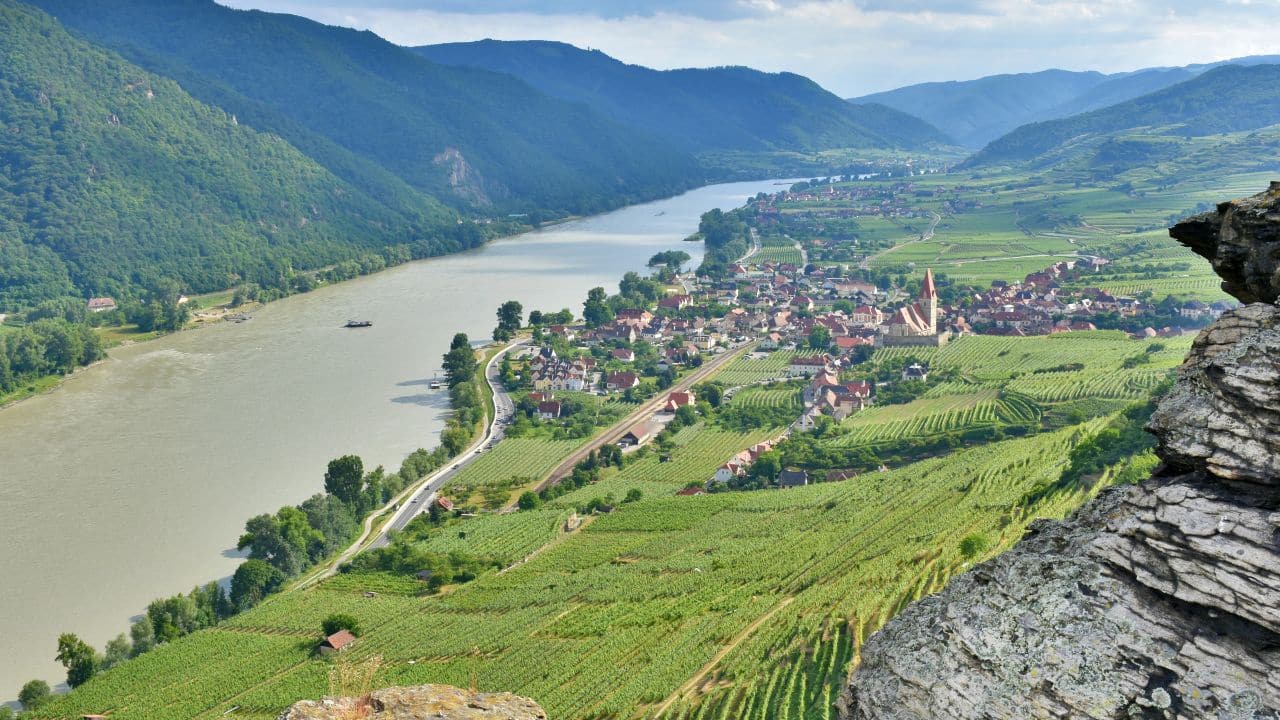
Carnuntum isn’t your average Austrian wine region. Officially established in 1993, it’s a southern gem located south of the Danube and east of Vienna — close enough for a day trip, but different enough to feel like a real discovery. And it’s not flat either: Carnuntum has three distinct landscapes (the Leitha Mountains, Arbesthal Hills and Hainburg Mountains), plus plenty of history nearby — castles, archaeological sites, the Danube National Park, and even the cool energy of nearby Bratislava, Slovakia. Vineyards cover 906 hectares, planted on a beautiful patchwork of sand, loam, loess and gravel, making Carnuntum a playground for red grapes — especially Zweigelt and Blaufränkisch. (White lovers: Grüner Veltliner is still here for you.) One signature style to remember? Rubin Carnuntum. And in 2019, the region finally received DAC status.
History of Carnuntum
Before it became a wine region in 1993, Carnuntum was already a name with weight — Roman weight.
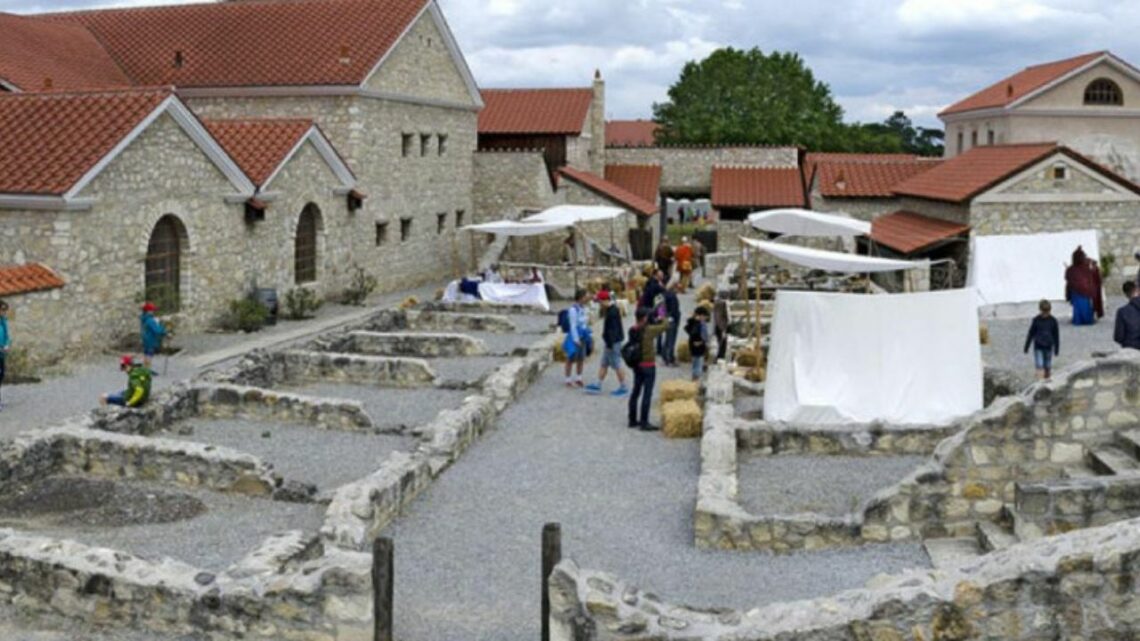
Carnuntum has a rich history dating back to the Roman period… and yes, we’re going to start there — because in this region, the past is not just a backdrop. It’s part of the personality.
Carnuntum first became strategically important during the early Julio-Claudian era, when it was chosen as a defensive sector along the Danube and became home to Rome’s 15th Legion. Emperor Claudius recognised its potential and established a military camp capable of accommodating 6,000 soldiers. Eventually, Carnuntum became the capital of the province of Upper Pannonia.
In the 2nd century, the city’s importance grew even further when the formidable 14th Legion was stationed there. A thriving civilian city expanded around the camp, and Carnuntum became one of the largest and most significant Roman cities in the region.
Then comes one of those “wait… really?” moments of history: in 308 AD, an important conference took place at Carnuntum between the four Emperors of the Tetrarchy. This conference resulted in the proclamation of an end to the persecution of Christians and a universal tolerance of religion throughout the Roman Empire — a major moment in both Roman and world history.
But history is never only glorious. As instability spread through the later Roman Empire, Carnuntum’s border position made it vulnerable to Barbarian invasions. The city was heavily damaged and gradually fell into ruin, abandoned by its inhabitants.
Now… enough helmets and legions. Let’s get back to the real reason you’re here:
What is Carnuntum wines — and why should you care?
Overall presentation of Carnuntum wine region
Carnuntum is a wine region carved out of Donauland in 1993. It sits south of the Danube and east of Vienna, and its vineyards spread across three gently undulating landscapes:
- the Leitha Mountains
- the Arbesthal Hills
- the Hainburg Mountains

What makes Carnuntum extra fun as a destination is what surrounds it. Between the lovingly reconstructed Marchfeld castles, the attractive archaeological park of Carnuntum, the Danube National Park, and the influence of nearby Bratislava, visitors get plenty of reasons to stay longer than planned.
And if you love the combo “walks + wine” (same, honestly), head to wine-growing communities such as Göttlesbrunn, Höflein or Prellenkirchen, known for their authentic Buschenschank (traditional farm inns).
Terroir of Carnutum : soil and climate
Carnuntum vineyards are planted on gently rolling slopes as well as plateaux. And the terroir is anything but boring.

Soils
Soils vary widely, with:
- sand
- loam
- loess
- gravel (especially at higher elevations)
Between the Leitha Mountains and the Hainburg Mountains, vineyards sit on two main types of terrain:
- Sediments from the Paratethys Sea and the Pannonian Lake
These marine and Pannonian deposits contain sediments with varying carbonate content, ranging from loose, sandy, and marly to clay-loamy compositions — sometimes with gravel. - Glacial terrace gravels (Arbesthal Hills and Prellenkirchen region)
These correspond to ancient Danube valley bottoms. The Danube terrace deposits are quartz-rich, sandy and gravelly gravels.
And then (because Carnuntum loves complexity), these deposits are covered by extensive layers of loess, either:
- dolomitic limestone loess, or
- clayey loess often without limestone
Finally, in the Hainburg Mountains, you reach the deepest and most hidden layer: granite, intruded into existing gneiss, still supporting high-altitude vineyards of Berg. It underlies Paleozoic carbonate rocks, forming cliffs above Hundsheim and the heights of Mount Spitzerberg.
Climate
Carnuntum enjoys a similar number of sunshine hours as Burgenland, with cooling influences from the Weinviertel hills on the opposite side of the river. However, it does not benefit from the moderating effect of Lake Neusiedl — so expect lots of local variation.
Result: Carnuntum experiences a range of microclimates, shaped by its geography.
So… what does this mean in the glass?
Okay — quick pause before your eyes glaze over from words like Paratethys Sea 😅
Here’s the real takeaway: Carnuntum’s terroir isn’t “geology for fun”. It’s the reason the wines taste the way they do.
Because vineyards sit on a mix of loess, sand, clay, and gravel, Carnuntum reds often give you this very satisfying combination of:
- 🍒 ripe fruit (hello, juicy Zweigelt)
- 🌿 freshness and lift (thanks to cooling influences and microclimates)
- 🪵 structure without heaviness (especially in Blaufränkisch)
- ✨ and a certain polished elegance that makes you go back for another sip
In short: you get red wines that feel warm and generous, but still fresh and precise — not the “heavy winter reds”, more the “one more glass, please” kind.
And if you’re wondering why two Carnuntum bottles can taste surprisingly different even with the same grape… it often comes down to what’s under the vines.
If you want the fun deep-dive (without turning it into a geology exam), I wrote a full guide here: How does soil affect the taste of wine?
Carnuntum grape varieties
With 906 hectares of vineyards spread across heavy clay and loess soils, plus sandy and gravelly areas, Carnuntum is clearly red-wine territory.
Red grapes
The most important and widespread grape is Zweigelt, followed by Blaufränkisch.
And Carnuntum also has its own signature style:
Rubin Carnuntum
One unique feature of Carnuntum is Rubin Carnuntum, created in 1992.
Originally a blend of Zweigelt and Blaufränkisch, it has evolved into a pure Zweigelt wine with:
- minimum 12.5% alcohol
- barrel aging for at least six months
- best enjoyed relatively young
White wines
White lovers, don’t worry: Grüner Veltliner is the main white variety here.
Carnuntum DAC
Carnuntum finally obtained DAC status in 2019, and for a region with such a strong identity, it was very much deserved.
The famous three-tier structure
The Carnuntum DAC follows the classic Austrian three-tier structure — Gebietswein, Ortswein, and Riedenwein — and covers a group of communes that each bring their own nuance to the wines: Göttlesbrunn, Hainburg, Höflein, Petronell-Carnuntum, Prellenkirchen, and Stixneusiedl, each made up of several villages and contributing to the region’s distinctive terroir.
Both white and red wines are allowed under Carnuntum DAC, but with clearly defined grape rules.
For white wines, the permitted varieties are Chardonnay, Pinot Blanc, and Grüner Veltliner. Wines can be blends, but at least two-thirds of the blend must be made up of these grapes, with the remaining portion coming from varieties classified as Qualitätswein.
For red wines, the focus is firmly on Zweigelt and Blaufränkisch, again with the same blending rule: a minimum of two-thirds of these grapes, with the rest from approved Qualitätswein varieties.
Across all three DAC levels, all wines must be dry, and for red wines, the minimum alcohol level is set at 12.0%, ensuring ripeness and a certain generosity in the glass. In practice, Zweigelt and Blaufränkisch really shine here, while Carnuntum whites stand out for their structure and character, rather than lightness alone.
As with other DAC regions, precision of origin comes with timing rules.
Gebietswein represents the broader regional expression.
For Ortswein, a state control number is required — from March 15th of the year following the harvest for white wines, and from November 1st for red wines.
Riedenwein, the most precise level, follows the same state control number timing as Ortswein, reinforcing the focus on origin and seriousness of production.
If you like generous yet structured reds — especially Zweigelt and Blaufränkisch — and whites with real presence, Carnuntum is a brilliant region to explore: confident, dry wines with depth, but without heaviness.
Wineries in Carnuntum
Now to the wineries! (My favourite part — as always.)
Philippe Grassl
A leading winemaker in the region, known for top-quality reds. One standout is his St Laurent Alte Reben, from vines dating back to 1961. The 2015 vintage is particularly exceptional according to Stephen Brook.
Gerhard Markowitsch
One of the three Markowitsch wineries in Göttlesbrunn. Their flagship red wine Rosenberg is a blend of:
- 50% Zweigelt
- 45% Merlot
- 5% Cabernet Sauvignon
Aged in barriques.
Dorli Muhr
Okay, quick confession: I’m a little obsessed with Dorli Muhr.
Yes, Blaufränkisch is “supposed” to shine brightest in Burgenland… and yet Dorli’s wines from Spitzberg are so precise, so elegant, and so full of limestone energy that I happily follow her across regions. She’s deeply passionate about this windswept hill.
Personally, I’m a big fan of her Blaufränkisch — so much that I even added my favourite bottle to my list of 9 wines to impress at dinner , if you want to taste what I mean.
Franz and Christine Netzl
They make attractive wines including the popular Rubin. Their range includes:
- a classic 2012 St Laurent “Selection”
- an old-vine 2016 Zweigelt from the Haidacker site
- a balanced and elegant 2013 Syrah according to Stephen Brook
Pitnauer
Operating since 1973, known for standout wines such as:
- Zweigelt “Bienenfresser” (named after the bee-eating bird)
- the blend “Franz Joseph”
Trapl
Founded in 2000, with notable wines like:
- Blaufränkisch Stix Reserve
- “Spitzberg”
- plus wines from Prellenkirchen
These producers showcase the diversity and quality Carnuntum can deliver.
Conclusion : Carnuntum wines
Carnuntum is a vibrant wine region located south of the Danube and east of Vienna. Established in 1993, it has become known for attractive red wines that combine fruitiness with elegance.
Its diverse soils — sand, loam, loess and gravel — help shape a terroir rich in microclimates.
Key grape varieties are:
- Zweigelt and Blaufränkisch for reds
- Grüner Veltliner for whites
And Carnuntum’s signature style Rubin Carnuntum is a pure Zweigelt aged in barrels.
The region is also full of excellent producers, including Philippe Grassl, Gerhard Markowitsch, Dorli Muhr, Franz and Christine Netzl, Pitnauer and Trapl, each offering wines that reflect Carnuntum’s diversity and quality. With captivating wines and a rich cultural heritage, Carnuntum is an exciting destination for wine enthusiasts.
Where to next?
Remember when I talked about Dorli Muhr? Check out this post, I talk about my two favourite wines of hers!
Austria is a small country… with huge wine diversity. From peppery Grüner to bold Blaufränkisch and Vienna’s urban vineyards, here’s your guided tour of Austria’s must-know wine regions
Austrian wines are having a moment — and if you’re wondering where to buy Austrian wine online, I’ve got you. Here are my trusted retailers for great bottles, good value, and ethical sourcing
Want a private wine tasting at home, at the office, or even in an Airbnb in Provence? I’ll bring rare wines from Austria, Japan, and England — and make it fun, easy, and unforgettable


You May Also Like
Rosalia Wines in Austria: Blaufränkisch, Rosé & DAC Explained (Terroir + Best Producers)
Burgenland wine: Austria’s red + sweet wine powerhouse (Neusiedlersee, Blaufränkisch & DAC guide)