
The Impact of Terroir on Blaufränkisch Production
11 minutes read
In our beginner’s guide to Blaufränkisch, we talked about how this grape is grown across Central Europe — but let’s be honest: it truly feels at home in Burgenland.
Why? Because the impact of terroir on Blaufränkisch is impossible to ignore.
Just a quick refresher: vines need five key things to produce quality grapes — warmth, sunlight, water, nutrients, and a stable environment. Together, these factors shape how the grape grows and ripens. And in wine, we call that terroir.
Understanding the impact of terroir on Blaufränkisch means looking at how the region’s soils, climate, and vineyard orientation directly influence the structure, flavor, and style of the wine.
So what makes Burgenland’s terroir so good for Blaufränkisch? Let’s dive in.
Ready to discover just how diverse Blaufränkisch can be? In Burgenland, the terroir isn’t just one thing — it’s a mix of limestone, clay, sand, cool hillsides, and sun-soaked slopes. And all of that directly shapes the wine in your glass. Limestone soils bring freshness and structure. Clay gives body and roundness. Warmer, south-facing vineyards push the fruit forward, while cooler northern ones preserve acidity and finesse. In short: the impact of terroir on Blaufränkisch is real — and it makes every bottle an opportunity to taste something different.
The Significance of Terroir in Winemaking
The French writer Colette once said, “Wine is the expression of its terroir.” And if there’s one grape that proves her right, it’s Blaufränkisch.
This variety is incredibly sensitive to its environment. Change the soil, shift the slope, move a few kilometers north or south — and you get a different wine.
So what is terroir, exactly? It’s the combination of soil, climate, and vineyard orientation. Each of these shapes how the grape grows, ripens, and ultimately… tastes.
Take soil. Blaufränkisch grown on limestone feels tighter and more mineral. Clay gives it more body. Sand brings softness and red fruit. If you want to go deeper, I wrote a full post on how soil impacts the taste of wine — it explains how different types of soil influence texture, structure, and aromas.
But it’s not just about what’s under the vines. Climate plays a major role too — cooler areas deliver more freshness and tension, while warmer ones lead to juicier, bolder styles. And yes, even the vineyard’s orientation (north- vs. south-facing) can tip the balance between sharp and round.
The takeaway? Blaufränkisch doesn’t just reflect where it’s grown — it amplifies it. That’s why the same grape tastes so different in Burgenland, Hungary, or Slovenia. And why it’s such a joy to compare.
Microclimates and Their Role
You can’t talk about Burgenland without talking about its climate — or should I say, climates. This region might be small on the map, but it’s packed with micro-variations that change everything for Blaufränkisch.
Altitude, sun exposure, day-night temperature swings, even how close you are to Lake Neusiedl — all of it shapes how the grapes ripen, and how the wine tastes in your glass. Some areas give you fresh acidity and fine tannins. Others? Ripe fruit and more structure. Same grape, same region, completely different result.
I break all this down in more detail in a dedicated post, especially if you want to understand how climate impacts Blaufränkisch more deeply. You’ll find it here: The impact of climate on Blaufränkisch production in Burgenland.
Now let’s get into the fun part: how all these factors come together in the different subregions of Burgenland — and what that means when you’re tasting.
Terroir and Blaufränkisch Flavor Profiles
As we’ve seen, the impact of terroir on Blaufränkisch is huge — and Burgenland is a perfect example of how much diversity one single region can offer.
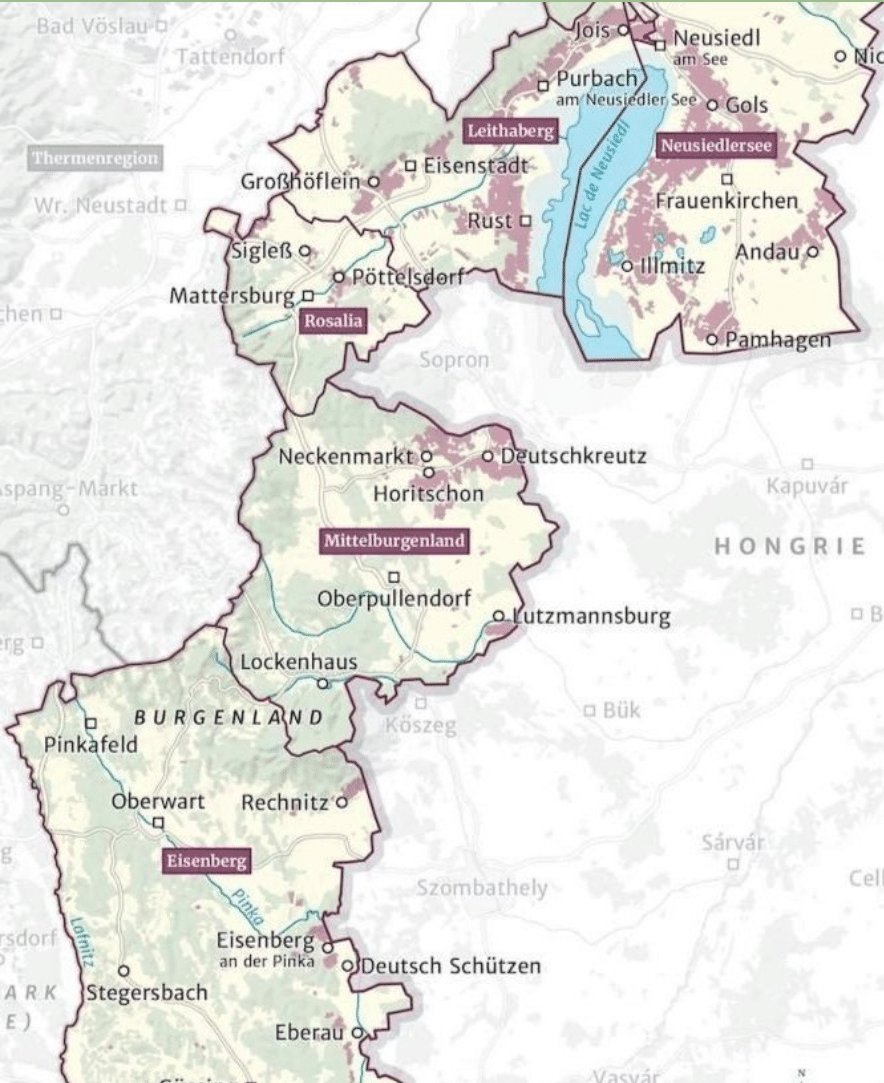
Leithaberg: up north, is all about limestone and cooler temperatures. That combo means slow ripening, great acidity, and complex wines with dark fruit, spice, and a touch of minerality.
Neusiedlersee: on the eastern side near the lake, leans sandy with a more moderate climate. The grapes ripen earlier here, giving lighter-bodied, elegant wines with red fruit and earthy notes.
Mittelburgenland: right in the middle, is Blaufränkisch country — warmer and clay-rich. The wines tend to be fuller-bodied, deeper in color, with plenty of dark fruit and spice.
Eisenberg (also called Südburgenland), further south, is cooler again and sits on volcanic soils. The wines are fresher, lighter, and super elegant — think red fruit, spice, and minerality.
Rosalia: also in the south, offers something a bit different with its gneiss soils and warm conditions. The wines here are bold and structured, but still with a nice mineral touch.
Single-Vineyard Expressions of Blaufränkisch
Because Blaufränkisch is so sensitive to where it’s grown, many producers in Burgenland choose to bottle it as a single-vineyard wine. In other words: all the grapes come from one specific plot of land — and the idea is to let that exact terroir shine through, without blending from other sites.
Benefits of single-vineyard Blaufränkisch wines
So what’s the point of single-vineyard Blaufränkisch? A few key things.
- Uniqueness: Each vineyard has its own personality — different soils, microclimate, slope, sun exposure… even when it’s the same grape and the same winemaker, the result can be completely different from one parcel to another.
- Expressiveness: Working with a single vineyard means the winemaker can really zoom in on that site’s character. It’s like giving a solo to one specific voice instead of blending a full choir. You taste that place, in that vintage, with no filter.
- Complexity: Because everything is more focused — and usually more carefully managed — single-vineyard wines often show a broader palette of aromas, structure, and depth. You get something layered, precise, and reflective of how perfectly ripe and balanced the grapes were from that one spot.
Examples of single-vineyard Blaufränkisch wines
Let’s look at a few examples to bring this to life::
- Leithaberg: Kollwentz Blaufränkisch Ried Setz — this southeast-facing vineyard in Kleinhöflein gets sunlight all day long, helping Blaufränkisch ripen beautifully. The soils are rich in limestone, which gives structure and freshness to the wine. Expect juicy cherry notes, a hint of licorice, and generous spice — a bold yet refined expression of the grape. It’s a serious wine, made for grilled meat… or a deep wine conversation. Younger vintages deserve a bit of air, so don’t hesitate to decant. And if you want to dive deep, Ernst Triebaumer is a must — he specialises in single-vineyard Blaufränkisch and tasting his lineup is basically a terroir masterclass.
- Neusiedlersee: Moric Blaufränkisch Ried Rotes Kreuz — grown on sandy soils in a slightly warmer zone, this wine is all about finesse: red fruit, sweet spices, earthy notes, and a lighter, graceful body
- Mittelburgenland: Strehn Blaufränkisch (Deutschkreutz)
Bluish reds from clay-rich Mittelburgenland. Typically mid-weight, red fruit, well-balanced. Strehn is a prominent local estate. - Eisenberg: Krutzler Blaufränkisch Eisenberg DAC— This wine is made with care from some of the best vineyards in Eisenberg and Deutsch-Schützen, where 30-year-old vines dig deep into the soil. What you get is a bold, spicy Blaufränkisch with balanced tannins and a clear sense of place. It’s structured, expressive, and built to age — but it’s also ready to shine now, especially with grilled beef, lamb, or rich sauces. A great snapshot of what Südburgenland does best.
- Rosalia: Alfred Fischer Rosalia DAC Blaufränkisch — This wine comes from the young, mineral-rich soils of Rosalia DAC. Here, Blaufränkisch thrives on crystalline and sedimentary ground, delivering wines that are robust yet fresh. Alfred Fischer’s expression holds dark fruit and spice, supported by vibrant acidity and clear structure. Think bold and regional, yet surprisingly elegant
Winemakers’ Perspectives on Terroir
I’ve been talking a lot but let’s see what the winemakers in Burgenland think about the terroir in Burgenland.
Uwe Schiefer (Weingut Uwe Schiefer): “I am convinced that Blaufränkisch is the grape variety that best expresses the terroir of Burgenland. My approach to winemaking is to focus on the vineyard and to let the grapes speak for themselves. I intervene as little as possible in the cellar and rely on natural yeasts and fermentation. My goal is to produce wines that are pure, expressive, and reflect the unique character of my vineyards.”
Thomas Leithner (Weingut Leithaberg): “The terroir of Burgenland is very diverse, and this is reflected in the wide range of styles of Blaufränkisch wine that are produced here. My approach to winemaking is to tailor my style to the specific terroir of each vineyard. For example, in my vineyards with limestone soils, I produce wines that are more full-bodied and complex. In my vineyards with sandy soils, I produce wines that are more elegant and fruit-forward.“
Roland Velich (Moric): “I believe that Blaufränkisch is one of the greatest grape varieties in the world. It is a grape variety that is very sensitive to terroir, and this is what makes it so special. My approach to winemaking is to focus on the vineyard and to produce wines that are expressive of the unique character of each vineyard. I use a variety of techniques in the cellar, but my goal is always to produce wines that are pure and balanced.”
In Burgenland, winemakers don’t just work the land — they listen to it.
Their deep understanding of terroir guides every decision in the vineyard and in the cellar. The goal? To let each wine express where it comes from, without forcing it into a mold.
That means adjusting things like:
Planting density: In limestone-rich soils, tighter planting helps concentrate the fruit and structure in the final wine.
Pruning methods: In sandy soils, less foliage can help bring out brighter fruit and keep things in balance.
Harvesting times: Cooler plots get picked earlier to preserve acidity, while warmer sites are left a little longer for fuller ripeness.
Vinification techniques: Some parcels get longer maceration to extract more tannin or flavor, depending on what the site naturally gives.
For these producers, it’s not about making the same wine every year — it’s about translating a place into a bottle, vintage after vintage.
Conclusion: The impact of terroir on Blaufränkisch production
So… what should you take away from all this?
If there’s one thing to remember, it’s that Burgenland isn’t one uniform region. It’s a mosaic — and that diversity of terroir shows up in the glass, especially when it comes to Blaufränkisch.
Here are three key ideas to keep in mind:
- The soils aren’t all the same.
Some vineyards sit on limestone, others on clay or sand. That changes everything.
Limestone = tension, acidity, a mineral edge.
Clay = more body, more structure.
Sand = lighter texture, fresher red fruit.
Want to dive deeper into this? I’ve got a full post on how soil affects the taste of wine you might like. - The climate isn’t consistent either.
North = cooler = shorter season = fresher, more delicate wines.
South = warmer = longer season = riper, fuller styles.
And altitude plays a role too: higher means more acidity, lower means juicier fruit. - Orientation matters.
A vineyard facing south will produce a different wine than one facing north — even if they’re neighbors.
South-facing slopes = warmth, fruit, richness.
North-facing slopes = freshness, structure, lift.
That’s the theory. But the best way to understand it? Taste.
Next time you open a bottle of Blaufränkisch, slow down. Ask yourself:
- Is it light or full-bodied?
- Bright and zippy, or smooth and ripe?
- More red cherry or dark blackberry?
- Any spice? Earthiness?
Then flip the bottle and check where it’s from. With a little practice, you’ll start connecting the dots — and finding wines that really fit your palate.
Blaufränkisch is one of those grapes that rewards curiosity. Especially when you taste single-vineyard wines side by side. You’ll be amazed how much the place speaks — once you know how to listen.
Where to next?
Where to buy Austrian wine online?
Ready to put your taste buds to the test? Head over to one of my recommended online wine shops and explore their selection of Grüner Veltliners. With this handy cheat sheet in mind, you’ll be a Grüner pro in no time!
The impact of climate on Blaufränkisch in Austria
And the adventure doesn’t stop there! The climate also has a major impact on the tasting profiles of Blaufränkisch. So, why not expand your exploration and discover the impact of climate on Blaufränkisch in Austria too?
A beginner’s guide to Blaufränkisch
New to Blaufränkisch? Check out my beginner’s guide and discover all you need to know. Whether you prefer it fresh or aged, Blaufränkisch from Burgenland is a must-try for any wine lover. 🍷
How does soil affect the taste of wine: A Guide for Curious Drinkers
Want to know why soil matters in wine? From chalky, mineral-rich soils to clay and volcanic rock, the type of soil influences a wine’s flavor, texture, and acidity. Discover how soil shapes the taste of your favorite wines — and how understanding it can help you find hidden gems beyond France!


3 Comments
JÚLIO C O VIEIRA
I would rich it witha region map
JÚLIO C O VIEIRA
Diane, how about always show a goegraphical map of the region?
Mademoiselle
great idea! let me add one!
Thank you for your comment and input